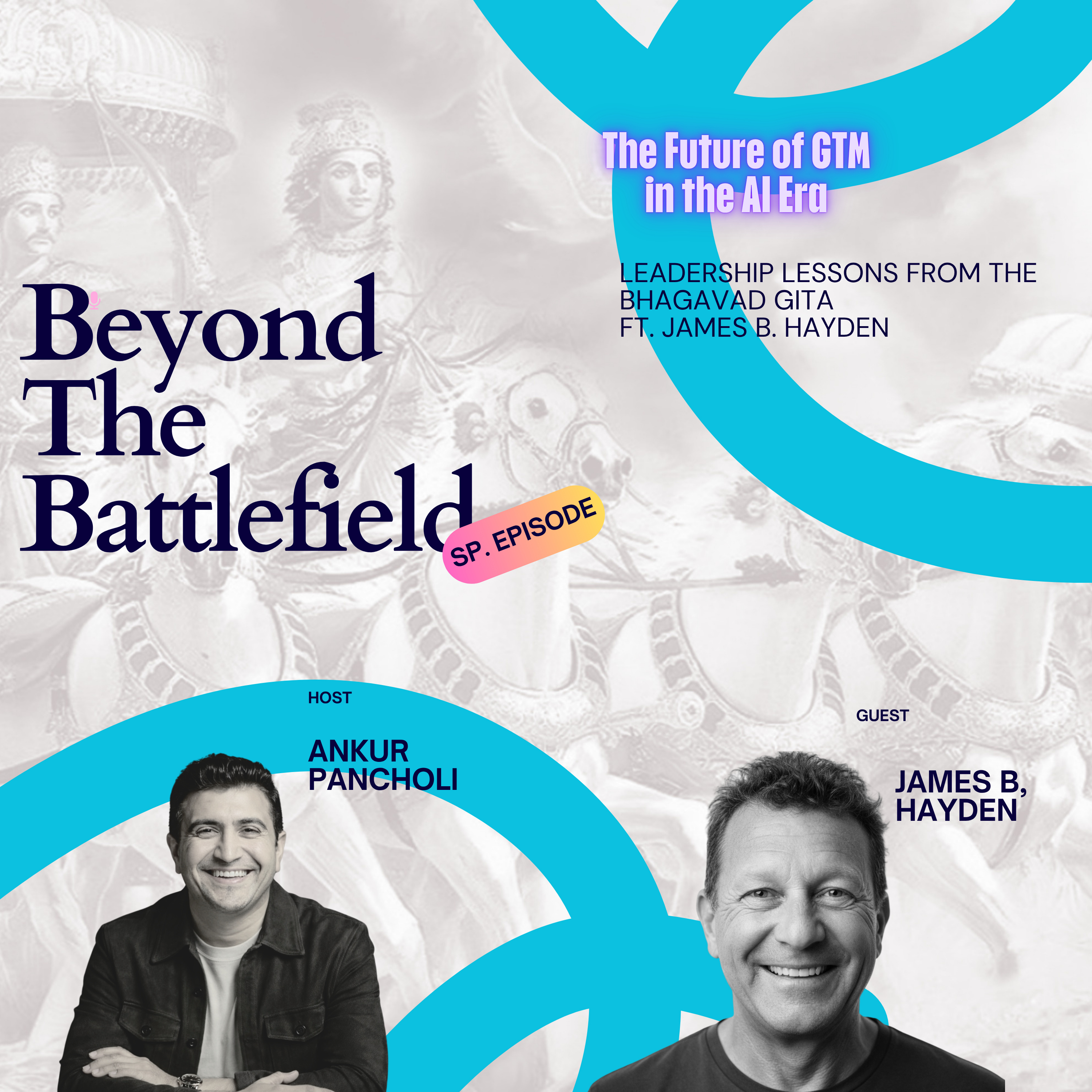
The Future of GTM in the AI Era l Leadership Lessons from the Bhagavad Gita ft. James B. Hayden
Tonight's Episode
In this powerful episode of Beyond the Battlefield, Ankur speaks with James B. Hayden about the future of GTM in the AI era, and what modern leaders can learn from the Bhagavad Gita.
As AI reshapes sales, go-to-market strategy, customer engagement, channel ecosystems, and organizational execution, one question becomes more important than ever: Can AI replace inner clarity?
Through the lens of the Bhagavad Gita, this conversation explores fear, truth, dharma, leadership pressure, AI-enabled sales, responsible decision-making, and why the real battlefield for every leader is still within.
James shares deep insights from enterprise technology, GTM transformation, acquisitions, leadership alignment, channel conflict, and the emotional pressure leaders face when truth and growth expectations collide.
This episode is for founders, CEOs, sales leaders, GTM teams, entrepreneurs, and anyone navigating leadership in the age of AI.
Keywords: Bhagavad Gita, Bhagavad Gita leadership, AI leadership, GTM strategy, future of sales, go-to-market strategy, conscious leadership, modern leadership, leadership lessons, inner clarity, dharma, AI era, sales transformation, channel strategy, enterprise leadership, business transformation, Beyond the Battlefield, James B. Hayden
#BhagavadGita #Leadership #AILeadership #GTMStrategy #FutureOfSales #GoToMarket #ConsciousLeadership #Dharma #ModernLeadership #SalesLeadership #BusinessTransformation #ArtificialIntelligence #EnterpriseLeadership #BeyondTheBattlefield #JamesBHayden #InnerClarity #LeadershipDevelopment #Entrepreneurship #Podcast
📩 Write to us: [email protected]
🤖 Explore the Beyond the Battlefield Companion GPT:
https://chatgpt.com/g/g-6845186212588191ae7aa9e327bebc9a-beyond-the-battlefield-assistant?utm_source=chatgpt.com
https://www.linkedin.com/in/jimhayden?utm_source=share_via&utm_content=profile&utm_medium=member_ios
https://jamesbhayden.com
https://lnkd.in/gDSFBTHW
https://open.spotify.com/show/6HFJQ3uchJsAAMAFdxdDxU
https://podcasts.apple.com/us/podcast/adapt-or-die/id1888076804
https://podcasts.apple.com/in/podcast/beyond-the-battlefield-bhagavad-gita-for-modern/id1829492330
https://open.spotify.com/show/7jjSEhPv6GsnmKfeaqL80X?si=SgC7P0LIRwafTNg94iMZ8w
Something strange is happening in modern leadership. Leaders today have more dashboards, more analytics, more AI tools, more market intelligence than any generation in history. But internally, many are more anxious than ever. They are performing confidence while silently carrying fear. They are leading teams while privately questioning their own direction. And somewhere between investor pressure, AI disruption, shareholder expectations, and the fear of becoming irrelevant, many leaders are losing themselves.
Welcome back to Beyond the Battlefield, the podcast where we explore modern leadership through the timeless wisdom of the Bhagavad Gita. Today's conversation is deeply important for anyone navigating leadership in the AIH because for the first time in history, machines can generate strategy, predict behavior, write content, analyze markets, and even simulate emotion. But one question still remains. Can AI replace inner clarity? Can intelligence without self-awareness become dangerous? And perhaps most importantly, can a leader still stay truthful under pressure?
Joining us today is someone who has spent decades inside that exact battlefield. From enterprise technology to GTM strategy, to scaling organizations to guiding leadership teams through uncertainty, we are honored to welcome James B Hayden. James has worked across high growth technology environments, advised organizations on go to market transformation, and LED teams through some of the toughest realities of business leadership. And in today's episode, we explore something the Bhagavad Gita revealed thousands of years ago.
That leadership is not destroyed by pressure. It is destroyed when fear disconnects us from our deeper alignment. This is not just a conversation about business. It's a conversation about identity, fear, truth, and the future of conscious leadership in the AI era. So take a deep breath and let's enter the battlefield within. James, welcome to Beyond the Battlefield. It's great to be here. And really thankful joining us today. So James, as we discussed earlier in Beyond the Battlefield, we discussed modern leadership from the lens of the Bhagavad Gita, which is in 5000 years old scripture spoken on the battlefield where the warrior decided not to fight even he was skillful.
Today I want to explore the possibilities of today's or future leadership. And we will also like to discuss your experience and my inclination how the GTM will evolve in future. Right and and how what kind of leadership quality people should now start building in. But before we go there, first thing I want to do just give a context on when Arjun was breakdown and and then breakdown doesn't happen because he lacks capability. It happened because pressure collide with his identity, his emotions, responsibility in modern leadership as well, especially inside high growth companies.
Do you see leaders going through similar inner conflict? Well, externally they look decisive, but internally they are getting fear, uncertainty, even sometimes exhaustion. Happens all the time. I mean, it happens, happens frequently. I've seen it in many organizations where especially what, what the leaders, the C level teams are conveying isn't necessarily what's going on in the rest of the organization. I've been involved in organizations that, for example, the the C level team has decided to sell the company, the rest of the organization, you know, as people are being told, you know, your jobs are safe.
Don't worry about don't worry about what happens, but you know, the board and the executives are painting a picture of not what is reality in the, in the organization. It's it's very important for everybody to be aligned in organizations. And one, one really experience I had with somebody I would just had a brief exposure to, but I consider a mentor was Lou Platt. He was the CEO of Hewlett Packard at one time, went on to Kendall Jackson and Boeing. And his advice and leadership was, and this is the difficulty, especially with so many venture driven companies is that they, there's an expectation that every quarter is going to be bigger, bigger, bigger, bigger, bigger.
And the, the reality or speaking, the speaking the truth with what's going on in an organization is really important not only to the executives and the board, but the rest of the company to get everybody on the same page. So what what Lou told me when I first was going into my battlefield, if you will, leading teams. We were involved in a huge project with, with Hewlett Packard. And I was introduced to him and he knew it was one of my first leadership positions. What he said to me was he said leadership of an organization is a lot like being the pilot of one of these big boats, super tankers, right?
And what happens is inexperienced leaders, what they do is the, they want the ship to go over here. So they turn, they turn the wheel and it's so big and it's so massive. You just have to, you have to turn the wheel and wait for the rest of the ship to come around. So in leadership, giving, giving clear direction and then being patient or waiting, waiting for it to turn is important. What I see in so many inexperienced leaders that don't have the scar tissue I want others do is they'll turn the wheel and the ship's not responding, so they turn the wheel back and it goes back and forth and ships going everywhere but where you intended it to do so.
I found that to be a very, very important and it became part of my Dharma, if you will, in terms of the way I approach approach teams and approach my mission, what I I need to accomplish. So one thing you said, when you know that you give an example, when there's an acquisition and people have uncertainty in their mind, what will happen, what new management will do. And most of the time even I have seen that it's not about uncertainty about the company because company was performing very well and that's why someone has acquired it.
It's about their own identity, their own role. They were not clear that their role, what they play are temporary, they're not permanent. And when the acquisition happens or changes happen or uncertainty happens, most of the time we are attached to our role or maybe I'm a CEO or I'm a manager or whom say where I am. And the uncertainty which comes up is that will I be more relevant after this? Will my if my role changes, what will be my relevance in this company? And one of the other learning which happens in Bhagavad Gita and we discuss a lot that Krishna repeatedly bring Arjuna back to clarity of role and action without emotional paralysis.
Role is is as of now in the battlefield. His role was warrior. But let's say when we are back home, our role is different and every rule carries some inner alignment, inner energy, inner power, inner wisdom, inner awareness that has to exist everywhere. But one thing which I have seen and you have seen much more about this that in this world of leadership at Target investor expectation and growth pressure that they're constant. So how does leader avoid becoming psychologically attached to those outcome, those roles, but still driving aggressive exhibition?
Being being tied to shareholder expectations and that while still being consistent or being part of their mission or Dharma, right. Yeah, it's, it's very, it's very difficult. And there's there's a term that's coming in later sciences called homeostasis. Homeostasis means we're always seeking equilibrium, but we never can, we never can maintain that and getting back to our center, if you will. So it's, it's, it's the battle we always face, you know, being, being the person you want to be in your family, being the person you want to be with your friends and family.
And then expectations are in your company are very, very different. And I don't believe we're ever balanced, but we're we're in that point of seeking balance. And as somebody who, who has high expectations in career and, and otherwise, it's the challenge is to get swept into, you know, we haven't made our number or I'm, I'm going to exaggerate what's, what's in the pipeline to please somebody. And my experience, for better or for worse, is if you're not speaking your truth, regardless of how difficult it is, it, it will come back to you.
There is, there's, I'm a big believer myself in karma as well. And it will that that comes back. So finding that warrior, that battlefield that we're we're always in is, is important, but it's important to to learn what the battle is because of that. That's always changing. And sometimes, I mean, what I like about what I know about the Bhagavita is the sometimes the ultimate battle ISM is to choose not to battle. And what I've learned also is your inner voice listening to that. And regardless of that potentially pleasing some way, I believe we live, we live in fear more than the reality of, of what happened.
So I've been faced with situations where I've had to go to a board and I've had to go to C level teams and tell them just we're not going to make it or this product's this product's failing. And and you know, I'd wake up at 2:00 in the morning in a cold sweat and worried like they're going to fire as we we haven't done this. And the the reality in every one of those situations I've faced and I went through deep fear. I was, we're going to be home, my homeless with my two daughters and wife and and that kind of thing.
Never, it didn't happen that, but you know, really facing, facing that fear and being brave enough to to tell your truth is so important. And it does that. It's one of the things you mentioned early in in this discussion is it's, it's a real challenge for people to do that because we want to, we want to please people. We want people to love us, I mean, and by love, I mean get praise and accolades for what we're doing and advance and make more money and, and do all of those things. And so when it comes in that battle between between being or our perception of being loved and revered versus really telling the truth and really finding your voice and mind changing you times is it's so important and speaking from that.
And and then you said Dharma Gita. Krishna explained that better to live in your own Dharma, even though it is imperfect, rather than living in someone elses Dharma, which is which looks more perfect. And that's where the inner alignment and this alignment comes up. If so, in India, when I learn in my childhood about Dharma, it is more about religion. And we'll be told that stick to your religion. Don't move to this religion. You said that it it's going to come back. And I, I recently created an episode on this which talks about that.
Where is the destiny? And Krishna says that destiny is in age, not in cloud. So your destiny is in your mind and it will respond, it will behave the way you respond. If I'm in an interview, if I don't respond right question, I'm not going to get that job. I will not grow. And that's that will define my destiny. So when you say everything is going to come back, it actually stores in your mind. If you don't speak out now, it's the glitch will be there. And Krishna says that you have to clean cut again, you have to come again and clear that there is no shortcut in the world.
You have to you are going to come back and when you come back, those things again come back to you because you are storing those into your age. It's not written somewhere in the cloud. So so you you explain it very practical way how a human leader feels when they have to decide an action. But moving towards Dharma, one of the idea is, you know, it's not your duty, but it's right alignment with one's deeper role and nature. And in modern business, especially into leadership, how do leaders recognize when they're acting from genuine alignment versus simply they're just chasing growth, validation, market pressure?
How? How do we bring that awareness into US? Wow. I believe it's, it can be confusing for a lot of leaders because once you begin to get power, you know, you have hundreds of thousands of people working in your organization and you, you know, you get to the point where you have yachts and private airplanes and that a lot of a lot of executives I see are a lot of very successful founders. They, their perspective changes and, and I believe they get off balance in terms of what their, what their voice is, right.
And that's when an organization loses that, that magic or I think organizations can have their own Dharma, if I understand it correctly. And having, having that mission, look at, look at the companies that have had amazing successes, everybody in the company, they, they know where they're going and, and they have a direction and they, they believe they're playing for something bigger than they can play for on their own. So the, the synergy of everybody coming together in that company is much greater.
For example, I, I worked at Microsoft at one point briefly, and one of the things I thought was very cool about the company is because they'd instilled a culture at that time where there was a belief that they were changing the way the world communicates. And they were, and it translated into back then it was APC on every desktop. So how amazing is that where you know you're part of a team and how special that is that you're changing the way the world communicates? Incredible. And some of the, some of the leaders I Revere today, I think they're very, very, the results, the results are pretty obvious.
But one, one I follow a lot is, is Jensen Wang, who's CEO of NVIDIA. And he, he believes and, and his philosophy, it really resonated with me because I've, I've seen that in my own life where he wants employees to face challenges and not always have a solution and operate in that, that area you were talking about earlier, that's a, it's a Gray area. I mean, the greatest, greatest growth I've seen in my career is where it looks like I'm operating in a fog, if you will, and there's not an answer. And I have data here and I have data here and I have a lot of experience experience, but I don't know this data and this data don't solve that.
So how do I bring in that new solution? Finding those solutions is really energizing and and amazing when when you can do that. And I believe that's where the growth comes is when we don't know when we're challenged, when we're, we're sitting, sitting in that fear, if you will. And sometimes it takes just stepping back, being quiet, meditating, praying, however you choose to listen to the listen to the universe, if you will, to, to get the answers. And it's not always having an immediate answer.
My father was an engineer in the space program and he lived to be 101. And one of the one of his secrets, he said is he was able to, to take a problem. He had any problem, you'd think about it and, and process it. But at the end of the day or when he sat down to have a meal, he would never take that with him. And he trusted his self and he trusted his mind enough. And this was after a lot of experience too, that a solution would come or someday he would figure it out. So he never, never carried that, that stress or that emotion of the problem with him.
It's just he trusted his mind to be able to, to come up with a solution. And that that stuck, that stuck with me where I've had challenges in the, in the battlefield and I've talked to a lot of younger entrepreneurs and founders is we all have that fear that, Oh my gosh, if I don't put this together and I don't do this, you know, what about I heard about this person that lost everything because they took this chance. That's where the growth exists. The growth exists in fear and, and then channeling it the right way and, and staying, staying true to your mission or your, your Dharma is important.
And then, you know, revising that. The biggest, the biggest growth opportunities I've had and the biggest successes I've had have been when I felt there was no solution. I was able to, when I was able to turn the fear into productivity. The way I process when I have something I'm afraid of is my mind goes into the survival mode rather than creative mode. And it's, it's, it's important to be able to channel that, recognize that, and then flip it around. I know in Bhagavad Gita, fear is something which is being explained in a way not fear is explained, but situations are explained in a way that you will you will never had a fear in life.
I give one of the worst which was explained and I I made a single episode out of that verse and given a title never not there. Geeta explained that the ultimate fear is you're going to die. You talked about family, we talked about job we talked about, but ultimately the end game of the fear is because I'll not have job, but I'll not have money and lot of family how I Will Survive and I will die, die, right, Every fear and with the death. So the way it is explained is when I give a title, never not there.
And the reason I give title is if you make it, if you simplify that line in a literal English, it's called I was always there. But Krishna and Gita explained in a way that never not there, never not there means that he's explaining that you don't worry, you are, you are going to die or your family is going to die. You were always there before me, you were there after me. You will always be there in the timeline. There is no microsecond where you and me were not existed. Every time we will be there, right?
So in that way it has been explained that even though you will die there another birth which is already coming in. So in a whole timeline, everyone of us existed in a different role in a different way. So you do not have to fear, worry about anything. So that's how you know multiple ways it has been explained. And this chapter 2 and chapter 3, if you fully just literally read also you will understand that. There is nothing to worry about in life, just your inner self. Activate that and you will grow.
Other thing you talked about that when you are into fear, when you are into uncertainty, when you are into emotion, your growth pattern goes down, your intelligence goes down because as soon as your EQ goes down, it is directly proportional to intelligence. And I give everyone an example. I don't know we have adopted before or not. If you're in high rise building, if you are in a hurry, you will press the elevator button 10 times. You are an engineer. You know that elevator is going to come in one second, one, one place, right?
But still we do because our IQ is gone. Now this is simple it's not a panic situation it's just you're late, right? But think about a situation where there is a high stake and then leaders start behaving in a different way. And the next thing which I wanted to ask you is that in Beyond the Battlefield as well, we often discuss how team eventually made-up the emotional state of leader. And so, in your experience, how much does that internal condition of a leader or a founder eventually shape the culture, energy and truthfulness of the complete organizers in itself?
It has, it has a massive impact. I mentioned, you know, what Bill Gates and Steve Ballmer said to Microsoft to set to set the tone, and Microsoft has reshaped itself again after after they left. But that that was important. And they also knew at that stage of the company that Bill is an avid reader of biographies. He knew that they'd hit the stage where they plateaued in terms of founders. So they brought in John Shirley as the president of the company to set the processes in place so they'd have scalable, repeatable processes for Microsoft.
And kind of the rest is history. And then, you know, recently Satya has really had a hand in, in turning Microsoft around. But some personal examples I've had as far as setting the tone for the team. And it's, it's real. It's, it's important. A leader sets the tone. And there's, there are two ways to lead an organization is to draw on a battlefield analogy. The the general who sits at the back of the lines with, you know, glasses or a way to, to see what's going on with the team and then directs to where they, they should be going.
The other leaders, the ones we're probably more familiar with in the way I generally operate, our leaders who are in the front of the lines with, with the, the team, they're exhibiting, exhibiting the behaviors of how to be, how to go to battle, how to do battle. And that so two different types of leadership. When, when there was one company, there was a travel technology company I was involved in and I was brought in by the two founders who wanted to recapitalize the company or sell the company.
And they've been kicking the company around for 10 years. They asked me to take over the poorest performing division in the company. I went around, I met with all the individuals on the team. There were about 32 salespeople in, in that particular division and the direction they'd been giving given. And this, this is the division that was #4 out of four, for five years in a row, they said pulling down the results of the company so they could do what they needed to do, get the, get the company capitalized again.
So I went around and met with each one of them. And they'd been told their mission was to go to these client companies and build trust and relationships and consult with them. And our job was to drive revenue. So they, we, we finally had a meeting of, of the entire team and one of the first questions they had before I spoke and I was about to was they said, what are your expectations about of us? You've, you know, you've met with everybody and I said, we're revenue generating organization. That's the bread and butter, if you will, for all of us.
We've got great products. We had a new product coming in that was just amazing. And I said your job every day is about being in front of customers and revenue generating activity period. That's it. Your job is, is about getting in front of customers and revenue generating activity. They heard that from me every time we spoke. It went out with them on sales calls and we brought in, if you know, Las Vegas, we brought in when, when they put up their new, new property, we convinced when to put our technology in.
So we, we started getting some big wins. I'd go out on the first few sales calls with them to show them and, and really not show them how it's done as much as coach them on because we all can, we all can improve, right? And so then as we approach the, the middle of the year, towards the end of the year, we had a meeting in the Phoenix area and in the US and the team wanted to know how, you know, what they should wear for the meeting. And I said, dress in a way that shows how you will exceed your revenue number this year, how, how you'll blow that out.
And you know, we had Superman and Superwoman and I don't know if I can say this on your show, we had one person who dressed up as a pimp and he said was pumping incremental margin profitably was very, very clever. And but the key is focus. They got a clear message of what what they needed to do. And then in the meeting, I addressed the obstacles that they had in their battlefield that we shared together, which was I had the people in that were responsible for the products in the company and went completely off script.
And I said, look, let's you know, we've got everybody here. Let's talk about anything that stops you that will stop you from exceeding your your number and went around. We had a discussion for for three hours. And then what I said was at the end of that I said, I'll have answers back for you on everything we've talked about had a big list and some of the some of the things we'd already answered. But by next Wednesday, some I won't be able to solve, but I commit to I'll remove these things. What I'd ask of you is you find a way to exceed your number.
I know it seems difficult for some of you, you find find a way to do it. And I said I'd like to shake hands with each one of you and and we commit to each other what we're going to do. So you don't have to do that. You're not going to lose your job if you, if you choose not to shake hands, everybody shake hands. By the end of the year, that division that was performing was fourth out of four was the number one division in the company. And of course, you know, after, after that, my job changed in the company.
But, but the key was, it was, it was focused. They had a clear message as as a leader, I was was there for them and at the front of the line with them and their own battlefields. But they had a clear, clear message in terms of what needed needed to be done, which was aligned with the rest of the company. And and there were people went on to be very successful and said, hey, I, I did things I never thought I could do. To me that was very rewarding. Yeah, that that that's a clear example of leading by example.
Leader leads by example and you said that right. But I just want to expand this question and and this is more coming from your expertise in go to market. Now in GTM we have multi party involved till now we're discussing in the same organization, but I have now 3 layers of the business models, a distribution system integrator manufacturer. Now that's also an one organization for customer for end customer, just in one organization which everyone works in their own role. But and at times I've seen that in the pressure again in the high state environment, I'd love the high state environment, but in terms of pressures that I need to grow my revenue anyhow, how do those people stay aligned and what kind of those structural changes or structural structural mechanism can be built on evolve time on time so that people are focused on their vision and their individual role and those three organization do not create conflict and that the ecosystem continue working.
Well, it doesn't always happen as you know, and the key there is really alignment and communication and prioritization. And you talked about different groups in terms of partners like systems integrators, resellers and then the rest of the organization. It's very clear to me and what I work with a lot of organizations on, say for example, the sales pipeline or you know, pipe pipeline of the sales activity. So you can have you can have a direct sales team, you have reseller team or systems integration team that's, that's working on the same projects.
The alignment through communication is, is super important. Salespeople, as you may know, and I'm guilty of that myself at times are usually usually the some of the worst in terms of reporting in your CRM systems, right? So that compliance is, is critical because you could have, you could have and, and I was just working with one company where the finance organization has one picture of the, the business operations who's responsible for delivering the solutions has another picture. Sales has another picture over here and then sales will bring bring in an opportunity or a sale and operations doesn't know about it.
So they've got two weeks to respond and and implement. And finance has another picture of like resources that are needed because that communication isn't enforces a strong word, but it's part of it is enforcement that communication isn't isn't something that is they see is important. That communication then needs to be taken, especially where we have partners, I believe was Gartner reported 2023. And in technology sales, 70% of the revenue comes through channel partners. So that's super important that you're you have consistent communication across your partners across internal organizations like sales, sales is reporting back those those opportunities that there's a communication that spreads across the business.
So also, you know, the value of what each, each one of those parties brings to the table, because the ones that I mentioned your, your channel partners are super, super important. Your direct sales is important. It's important they understand what they're a part of within the business and the part they play in it. So you know, a lot of sales, I think you're probably hitting, hitting at direct sales and channel can have conflict. That's why it's important to have ACRM system and have your, your partners and your direct sales team aligned and have rules like of, of engagement, but also have that information going back to your internal teams that are, that are important.
So it's, it's selecting, selecting the right partner and, and players on your team to to be in your battlefield. And, and then the, the leader outlines what, what each one of the roles are. And you cannot communicate enough around those areas. So connecting, connecting those players. And it's, you know, it's like that analogy I used earlier of turning the turning the wheel in the battleship, like, wait, we're headed this direction when you have a change and every one of those groups knows what that changes.
And as I mentioned in the example with the the hospitality or the travel technology company, it breaks down to your role is, and your role could be maximizing your time in front of clients and revenue generating activity. For example, is your role in this is to do that, right? That's your job or on the battlefield to hold this line or to not hold this line that we were choosing not to, to go to battle. But it's a leader. Good, good leaders are really hard to find because you can get caught up in so many other things that are important.
There's nothing more than your team having being aligned and and headed in the in the same direction. I think over communication is something which I I Tommy that because when you communicate once about strategy, about structure, about plan, about individual's role, sometimes when the team is not within your control and when I say not control, you don't have direct influence because those reseller sellers have their own PNL and their own priorities. You can't see overnight change those reservice and those partners, they are there with you for years, right?
But over communication is something which you know, keep on doing, which which I also understood from you that communicating on a right channel, which will which is going to help and moving taking it to forward. And when we're talking then beyond the battlefield about modern leadership. And one thing which came in my mind when I started to join this studio today, in last two decades, GTM was largely about scale, bigger funnel, more leads, more outreach. And we have seen a lot of internal workflow automation within the company.
So that like you said that no structure say PCRM those kind of things has been. So you have transparency over that. But with AI coming in, it is changing the equation together. Now suddenly one person with the right intelligent stack can perform outperform entirety. So we are entering into completely different era of GTM is AI is going to change the game the way we are working how, how is going to evolve? Let me get on my crystal ball. It's, it's, we're operating in an area where there are things we don't know if you look at our history as humans.
And I was, I was involved, I was head of a web practice for one company when the Internet was coming in and, you know, really gaining traction and, and that, and there were people that believed at that time that it was a fad and would go away. And there are people saying that about AI today. You know, I mean, they're, they're organizations that they want to scale their technology, but they don't want their employees using AI. And on the other hand, there's some of the biggest companies that biggest tech companies, you know, I don't know if your your company's doing that, that are actually tracking and stack stack ranking employee usage.
Now, I believe McKenzie came out last week and said there's a three to one return. So every dollar companies invest in AI, they're getting $3 back. And and it went farther though went specific to say that it's not just prey and spray across the organization. It's in focused areas. Maybe it's just three areas where where AI is being being utilized. So we're we're real, real early stage still on what I'd call modern day AI and and it's evolving. Will it replace sales teams? No, I'll tell you that with certainty now.
It will not replace sales teams. What it does though, and what I would have loved, I would have loved to have this early in my career because I can find anybody and I can create a bespoken message to you that it's like, well, how does how does James know me, you know, or how how did how do you find out that information? It's great because I can see who's going to buy website specifically what they're looking at. I can tailor a message back to them, qualify them quickly in or out of the pipeline and and really define what a what a potential solution is.
It gives us, gives us a great deal more data and it can do some of the initial upfront qualification when, when it comes down to trust. First of all, we we know and we've seen, we've all seen the stories that AI lies. Well, we will do too sometime.
So, so you know, we need to be careful of that. It's is AI the master or the servant? It should be our servant when it, when it comes right down to it. I I've said it and other people have said the same thing, that AI will not replace salespeople. The people that will thrive and sales will be AI enabled. There's no question about it. No question. And if they're not AI enabled now they're behind. They should be. And then they will be replaced. Pardon me. So then those people will be replaced with the person who is thriving with the.
Absolutely, they could be, but you know, it's, I believe that's part of that's part of growing and it's part of part of the tools you need to take to the, the, the battlefield is being open to what's what's ahead of you and embracing that. And, you know, people, people adopt new solutions, new technologies at different paces. There's early adopters and innovators, you know, people in the mass market, laggards have to have to know who you are. If you're choosing excellence and you're choosing really to lead the battlefield, then experiment with some of the technologies, figure out it is there a way I can do my job more effectively?
That is a tool to take to your own battlefield is, is that improvement and not staying stuck in your way? Maybe there's a better way to do things. And and that's not not only across technology, but how do you do business? You know, your your processes because business change. You know, I deal with a lot of organizations where they have a conflict between younger people and older people and they feel everybody's different. And what what I see is older people that come in have wisdom and they have that pattern recognition.
They've seen, they've seen the movie and they know intuitively how to, how to solve a solution, right. Younger people have grown up with the technology that the older people have it. So the, the people I've seen in organizations where they've integrated different ages as well have been they, they bring in people that have that wisdom who have to have the attitude that I don't know everything. I'm still, I have a beginner's mindset when it comes to this technology over here and I'm willing to learn.
A friend of mine coined the term mentor, a mentor and an intern at the same time in an organization. And you know, I think that's that's true. And and it's part of the the team culture you were talking about too, is, is having that acceptance. Everybody has a different role, everybody. People may have different perspectives, but celebrate those perspectives and leverage those make make the most of those. One of the biggest frustrations that keeps I keep reading reports about it. There's people don't feel heard in organizations or that their ideas are valued and the people that know the battlefield, that know the customers the best are the ones that are on the front line.
So it's incumbent on on organizations and leaders to to tap into people's strengths. And maybe that leaders, not the strongest one on the battlefield, but they know where to put the strongest players. Super important. And when you say it about AI can like one of the thing which I learned and this in chapter 3 of Bhagavad Gita, how human composition is being done, physical body, causal body, subtle body and soul. So how this thing has been done and AI exactly built on that. So physical body is your all data centers and all but causal body which is your emotion and desire.
Subtle body is your intellect, your intelligence. Right now that intelligence is built on AI. Consciousness is not there. What they are not able to replicate is your emotions. So they are simulating the emotions. So when you ask AI something, it will give you 3 option and you will distract from where you started and where you ended. So that that's the learning model they are using from the human composition only. But but you are right, the eye can lie because there can be an AI bias. Who, who is writing the code, who has created it can create an AI bias, right?
And that's not. Human, you're right. It's it's interesting. Sam Friedman, ChatGPT. He said that one of the biggest uses of ChatGPT for people in their 20s and 30s is therapy. You know what's what's going on in their mind so that, you know, turning you're turning to AI to get advice on your own improvement. You're turning to a machine to get that advice. It's interesting. I'm not saying it's bad or good. I took the challenge I put in and I, I asked, tell me something I don't know about myself. It's interesting.
It's an interesting thing to put in AI and you'll get you'll get interesting answers back on on that. But that that may be, it may be over reliance on what AI is because we get as I think as humans, people I talk to and I know myself, I get some of my best insights and answers. And you know, where I've chosen not to be in a battlefield. I'm looking for the solution to, to equip myself better is it's not when I'm working and it's not when I'm online. It may be on a mountain or when I'm in solitude or meditating.
That's when some of the best insights come. I think we have to have that that balance as well. There was a term John Nesbitt, who wrote Megatrends, came up with, which was high tech, high touch. The greater the velocity or adoption of technology we have, the greater need we have for human interaction and touch. And we saw that, saw that during the pandemic. There was massive amounts of mental illness that occurred because people were were so isolated. Yeah, it's there's, there's, there's a lot to.
It's it's going to be a very messy world moving forward. So before we close one thing which one last thing which I want to discuss with you is intention behind action. Now one thing in Bhagavad Gita which explode deeply your intention behind action. Like you said that you know you not every time you need to fight a battlefield, sometimes you have to leave the battlefield as well. And that what Krishna did one time in his life, he decided he will not fight and Christian himself move away from a big battle because the intention was not to win.
Intention was to save the society. Because if that battlefield has been fought that a lot of people who will lose their lives. And he decided I will not fight. And that's what one of his name, Rancho came in because he left the battlefield to run his battlefield and he left. His name is also like that made, right? So AI can massively amplify exhibition, but it cannot decide intention. That's what we discussed, right? So intention is something which I want to do. Killing someone is not bad. If my intention is right, Army, military, they're killing multiple people, then they're not being centers, right?
Because their intention is to save the country, killing the enemy. But you and me, they're killing someone, you know, we are behind the bars. So in this AI era, what do you think who will separate a responsible leaders versus the leader who is kind of dangerous? The way he explained someone who is following only AI but someone is very responsible. So what? What one thing will separate both of them and how do we identify that and bring in ourselves? How do we? How do we separate leaders and understand it?
It's, it's about human interaction when it comes down to it. And that we, I believe we have a sense, some people call it gut feel of person's intentions with, with what they're doing. So you know, if somebody, if somebody lays out a bunch of garbage or BS, right, I'm sure you've had it. I've had it where you just sense like, you know, they're in this because they're going to get a bigger bonus if we do this. Rather than being concerned about about what you are ultimately understanding what, what that intentionality is behind the leader, what, what they're concerned about.
Like a lot of people talk about being servant leaders and seeing that in action where somebody really cares about the people on their team as concerned and they're not jumping from one thing to the next. That that communication is something that we all need to listen for, not just listen with our ears with our whole body. That's one thing AI doesn't do is 90% of human communication is non verbal. So when you're with with people in a meeting, I think understanding the intentionality of the team is, is really important.
And I see misalignment between some organizations like an executive team where we're going to flip this company and we're all going to make $10 million each or you know, $15 million each. And, and not communicating to employees what the intention is that we're going to flip the company and we just don't care what happens to you, right? It starts showing up in behaviors of, of executives. Ultimately, especially with the way companies change today, where you may come into the hottest company making a huge difference today and six, six years from now, it's outdated and gone.
So you, it's, it's a balance between watching out for yourself and your own interests and what, what's going down the road, what's happening down the road. But I think really caring for people is so important and having that developing a loyal tribe. We're still tribal and there are tribes of people we work with. I've been in situations where, excuse me, things changed within, within companies and I had to let people go.
And excuse me, the what, what happened was I've kept in touch with people. I gave them, you know, as soft a landing as I could, worked with him on getting a job and it wasn't because of their performance. It's just things have changed in the company. We had a layoff. Things were were going downhill. You know, that's never easy for for someone. If you see, if you see signs in certain companies of intentionality, like one organization I was with duringthe.com dot bomb bubble, there was a COO who told me he had to lay off.
It was over 100 people. He said he got it down to the point where he, he could do it in less than two minutes per person. You know, I mean that those, those actions are where you see that and you know, the, the tech layoffs that are occurring in a lot of companies because they over hired you. You see that. And I'm not saying it's, we can't seek stability because that's, that's an illusion, in my opinion, that align yourself with people that are good people that have the right intentions. And you can, you can see that pretty quickly in an organization.
I, I left one organization with within three months because I was completely misaligned with the CE OS values and the way he ran the company and, and wasn't, wasn't completely honest. So I think it's, it's important. It's a difficult thing, though, when you're, you know, supporting a family and doing the other things to go well. I don't believe in what they're doing. I'm going to, I'm just going to leave. And, you know, you tell your your family that I'm going to find another job, but be sensible about doing it.
Intentionality is so important. Finding the right team and the right leader is, is, is everything. It's the reason I'm still still doing advisory work, because I don't trust with people. And I think you really will explain what we have discussed this part multiple time in Bhagwati that keeps on coming. And we we discuss about subtle intellect. You will explain that gut feeling body language, AI can't do that, right? Listening power, a detail we have that AI can't do do that. One of the example we, we picked up that Google Maps, if I open a Google Maps, it will give me two or three option to reach my office, right?
If I'm not aware, I don't have subtle intellect, I'll select the shortest one and I'll go. And I did that one day. And what happened is that my car did not move after three kilometers because the the lane was too narrow right now. That's what the idea and you explain that you know, the body language, gut feeling, reasoning power, why am I doing this? That AI will not do. And that's where the leader differentiate and you explain in an excellent way with practical example. And that's what we are looking at that this scripture was spoken 5000 years back and it has many more metaphor about body, about sense, a lot of metaphors and they were the top most of the metaphor at that time.
But today in a modern day, things are changing. We can't easily relate. And that's what we are trying to do with Beyond the Battlefield that those ancient wisdom is still powerful. But how do we articulate into modern day so that, you know, we take it forward and people understand that in next decade, how do they live their life using the same wisdom? So James, thanks a lot. Thank you very much. I was really overwhelmed and understood a lot of things from you. I'm sure a lot of listeners also will understand that how important to be aware and be focused into your role when when you said that step back not necessary to fight every button.
It's not you. Yeah. And what you're providing, and I would encourage people to subscribe to be on the battlefield. It's the biggest part of the battle is your mindset and preparing for that. And what what your study with a Bhagavita or other studies can do before you come to the battlefield is knowing yourself better and knowing what you bring to the battle, what your strengths and weaknesses are. Knowing when to when to go to battle and not go to battle like we've we've talked about what you provide is a great service.
Thank you. It was honored to be here. Thanks a lot. And beyond the battlefield is not moving out of the battlefield. We say that battlefield was never outside it, always inside. That's the tagline. We keep on saying that battlefield is always inside, and that's what we say beyond the battlefield. It's not moving up from the battlefield. Look into Battlefield inside you. That's the biggest part. Yeah, thanks. Thanks, James. Thanks you very much. Thank you very much. Cheers.
What a profound conversation. Today. James reminded us of something many modern leaders quietly forget. Leadership is not the absence of fear. It is the courage to remain truthful even while fear is present. In a world racing toward automation, AI acceleration, and endless pressure for growth, perhaps the real differentiator will not be intelligence alone, but inner clarity. Because AI can process data, it can generate answers. It can optimize execution, but it still cannot replace human awareness, human intention, human conscience, or the quiet wisdom that arises in silence.
And maybe that is why the Bhagavad Gita still matters so deeply today. Not because it teaches us how to escape the battlefield, but because it teaches us how to stand within it without losing ourselves. James shared something beautiful today. That sometimes the greatest leadership move is not fighting harder, but stepping back long enough to hear your own inner voice again. And in the coming AI era, that ability may become one of the rarest forms of leadership. So wherever you are today, if you are carrying pressure, uncertainty, fear about the future, or questioning your role in this rapidly changing world, remember this.
The battlefield was never outside, it was always inside. James, thank you once again for joining us on Beyond the Battlefield and for bringing such honesty, wisdom, and depth into this conversation. And to all our listeners across the world, thank you for being part of this journey. If this episode resonated with you, share it with someone navigating their own battlefield. Follow Beyond the Battlefield on your favorite podcast platform and write to us at Beyond the Battlefield at Outlook dot in.
We truly love hearing your reflections and experiences. And don't forget to explore our Beyond the Battlefield GPT companion link in the description where ancient wisdom meets modern leadership. Until next time, stay aware, stay aligned, and keep looking beyond the battlefield.
 Apple Podcasts
 Castbox
 Castro
 Goodpods
 Moon FM
 Overcast
 Pocket Casts
 Podbean
 Podcast Addict
 Podcast Republic
 Spotify