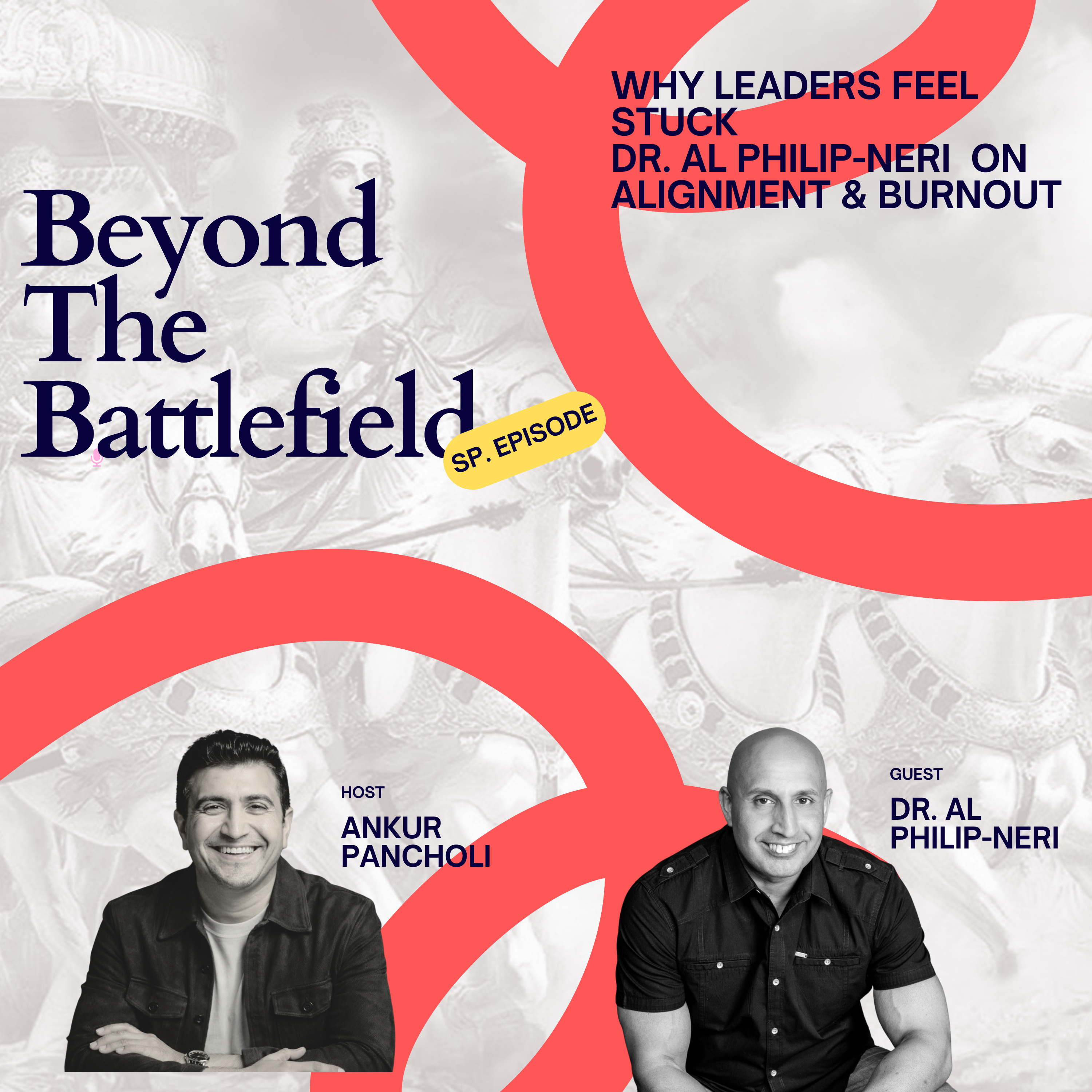
Why Leaders feel Stuck with Dr. Al Philip-Neri
Tonight's Episode
SEO Description:
What makes capable leaders feel stuck, burned out, or unable to act — even when they know what needs to be done?
In this powerful episode of Beyond the Battlefield, Ankur speaks with Dr. Al Philip-Neri, performance psychologist, strategic advisor, author, and leadership expert, about the real inner battles modern leaders face.
Through a deeply practical conversation, Dr. Al explains why many leaders struggle not because of lack of talent, but because people are often forced to operate against their natural strengths. He shares a simple but powerful example: asking a left-handed person to write with the right hand may still produce output, but it creates stress, discomfort, and inconsistent performance.
This episode explores leadership, self-awareness, burnout, career alignment, people development, decision-making, role clarity, and the difference between performance and true inner alignment.
Connected with the wisdom of the Bhagavad Gita, the conversation reflects on Arjuna’s inner conflict — a capable warrior who became stuck not because he lacked skill, but because his inner state was misaligned. Like Arjuna, many leaders today struggle between role and nature, knowledge and action, commitment and attachment, success and inner peace.
Dr. Al also shares a moving real-life story from his time leading a juvenile correctional facility, where he refused to fire a cook who showed human kindness by preparing birthday meals. It becomes a powerful leadership lesson on values, integrity, courage, and protecting inner peace.
This episode is for leaders, founders, entrepreneurs, HR professionals, coaches, and anyone navigating pressure, burnout, people challenges, or career confusion.
Key Themes:
Leadership under pressure, self-awareness, burnout, inner alignment, Bhagavad Gita leadership, performance psychology, people development, role clarity, values-based leadership, career growth, emotional intelligence, detachment, decision-making, modern leadership.
Keywords:
Bhagavad Gita leadership, Dr Al Philip-Neri, Beyond the Battlefield podcast, leadership podcast, burnout in leadership, self awareness for leaders, inner alignment, performance psychology, modern leadership, executive leadership, people management, career growth, leadership burnout, leadership and Bhagavad Gita, emotional intelligence, values based leadership, conscious leadership, leadership under pressure, entrepreneurship mindset.
Hashtags:
#BeyondTheBattlefield #BhagavadGita #LeadershipPodcast #DrAlPhilipNeri #ModernLeadership #LeadershipDevelopment #SelfAwareness #BurnoutRecovery #InnerAlignment #PerformancePsychology #ExecutiveLeadership #EmotionalIntelligence #CareerGrowth #ConsciousLeadership #Entrepreneurship #PeopleLeadership #GitaForLeaders #LeadershipMindset #ValuesBasedLeadership #PodcastEpisode
What happens when a leader is capable, experienced, successful, and still feel stuck? What if the real problem is not the strategy, not the market, not even the team, but a deeper mismatch between who people are and the roles they are forced to play? Welcome back to Beyond the Battlefield, where we explore modern leadership through the timeless wisdom of the Bhagavad Gita. Today, Encore is joined by Doctor Al Philip Neri, a performance psychologist, founder of Cohesion HQ, and creator of the Execution Advantage framework.
Predict, Align, Apply pressure, Execute, leading to real performance outcomes. Doctor Al works with CE OS founders and leadership teams to understand human behavior under pressure, how people execute, why teams breakdown, and what happens when talent is placed in the wrong seat. And that is exactly where today's conversation begins. In the Bhagavad Gita, Arjuna was not weak, he was skilled. He was trained, he was capable, but in the moment of action, he froze, not because he lacked ability, but because his inner world was not aligned with the role he had to play.
And today, through Doctor AL's lens, we explore that same battlefield in modern leadership. Why do leaders get stuck? Why does burnout happen even to high performers? Why does knowledge not always become action? And how can leaders understand their true nature before they try to lead others? This is a powerful conversation on self-awareness, pressure, alignment, performance, and the inner standards that shape real leadership. Let's step into the battlefield. So Doctor El, welcome to Beyond the Battlefield.
So here we explore why even most of the capable leader feel stuck, not because of the situation outside, but because of the battle within. And Doctor El, we are really excited to have you here with us. And you know, today we see many leaders who are highly capable, experienced, successful and yet in certain moment they feel stuck and and almost unable to act. They don't they are not able to decide. So just I want to understand if you also seen that in the leaders today or have you yourself experienced similar situation and and what do you think is really going on on on those moment inside the mind?
Got it. Well, first and foremost, yeah, thank you for having me. You know, I think a leader getting stuck, if we if we get to the the core of the question, a leader getting stuck is really because they don't really understand their people on what are they naturally wired to do, right. So you think about it, most people are operating on what I call behavior modification if they're modifying their behavior to be successful in a role versus really being aligned with how they naturally operate, which then gets fueled for them to excel.
So the problem is where a leader gets stuck is you have a desired outcome. But if people are modifying their behavior, your expectation is you want the outcome with immediacy, right? Quickly. But they're having to modify their behavior. And that outcome doesn't necessarily come quickly, nor does it come with predictable execution, which leads to a predictable outcome. So let me, let me put it into a framework. So I'm left-handed. OK. So if you think about this, if you could have me write with my left hand all day, every day in everything I did in your company, you would get somebody who's naturally capable, naturally adapt.
I've been writing with my, I'm 55 years old. So I've been writing, let's say, since I was 3, right? I've been writing with my left hand for 52 years now. Let's say you make me write with my right hand.
How good am I going to do? I've had 52 years of working naturally like this. Now all of a sudden you're putting pressure on me and you want me to execute, to give you a desired outcome. Well, guess what? This stresses me out, creates a lot of discomfort. So I think what happens with leaders is why they get stuck and they're just like, I don't know what to do. I don't know what to do with this person. I don't know, right? I keep telling them over and over again or whatever the case may be. I think it's because we, we're just not digging deep enough.
We're not digging deep enough to make sure we really understand the human to get the best out of performance, right? So I think that's what happens in leadership when and it keeps you up at night, right? Because you're frustrated, you've tried motivation, you've tried this, you've tried this, you've tried this, and it's still not working. And so you're just, you're you're at a loss. So then you're like, well, what do I do? What do I do? So yeah, does that hopefully that answers your question. Correct, correct.
I think I, I also, I've also seen similar situations, right. So what you said is that if I have a habit for 53 years of doing or executing something in one pattern, even though I'm skilled enough, I am stuck that if a new situation arises or my emotional intelligence changes, how do I handle that? But you know, again, so I'll, I'll just take that discussion forward. We've also seen people confused about that next schedule move. It's it's most of the time they look at, you know, if I'm getting a good pay increase, I'm getting a good title, right?
I'm I'm good enough. They I think that they don't have a clear path forward for their career that just most of the time, right. So sometime I find it it's interesting that leaders spend years building roles, titles, responsibility, but rarely pause to ask who are we beyond those roles? How so? How often you have seen leaders confusing into their roles with that true nature and how one can find about his own nature versus the role he's play. Yeah, got it. Yeah, It's an interesting question, I think.
I think #1 in leadership is that you have to understand a title is just a title, right? A title doesn't earn you respect, right? And it might at a superficial level, but it doesn't at a humanistic level, right? It's just a title. I think, you know, like for myself, I can create a lot of frustration for an organization, in all fairness, right? And the reason I can create a lot of frustration is because of how I operate. So I operate very big picture, very aggressive, very big picture, very motivated.
And what I'm, you know, when I'm focused, things that nature and I can work very fast, like a juggle a lot of things. So if you tell me, so if I'm coming in as your performance psychologist, I'm coming in as your strategic advisor, I'm coming in as your consultant, whatever you want to label me, it's just a label. And you tell me you want to grow and you tell me you're open to change. And you tell me that we're going to do whatever it takes necessary. And we're going to, we're going to change it because we want a different outcome.
Well, if you tell me that, and I inherently believe that and I'm going to come in and I'm going to come in and we're going to do organized disruption, right? And we're going to start shifting things. We're going to start understanding people we're going to do things differently need to get that desired outcome and it might be hiring people, it might be promoting people, it might be firing people, it might be demoting, it might be creating positions, whatever the case may be setting standards right things that nature well all of that creates a level of uneasiness.
Now if you then turn around and you tell me to slow down or you tell me this isn't working out what that point you're frustrating me right because you told me you wanted the desired outcome. You hired me because I showed you confidence in achieving the desired outcome. Now what you want is you want me to go back and operate small. You want to you want to put me in a shell, right? You want to put me in a box. You want to slow me down. So while I could take the attitude of I'm getting paid anyway, right?
Whether it's a yearly contract or monthly, I could take that attitude. I'm I'm a title. If he doesn't want to change, he doesn't want to change. But the problem is, is that it's going to bother me internally, right? It's going to bother me internally because I want to move the needle forward. So I, I think The thing is, you know, when you're a, when you're a leader, you have to really understand what standards will people uphold to, because really it's standards, right? So if you embed certain standards and people are coming to work with different skill sets, different strengths, but they embody the standards, guess what?
You're going to always be able to move the needle forward because people with standards will want to increase standards. But if you, if your standards are loose and you allow all this other stuff to go on, I don't care how talented you have people or where your desires are as a leader or you think you're going to get people on on your bus to move that forward, it's not going to work because you're too loose, right? You're too loose. You don't really, you don't have those tight, tight, tight standard.
So when it comes to career paths and career planning, I mean, you have to really figure out at the end of the day, what's your foundation look like? And then I tell people you want the right person on the right bus in the right seat, and then that career trajectory goes at the correct direction. And you do have to be creative with people because just because somebody is a subject matter expert does not mean they know how to lead people. And a lot of times what we do in companies, we take someone who's a subject matter expert and because they're so good at what they know and what they do, we put them into a leadership position where they're supervising other people.
That doesn't work well because they're not good with people, but they are great at that subject matter. So what do you do with an individual like that in a career path? You got to make them a lead, a trainer, a trainer trainer, right? Where they can stay in their lane, where they can be that expert, but they're not going to be responsible for people's performance reviews or raises or management, right? Because that's unfair now, right? Because they're not a great leader, right? And you know, as well as I know anchor you, I'm sure you've come across some highly intelligent people.
Highly intelligent people are highly intelligent, but they usually think everybody else is dumb.
And that doesn't make a good leader when you think everybody else is dumb, right? Because you're so brilliant yourself, right? And so there's a difference between being really good at something and then just being able to get the best out of people. So being a leader is how do you get the best out of people? How do you develop people, right? That's what being a leader is about. And it's understanding that everybody operates at different levels and we got to raise the standards at all those different levels within the role of the of the job.
So yeah, when it comes to building career paths, it's it's very, very tricky to do it correctly to where you have retention. I think you said three things which we just stuck into my mind. One of the things which you just said that as a leader we need to build more leaders. And that's what you know is I've seen many leaders fail to do that because they are very good individual contributor, but they don't know how to lead the team and how to build or develop the people within the team. Other thing you talked about initially in the beginning about role and in one of our episode I we have covered and if you look at the Bhagavad Gita, I think whatever you said are very ancient 5000 years ago.
So it has been said in a very simplistic way, the storyline of war, what we say is we feel that we are different waves of the ocean, but we are actually ocean. So so waves feel that he's bigger, he's smaller, he's different, but actually when he reaches to the shore, it comes back to the ocean. So your roles titles are just temporary. What you are really inside will define your personality, will define your leadership quality, right? And the third thing you said he's a right people at right role.
A subject matter expert cannot become a team leader. And that's what we cover enough. So so we we we talk about four different fragment based on the inner nature of a human. Someone who is more intellectual is is not built to do a labourist job. He can't do a coding, but someone who is very good into coding, he can't become a leisure because his inner nature doesn't define him. Allow him to work that right. And I think you are also doing similar work into, into your business, into your job to identifying the right nature of a human who fits into that role, right?
So, so I think those things are very well resonating. What what we are talking about. And, and you're really put into right perspective and the listener who are following and now getting a right way of how to they put this into right perspective, right? Because what we are talking about is sometimes philosophical or psychological, But you know, the right perspective or practical perspective is very important for this now moving forward. So is that he is an individual leader like we, we take decision at times and there are moments where we know what needs to be done and we do that.
But sometimes inside we resist. So have you ever seen that, that when even the right decision just doesn't feel right internally, what we someone should be doing that to make sure that we are really aligned with what we are doing. Otherwise, you know, most of the time we do something that kind of guilt inside that I've not done right, still, I've done right. Yeah, that's, that's a good one. That's a really good one. I mean, at the end of the day, I mean, you don't, you don't want to compromise your values or your integrity, right?
Or what you stand for as a leader, you're going to have to make tough decisions, right? Especially if there are why decisions, right, about human capital, right? And human capital, anybody knows who runs a company is the biggest line on your PNA. And sometimes you've got somebody that you really like and a good person, but they're just not contributing to ROI. And that's tough, right? That's tough because you've got to honor your role as CEO and protect the ROI so you can scale ROI and this person just isn't contributing, but they're they're a likable individual.
I think that is just maturity and development of how you let somebody go, let's say in that case, right? And you can still they're going to be upset and you know they're going to be upset. So there's no reason to sugar coating that, but it's also a development opportunity for them right now. The question lies is when you're being told to make a decision that just doesn't sit well in your gut maybe about somebody, right? And I'm going to give you an example here that I lived. And I think at that point you have to question, you know, is this, is this the right organization for you anymore, right?
Because the reality is, is those decisions are going to come more frequently and they're going to create more internal stress for you. So, and it might not be that they're bad company or something, it just doesn't sit well with you. So then you've got to say, OK, I've got 10 more years until I can retire. Let's say, can I withstand this for 10 more years? Or is this going to end up creating burnout and stress and things that nature. And I think you got to protect your inner peace and your inner well-being and go find that alignment.
Now, I'll tell you, I was in a predicament very similar to this where when I was running a juvenile Correctional Facility for the state, I had a cook and she, you know, she was probably in her 50s and I was in my 30s, young 30s. But she would cook a birthday meal for everybody. So if it was your birthday, whether you were an inmate or a staff, she made kind of a special meal, right? So she still had the chow hall meal for everybody, staff and inmates, but she would, she would try to do something just a little bit different on your birthday.
And again, it was staff, teachers and inmates. And she approved that through me, right? And because obviously we kind of had the budget for that and, you know, we would buy things in bulk. So this required, you know, thinking outside the box. Anyway, the the higher ups found out that she was doing it and they told me to fire and I was like, but no, but she asked for my position. So if anybody should be fired, it should be me, right? I told her it's OK. Like you guys talk about wanting to run a program versus a prison.
So to me, that behavior is running a program over running a prison, right? These are juveniles. We're trying to hopefully not end up in the adult system. It was it was a big mess. And I end up refusing to terminate her. I said, I said I'm not going to do it. Like it doesn't even warrant a riot. How about we just stop, right? How about we just stopped, right? Like, she doesn't need anything in her file. She doesn't need to be like, this is crazy. And at the end of the day, I ended up telling the way higher ups, I said I'm not going to do it.
I said if you want to fire her, you fire her. I'm not, I'm not going to, I'm not doing it. And I understand that at that point I'm putting myself in a very bad position where I could be fired or rode up or something like that. But at that point I was just like, no, like this is conflicting with just common sense and human decency. She wasn't doing anything wrong or maliciously right. And it was a simple solution. We'll stop. And then if she does it again, OK, Now that's an issue of insubordination, right?
So I think in my gut, I was just like, these people are crazy, right? And that was actually my last government role was that role because of decisions like that where I was like these don't these don't even make any sense. So, so at some point I started going, this is this is I doesn't sit well with me, right? And it's time for me to move on, right. And so that's, that's what I ended up doing. So, yeah, I mean, and it's tough, right? It's tough because, you know, especially if you're getting paid a good amount of money, right, to maybe go somewhere else and make less and you got a family things that nature, yeah, you, you start getting very conflicted on, on what's the right thing to do.
So very, very tough as a leader. That's a very, very bold move. You you took doctor and rights because I can understand the situation that if you have to fire someone by the instruction of the top leadership, but you are not convinced and you take that call that no, I'm, I'm, I'm I'm going to own this responsibility. Not not she, right. So that's that's really bold move. And that's what the inner alignment is, right. So if you are not aligned with the decision, it is difficult, but you have to align with your inner self.
Yeah. And that's why the inner battlefield is right. So one more thing which which always you know, when, when we interact and it always keep on coming in my mind. So I thought I'll ask you today that in today's fast-paced carrier environment, right, only the performance get reported and we are just talk about our self alignment, our self understanding. There is a little room for someone to even think about this or even want to realize that what is the difference between his nature and his role in his inner alignment and his role, whatever you say, right, That someone else would have taken that call, but you did not.
So how does someone even begin to recognize what is his true nature to inner inner self? And even after playing the role for years, like you say, 52 years, we are writing, right? So for multiple years, I am doing something on a performance basis, but all of a sudden I and I, I don't have that room to even understand because I'm we are just running behind the numbers, right? So. So how does someone begin to recognize this? Yeah, that's a good question. I mean, self-awareness is at the cross of leadership, right?
You have to understand that. I mean, there is no perfect, right? And so you you just have to understand how. Your strengths sometimes can come across as negatives to other people, right? And that's weird for a leader, right? Because you're like, I'm the leader and I got it. I got to drive the ship and I got to do this. And that is true. That is absolutely true. You're in a leadership role for a reason, right? And you're going to handle responsibility. But I, I think for myself, because I was a leader at a very young age, as I matured, as I became more self aware, as I became more aware of how my intense personality can sometimes intimidate people, scare people, that is that getting the desired outcome.
And that's what I think as a leader, you have to go back and always ask, like when you look at yourself and you're in this role, are you operating as a role model? Are people looking up to you? Are people wanting to emulate and be like you? And you take that term role model versus leader. And I think it shifts a little bit of math that is crazy to think about that every day I come to work, I'm a role model. No matter what the title is, I'm a role model. And everybody in the company could be a role model.
So I think The thing is leadership is about self-awareness, right? And it's understanding that your strengths can also be viewed as negatives in the context of the individual that's receiving your information. So as I grew, as I matured, as I read, as I said, I need to focus on equanimity, right? As well as momentum, you start realizing that, you know, for myself, while I'm visionary and I'm very intense, that can also be very scary to other people. And so you as a leader, if you're, if you're the leader, you're the role model is how can you adjust yourself?
You're not selling your values, you're not selling your soul per SE. You're just adjusting your delivery, right? And, and I think as a leader, when you think about it, when you get frustrated, right, with the lack of performance or lack of results, you're going to go back to your true character self, right? Which, which in some cases of being very visionary, very problem solving driven, like you work fast. You want the results. Like you will scare the daylights out of the most of the people at your company because they've never seen that side of you.
You're no longer this like, hi, nice, good to go, keep up the good work, right? This this professional like smile, right. All of a sudden, because pressure is here and I talk a lot about pressure because pressure is here. Everyone's going to resort back to what you know and how you operate. So understanding that as a leader, I think is crucial. It's understanding, it's you understand being self aware, but it's you really understanding how you operate under pressure. And I talk about that in in my book that I will be releasing very, very soon is pressure sure is the key, right?
How do people operate under pressure? And that's what you got to figure out. And as the leader, you have to be aware of how you operate under pressure for the greater good of your organization or your cause or your mission, etcetera. So leaders, yeah, a lot of self reflection. You don't have to beat yourself up, but you do have to say, OK, what what could I have done differently and what am I going to do differently next time? That those are two very important questions as a leader in your own personal growth etcetera, etcetera.
I think self-awareness is something which I've seen that people really ignore. I was talking to a few leaders last week, just a small thing about self-awareness on health thing, right? And most of they said that we know that, but we'll do it after retirement, right? So, so it's a very little thing, but people don't take it seriously. Whether people don't have time, don't have money or just don't want they want to ignore. If you look at evil podcast, I've spent almost 15 episode only to discuss self-awareness.
It is so important for a leader to understand what he is and for what he what they are. Without that, you can't give a solution to anyone. And self-awareness is important because we recognize and understand the problem, but the reason what we discover, if you are going to tell me 100 times, I'll discover the reason only when when it is discovered by me. Otherwise I'll not understand that. So I think that is something very important in leaders life that you need to be self aware what is happening around you and that's that's the only way you can be aligned with the result carrier and awareness about it.
Now you talked about your book and you're also in one part of your discuss, you're working on AI and many other thing, right? So we keep on acquiring knowledge through different platform and we often assume once we know what's right, the action will follow. Correct? But but that's not always true. You acquire knowledge, but you need to act. Right. But why do you think leader feel that they know, but still they they still hesitate to act? Yeah, yeah, Knowledge is knowledge is only one component, right?
You got to implement the knowledge. That's Part 2. And I think, I think The thing is, is you think, you know, but you, you're a little bit scared to implement something new because it's going to take work to correct because nothing is ever perfect, right? So you, you learn a concept or you learn something and you go to implement it. You're, you're foolish if you think it's, it's just going to be perfect, right? It, it's not, you're going to have to tweak it. You're going to have to evolve, you're going to have to make pivots and that things that takes time, effort, energy, and sometimes money, right?
And so I think then it's just like, Oh, it's just easier to go back to the other way we do things, right? And I think that's the difference between people who want to scale and grow. So let's chat about that little bit, right? Growth. You can grow in your current self because growth is, is, is very miniscule, right? But you cannot scale until you change and operate in your futuristic self, right? You've got to operate today towards your future, which that takes knowledge, courage, trial and error, resilience, never given up, pivoting things that nature and that can be scary for people and it can also be very time consuming for people.
So you know, I hear it all the time with top level leaders that they, you know, they've got this idea in their head and then they just settle back. And that's where really that's when we start talking about performance and we start talking about like world class athletic organizations, right? To compete at the highest level. I don't care what the sport is, right? We think about special operations, we think about SWAT teams, we think about a Coast Guard, rescue swimmer, emergency medical personnel, right?
We think about when the stakes are so high, you don't have a choice but to operate towards excellence, right? You operate under excellence. So standards. And I think at the end of the day, what it is, is you're uncomfortable pretty much the whole time because you're constantly just revamping, revamping, getting better, more and more reps, right? But you know, you know, like, you know, one of my old boxing coaches will always say it's better for you to to bleed and practice right then it is in a fight, right?
And just because you've trained so hard for war per SE that when the time has come, whatever your environment is that you are prepared, you are ready, right? And so, well, I think the thing with with leaders is they have an idea because they went to a conference or they read a book, but unless it's embodied with metrics and accountability, they're probably not going to implement it, right? And that's where guys like myself come in, right? Because I will hold you accountable. I will push and I will push that needle forward.
I will make you be uncomfortable, make those hard decisions. And we're going to do that as an organization. But everybody is embedded because they have their eye on the prize. And that's one of the problems is that you got to get everybody embedded on the price, right? What's the prize at the end and how does this affect me? And so companies want to scale, but it only affects the CEO salary or the well, dude, like you want all these people like to ride the bus with you and like you got to figure out how to reward them too.
They think they got to have buy in motivation for, to be a part of this because then people will work through the pain if they're all collectively working together towards something. So yeah, it's, it's a tough one, though. It's a, it's a tough one for somebody that just doesn't want to do the work because nothing comes easy. Nothing comes easy. Right. And, and many times what we have seen that that hesitation is because of results, expectation, their own image, their own personal becoming. So have you seen that attachment to outcome or perception is playing a role in a decision?
For sure, Yeah, for sure. I think, I think there's leaders that make very self-serving decisions for themselves, right, because of a bonus they get or an opportunity that they get. I actually just did a call with somebody and the disconnect was that the, the person running this office, this was a wealth management office. He was there a year and the advisor who was very successful and had been with the company for five years, loved the core values of the of the organization. Like it's not about the products, it's about our high net worth clients and what's in their best interest, what's in their best interest for their families and things that nature.
And that's why he loved that that practice, that brand where he's at. But he said that the managing director that came in a year ago is very toxic and it's very self-serving, wants the office numbers to look good. So he looks good, right? Doesn't matter whether this product was right or wrong for the client. It's just what maybe the better bonus structure because you know, XYZ company is paying out better or whatever the case is. And it was all about him making the office look good. So he looked good.
And so I asked the individual, I said, well, how long are you going to tolerate it for? I said, here's your $1,000,000 question. How long are you going to tolerate it for? Because you love the brand. So you got to either switch to a different office or you got to leave the brand, right? If that guy's not going anywhere, well, he's not going to change. And if you don't have any reco, he's not going to change. So now I said you conflicted with how long are you going to let this go before every day you wake up feeling conflicted.
And that's what's happened, right? You're conflicted every day because you're getting a direction, but you disagree with the director, you know? So absolutely there are leaders that do things for the benefit of themselves, Absolutely. Yeah. And that's that's where I've seen many organizations are losing their path to growth. They're not able to skill right. And those leaders are good for the short term numbers they need organization needs that kind of people, but not at the leadership level or decision level where you know they need to think about long term.
And because if you are looking internally for your own outcome, I think where the team will not grow, company will not grow and how it will go, right.
Let me take you to a different topic and I want to talk about burnout for some time because most of the time I've seen many higher achiever leaders, they burnout, they're doing well externally, they're successful. So what do you think the burnout is always about workload because what we hear is that I was too tired because I had a lot of meetings. I need to execute many things. I need to decide so many things today, right? Or sometimes being misaligned with what who they really are. And So what?
What's your point of view on that? Burnout is real, right? For sure, burnout is real, but you got to ask, why do people burn out? And this is where if you can get somebody working in their superpowers, so go go back to me working in my left hand. If you can get somebody working in their superpowers, the chances of them burning out are slim to none, right? Because they're working in their superpowers. So again, for me, I'm very big picture versus the cheater, work very fast, juggle many things. So if you slow me down, we can say it's disengaged, that's fine.
But I'm just going to get burned out because I'm frustrated, right? I'm just frustrated. Now the flip side, let's say somebody you have that likes to be very task driven, make collaborative decisions, committee based decisions, and you're constantly having them run at 300 mph and do 50 things. You are going to burn them out. They weren't the right person for the pace of what you expected right? Now, could they be a subsidiary to the person that can handle the pace? Yeah, they'd probably be a great subsidiary, but they can't run that pace, right?
And so you've got to know what pace your people can handle. So it, you know, it's like running a race, right? A mile race, a marathon, whatever the case may be. There's some people, you know, that can sustain, you know, running very fast for 26 miles, right? The people that win these things. And then there's other people, their time is twice as slow or twice as fast, but they still end up finishing it. They just don't finish it at the same time. So sometimes it's you got to allow again, when you know your people, you can allow what's the fair expectation?
And inherently people are always going to tell you they can do it because they don't want to disappoint you, right? So if you got an employee right there, good human, they're going to tell you they can do it because they don't want to let you down. And they, they just don't want to let you down. But you as a leader have to recognize that, you know what, no, this person doesn't turn anything around in a day. They usually need 3 days. OK, so how do you adjust? And is that affecting performance outcomes?
Is that affecting return on investment? Is that affecting top line revenue pay? These are questions you need to ask and then say, OK, how do we adjust differently? Right? And maybe it's that you could forecast and predict a little bit differently to give that person more time to do something instead of waiting till the last minute because you'll still get quality work out of that person. But because you rush around like a bumblebee, you're putting pressure on other people that don't operate like a bumblebee.
So, So yeah, it's a great, but burnout is real. And burnout, stress disengagement is a real thing. And real, I mean, statistical studies by Gallup, I mean the number is insane. I mean, it's insane. I mean, they say right now that like 31% of employees are actively disengaged and looking for another job while on the job every single day. Now, why are they disengaged? Is it burnout, stress? And what what's causing the disengagement? 1% that's 130 year workforce is disengaged and looking for another job while on the job.
That's terrible. Huge. Huge. Yeah, I was to see here. Yeah, you need to fix that, right. So I mean you're basically wasting 1/3 of your salary people that aren't engaged in your company. Like that's nuts on your PNA. Yeah, yeah, because because you're invested on those people for years and they are they're not engaged and definitely at one point of time they're going to move more up, right. So, so even even I've seen both the kind of people right and we can I see very clearly some people work very hard, they feel trained and others are equally engaged but energized.
I'll give an example. India, we have, we have a fan of cricket, someone is playing cricket for three days continuously and he's not tired. The same person on Monday morning and air conditional conference room within one hour he's tired. Yeah, right. So, So what, what I understand what changes is it's not about energy and what you eat, what you consume, because you are in the same environment. It's, it's more of an inner alignment with the what you are doing right? So, so with cricket, with something which I, I really like, I can work 24 by 7, right?
But but something which I'm not aligned, I'll, I'll start feeling burnout, right? So that's where inner alignment come right now. You talked about your upcoming book, but I have question around your previous book as well, the formula of balanced life and you, you talked about balance, which is often misunderstood today. And, and I agree what what what you are trying to communicate, but for the benefit of the listener, how do you personally define balance beyond managing time and priorities? Yeah, yeah.
So balanced. Let me start with this anchor. The reason I wrote the book is because people always ask me, how do you juggle so much in a given date? You have a very hectic life. True. Always have. How do you juggle it? And I was like, I just do it. And then I had to think about that. And they're like, what do you mean you just do it? I'm like, why just do it? What's in front of me, I take care of, right? And I plan ahead and I do it. So I thought about it and I realized that in my mind, in my opinion, life comes down to 9 things.
Obviously, you want to make money, you want to protect your time, you want to be healthy, you want to have fun. You want to make sure you protect your family. Leave a legacy, right? Give back to others you want to fuel your mind so personal enhancement, you want to have this loving support system, right? Personally, professionally. And then I realized all eight of those things actually, in order to have balance, need to function every day, all day, all 8 of them. And I know that sounds weird, right?
But if they're all functioning together and you know why? So my last one is why, Why do you want a life that looks like that? Why do you want a life that looks like you're making the money that you feel like you deserve or want? You've got the time, right? Protected, you got health, you're having fun with your family and friends, right? Why is it that you really want that, right? You got to figure out at a deep level, why do you want that? And then, OK, go out and do something every day in all eight of those categories, right?
So you're going to go to work and we'll say that's money. OK, that's fine. That's just a job. But what are you doing to increase your value? Listening to a podcast. Well, that could go back into personal enhancement things that nature, the time. How are you making time? You brought up exercise, right, or health. How are you making time, right? You're never too busy to go for a 20 minute walk. Give me a break. You can be on a 20 minute walk and be on a conference call. You can be on a 20 walk. Listen to a YouTube video, you'll be on a 20 minute walk.
Listen to a podcast. Give me give me a break. That's just an excuse and and that's a low level, right? Well, it's expensive to eat healthy. It's expensive to eat out, right? So it's just a matter of you wrapping your head around what is he eating healthy look like for you, right? And what turns a lot of people off is diet. OK, then don't diet, right? Just make better choices and eat a little healthier, right? Having fun. Well, to some people, what is that? That might be an annual family vacation.
That may be a date night with their spouse once a week. It might be taking their kids once a month to do some fun. I don't know what it is. It's your life, right? Leaving a legacy that should be important to you if it's not, right? If you have kids and grandkids, you should want to leave a legacy. You should want to leave something to make their life a tad bit easier than it was for you, right? Like, think about that, right? It's a gift, right? It's a gift to pave the way for them for your hard work and then that they're going to do the same, right?
Think about that family legacy. You don't have to be a billionaire to have a family legacy, right? Thank giving back to others, right? If you don't have money, give time, right? That's free. Come give an hour a month or something like that, right? Personal enhancement. We talked about it. You got to fuel your mind all day every day. I believe you got to fuel your mind around other people that are positive and engaging and and they move your needle forward and every day, not once in a while, every day and then your support system.
I tell people you got to be around dream fulfillers, not dream killers. So you got to be around positive people. People want the best for you. People they won't necessarily agree with you, they might even challenge you, but they want the best for you, right? But those toxic people that drain you, Nah, you got to limit your interaction, limit your interaction with them. And then again, the last principle I talk about is your why. So that's what I talk about. So I feel like it's my system is very easy to implement if you just say, OK, what, what am I going to do tomorrow or what am I going to do today if we're early in the day?
To start addressing each thing on his list and before you know it, they'll start turning into habits and it just starts to become part of your lifestyle. There's no excuses. There's no excuses. So you just start doing everything every day, period, period. So you're right and and I've seen that, you know, this balance between work and life and all of those thing is just treated like a productivity tool. So they are they are not looking at a real transformation of every individual in the organization in a personal life.
If we look keep looking this as a productivity tool that if your family and work life is balanced, you will be more productive. I think that's that's a myth. Some sometime it need to be broken. Yeah. So the conversation is getting more and more interesting. But now I'll take one more question before we summarize. So in in Bhagavad Gita, Krishna keep on talking about detachment to Arjun, right? And so, So what he's suggesting is that he has to Arjun has to fight without any baggage, just as a role of warrior, nothing else.
Because the situation he was in is he was to fight with his keens, his relatives and at that time under the high pressure he got emotional and he has got come up with all the excuses that what today's modern leader are bringing in for not doing something. And all the reasons were justified with with the documented proof that this is written there. This was told by this one. This was done like that way. But what was solution was that you should fight without attachment any attachment and just as a role role of a warrior.
But leaders today are expected to be fully committed to result, but that commitment often turns into pressure around them. So. So is it possible to stay fully committed and still be internally detached And and how can someone start that journey? Is it possible to be fully committed and internally detached? Yeah, that's a deep question. Probably, probably for a short term, right? Probably I think that you could have your eye on the prize, the results, as long as you're benefiting from it and not really care like, like, but there'll be a point where that can't carry through trials and tribulations, pressure, adversity, right?
It, it just won't carry through because you need that internal connection to it to dig deep to say, OK, we're going to figure this out, we're going to solve this. Are there leaders probably operating like that because they're making a ton of money? Probably, right. Probably where it's kind of like they're faking it right until whatever they get let go over the next opportunity comes. And I would just say that that's sad and I and I would, I would want better for you, right? I would want you to find something that internally drives you to want to fight and get results, because if not, that's just empty leadership.
And then you're being very hypocritical when you're asking other people to do work and sacrifice and things that nature. And internally you're like, yeah, whatever, man, I'm just here for the paycheck, right? So I would challenge you that if you're currently in that boat and you know you're doing it and you know you're doing it, so don't act foolish. You know what you talking about. No, you know, if you're doing it, that you just live to a higher standard, right? So either start caring and change your behavior and start caring because I promise you, if you start caring with like 100% emotion, right and clarity, your, your team will deliver better because they'll feel it.
Or just get out of the way and, and let somebody else come in that actually does care and go find something that you do care about. Right? That's funny. I just finished the call this morning with somebody who's very relationship driven and that individual was given a very transactional role and I and I told him you, you would you would despise it because you're relationship driven and you, you, you pride yourself on your ability to create long term relationships. I said you'd be so miserable in the transactional role.
That was so fake. I said, sure, could you be successful at it for six months, maybe a year? Sure, but you would be miserable the whole time. So yeah, that is a that's a great, great question. And, and you know, and I and then be self aware and be honest with yourself, right? I'm going to challenge your listeners that be more self aware and be more honest with yourself because you're not being a good leader and you're not being a good role model. If we go back to my comment about being a role model, if that's you, you're not being a good role model.
And that's not fair to everybody that reports up to you. And it's not fair to the company and the board and the owners. It's not fair. It's not fair to anybody. Operate with a higher standard that that's. I'll leave it at that. You're right. So this is very tricky. The situation committed and still internally detached, right? So I tried doing that two things I discovered. One is your growth will be slowed down for sure. But what you will get is you will become the highest skilled person for the subject because then we are not attached.
You will try to do everything what you can and you can bring that innovation back into this thing. But you are right that the growth will be slowed down, right? So I think the conversation is going very well. I want to tell you one thing that Bhagavad Gita went up to 700 verses, not because a leader was giving some knowledge, because a follower has asked multiple questions. And those questions were so effective that every time the leader has to think multiple time because because Arjun wanted to run out of that war and Krista wanted him to fight the war.
And that's how they, this has moved from first words to 700 words. And, and that's what I said that my journey is longer because I want to peel every layer of that learning. So thank you. Thank you very much for joining us today. And it is really, really exciting to know your perspective on all of those subjects. Thanks a lot. You're welcome. Thank you.
What a powerful reminder. Leadership is not only about pushing people harder, it is about understanding what people are naturally built for. Because when a person is forced to perform against their nature, even talent becomes tired, even skill becomes stress, even success begins to feel empty. And maybe that is why the Bhagavad Gita still speaks to us. Arjuna's crisis was not a lack of capability. It was a moment of inner misalignment. And today, Doctor Al reminded us that modern leaders face the same battle.
Role versus nature, Performance versus pressure. Knowledge versus action, commitment versus attachment, and success versus inner peace. The real question is not only can I achieve more, the deeper question is, am I becoming the right person while achieving it? A heartfelt thank you to Doctor Al Philip Neary for this honest, practical, and deeply insightful conversation. And thank you for listening to Beyond the Battlefield. If this episode gave you even 1 moment of reflection, please share it with someone who leads, builds struggles, or silently carries pressure.
Subscribe, leave a review, and write to us at Beyond the Battlefield at Outlook dot in. And don't forget to check the GPT companion link in the description. Until next time, remember the outer battlefield may test your skill, but the inner battlefield reveals your truth.
 Apple Podcasts
 Castbox
 Castro
 Goodpods
 Moon FM
 Overcast
 Pocket Casts
 Podbean
 Podcast Addict
 Podcast Republic
 Spotify