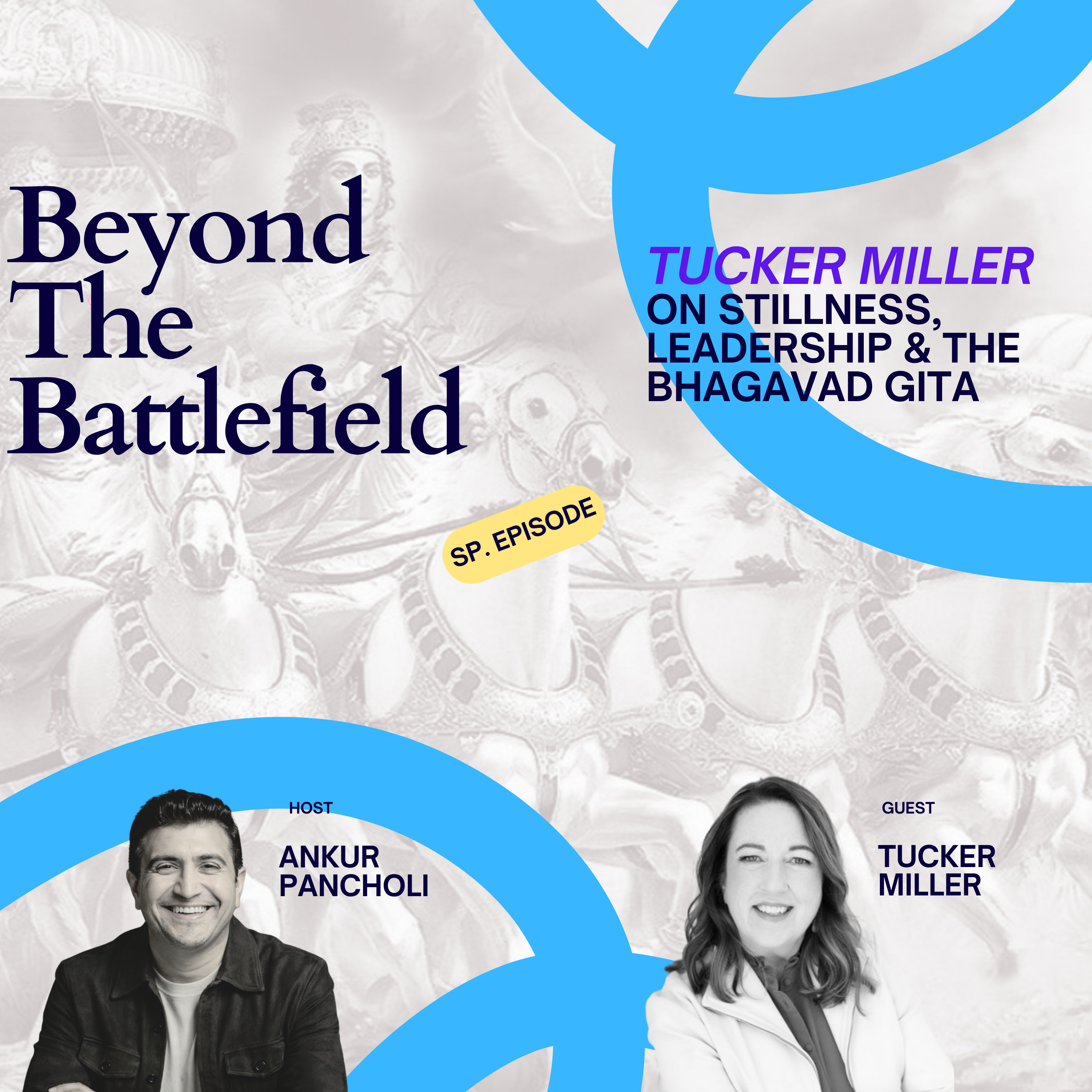
Tucker Miller on Stillness, Leadership & The Bhagavad Gita
Tonight's Episode
In this powerful episode of Beyond the Battlefield, we explore modern leadership through the timeless wisdom of the Bhagavad Gita. The Bhagavad Gita reveals why even strong leaders can feel internally conflicted despite outward success. Through the lens of the Bhagavad Gita, host Ankur Pancholi and leadership coach Tucker Miller unpack burnout, fear, decision fatigue, ego attachment, and emotional overwhelm. The Bhagavad Gita teaches that leadership is not just about performance, but about inner clarity, stillness, and self-realization. In this deeply reflective Bhagavad Gita conversation, listeners will discover how ancient wisdom can transform modern leadership, communication, resilience, and conscious success.
This episode explores how leaders today silently struggle with confusion, anxiety, overthinking, emotional baggage, and pressure to constantly perform. Drawing parallels between Arjuna’s battlefield crisis and modern boardroom realities, Ankur and Tucker discuss leadership psychology, mindfulness, difficult conversations, emotional intelligence, meditation, resilience, AI-driven decision-making, and the importance of separating identity from professional roles.
The conversation also dives into practical leadership tools — including intentional pauses, self-awareness, journaling, stillness, and coaching — to help leaders move from reactive behavior to deeper clarity and alignment. Tucker Miller shares insights from his 35+ years of executive leadership and coaching experience, explaining why unresolved fear and emotional patterns often block innovation, creativity, and authentic leadership.
If you are seeking practical leadership wisdom, deeper self-understanding, emotional clarity, and timeless insights from the Bhagavad Gita for modern business and life, this episode offers a profound and actionable conversation.
📩 Write to us: [email protected]
🤖 Explore the Beyond the Battlefield Companion GPT:
https://chatgpt.com/g/g-6845186212588191ae7aa9e327bebc9a-beyond-the-battlefield-assistant?utm_source=chatgpt.com
Keywords: Bhagavad Gita leadership, Bhagavad Gita podcast, leadership psychology, conscious leadership, executive coaching, burnout recovery, self-awareness, self-realization, emotional intelligence, mindfulness for leaders, leadership communication, Tucker Miller, Beyond the Battlefield, meditation, anxiety in leadership, resilience, AI and leadership, transformational leadership, leadership mindset, difficult conversations, modern leadership, spiritual leadership, corporate burnout, inner clarity.
#BhagavadGita #Leadership #BeyondTheBattlefield #TuckerMiller #ExecutiveCoaching #ConsciousLeadership #SelfAwareness #SelfRealization #Mindfulness #LeadershipPodcast #BurnoutRecovery #EmotionalIntelligence #ModernLeadership #SpiritualLeadership #Meditation #InnerClarity #LeadershipDevelopment #TransformationalLeadership #AILeadership #PersonalGrowth
Welcome to Beyond the Battlefield, where we explore not just the battles leaders face outside, but the invisible battles unfolding within. Sometimes a leader is not lacking skill, not lacking experience, not lacking intelligence. And yet, when the moment comes to act, something freezes inside. The decision is clear, but the mind is noisy. The role is powerful, but the person inside feels uncertain. The world sees confidence, but within there is hesitation, fear, avoidance and a quiet longing for clarity.
This is where the Bhagavad Gita begins. Arjuna was not weak, he was not untrained, he was not incapable. He was standing at the edge of his greatest responsibility and suddenly he could not move. And today we bring that ancient battlefield into the modern boardroom. Our guest is Tucker Miller, CEO of Onward Leadership, attorney, executive coach, speaker and author of the 1st 4 Words, How to Have Conversations That Get Results. With over 35 years of senior leadership experience, Tucker has coached and guided leaders through questions of culture, courage, communication, inclusion, and the difficult conversations most people avoid.
In this conversation, Anker and Tucker explore confusion, decision fatigue, ego, attachment, burnout, emotional baggage, stillness, self-awareness, self realization, and why sometimes the conversation you are avoiding is the very conversation that could change everything. Because leadership is not only about moving faster. Sometimes leadership begins when we finally become still enough to hear what is true. Let's begin. Welcome to Beyond the Battlefield, it's our true pleasure to have you with us today.
Thank you. And before we begin, I'll just set a context to for the benefit of both the listener of your platform and my platform, just give a context. So Beyond the Battlefield is all about modern leadership, but with the lens of ancient wisdom, wisdom of Bhagwatita. And the situation start when a warrior, a leader who has been fighting for and winning every war in the lifetime, and he has only one thing to do in life, win a final war. And he was preparing for that for 13 years. And when he's in the battlefield, he decide not to fight because he sees his relatives, his kids, his friends in front of him.
And the charioter who was his friend, he asked him to take the chariot back and he puts put down his all arms. And he said, I'll not fight. Now that's the situation where a leader is. And Bhagavad Gita help us to guide and understand human mind with the voice of Krishna. This is a conversation between a leader and his friend. A friend who becomes his mentor, his guide and he's true leader to help him and came out of the situation and help him to understand the mind. So we have also seen such situation in leader today.
They are standing strong outside but yet navigating many battle within very quietly. And Arjun was into exact pace and not lacking those skill but lacking inner clarity. Now that is where you know we today we will, we want to have that conversation with you and understand through your lens and through the timeless wisdom of Bhagavad Gita, we will, we want to explore that inner matter today, right. So first thing which came in my mind today when I was trying to join this studio. Many leader believe they are clear but the decision shows confusion so.
So in Bhagavad Gita Krishna said that confused mind cannot even understand clear truth properly. So how? How can a leader recognize that they are actually operating from a confusion and not clarity well? I think the insight here is do I really know what I think I know and how am I going to test it? So you need to start looking at what kind of results am I getting, What are the questions my team is raising? What are my executives questioning? There are a lot of points of Intel, and I think so often as a leader, we think I need to know and do everything and trust everyone follows along.
But that's the hubris. That's the place where oftentimes mistakes are made. They can have very high stakes. And so you want to think about how am I looking into the mirror and what points of Intel do I want to use to really understand the impact that I'm having? And as an executive coach, that's oftentimes where I'm very helpful to leaders who may not feel safe raising questions of uncertainty outside of their friend network or raising questions internally within an organization or with their team.
But creating some safety to take an honest look first and foremost at what do I really believe in and how am I showing up is key in having a better impact as a leader. OK, correct. So you're right. And then the next thing immediately comes up is this isn't fatigue, which is actually an inner avoidance. TV today. Yeah, right. So today, today we call it this. This isn't fatigue, but it is actually inner avoidance. That's right. You know, was actually avoiding A deeper truth. He was he was not just tired out of deciding the way.
You rightly say that, you know, many times leaders feel that, that they've done a lot Now they just want to denounce. They want to leave and let the people come up. But actually they are, they are, you know, avoiding a decision. And when, when I was talking about this battlefield part, Arjuna was giving every right logic. Today you and me will agree on to those logic that why he should not fight. And if you or me would we have charioted, we would agree that what he's saying is right. One of the things I want to say that he said that I, I'm a very learned person.
I've gone through all the biggest university of the world and I know that I've been taught from day one one that this is how you have to this is the reason why you have to fight today. You are asking me to fight to my relatives, my friends. If they're not there, what will I do of all of this wealth? And that's logical looks today. But but in this whole conversation there was no easy answers. There's rarely easy answers to. Anything. Yeah, yeah. Like, so from your experience, you know, our leader really overwhelm or they're avoiding something deeper within themselves.
That's such a big question because if I ask a leader, what are you avoiding, they'll say nothing. They won't acknowledge it very readily. But your point about my inner awareness as a leader is so key. And as we start to unpack what are the ways that I can improve and get more insight about that inner awareness where my values are guiding, I might start to see those little fishers where maybe I am. I'm avoiding a few things. So it frequently comes up in my work where I'll ask a leader, what's the conversation that you know would change everything if you had it.
Now I'm not asking them what conversation they're avoiding. I'm just asking them which one they know would be game changing. That's an easier question for them to answer. And it gets to the same, same root issue because the next question after they tell me that is, so why are you not having it? And then we get into all the reasons and explanations. Sometimes there's some fear that lives very beneath the surface that we may or may not understand until we start unpacking it and revealing, OK, I'm afraid of how the other person's going to react.
I'm afraid that this may reflect badly on me. They may not express it as a fear, but in the explanations, excuses, the rationalizations, the justifications, we get there. And then it's a matter of so how do we move forward? Because clearly, excuse me, clearly not having that conversation is an impediment not only to getting more of what you need to have happen, but it's an impediment to your soul because you know what needs to happen. How can we move forward in that way? So you rightly say fear.
Fear of losing something. Yeah. Fear. Fear of losing the validation, losing the title, right? Because I give them the right example or context of Bhagavad Gita. That's a warrior. He has not lost any war. Yeah, in the lifetime, Right. And now he says that I'll not fight. So skill is not a problem, right? That's right. So, so, so many times people confuse their role versus who they truly are. And, and, and that confusion actually drives fear. That's what you say. Ego, attachment to that role, Right.
So. Absolutely. But how do a leader start separating those who they are from the roles from the roles they play? So as a individual versus that role, how do they separate? Because when, when let's say we are into some role, right? We are so attached, so engrossed with those roles that we take everything on our everything ahead of. However, there are many things and we are emotionally attached as well. So ego is there attachment is there fear is there? So is there any way we can separate this out?
See, when when we discuss these things under Beyond the battlefield, we talk on a philosophy and psychological level and try to convert something, you know, practical way. But but today we just really want to understand from your practical point of view that is there a way that we can separate that out? Yes, there is. And I think the first thing to understand is my attachments, your attachments to how things ought to be or how we want them to be. That's not who we are or our personality. And so through the process of discovering what I want to have happen is different than who I am as a person.
And I can be who I am, maintain my personality, my values, but adjust my attachments to address the current situation, a reality that I'm in. That's often times where that mirror is very close to our face. Of which part is who I am and what I value, and which part of it is the things I wish would happen and can't really control. So focusing more on what are the things that are uniquely mine and that I can control. That's me as a leader, and we're in these leadership roles largely because of that.
The skill is a piece of it, but someone saw something in us that said this is the person to move us forward. And unfortunately, leaders get in a position where they think, but if I make this move, if I take this risk, all these other things are going to happen. And that becomes the reason for not behaving in the ways that they're recognized already as having the capacity for bringing forward. So separating that out. And as an executive coach, that usually happens over time in conversation, addressing it bit by bit so that people learn new habits of separating themselves from their desired outcome and who they are.
Because the leader is in the personality and The Who and the values. What you do with it is separate. Right, right. I think, I think you, you framed it very well. It also made me clear as an individual when when you're talking that a lot of thought came in my mind. One of the thought is that we do play multiple role in a day. Yeah, right, right. And, and we know that we have to play separately on every role right now when it comes to business job or my position in my day job, we are too much attached to that.
And that's where we need to remind ourselves that after 8 hours of work, you are getting every day getting into a new role, right? So that eight hours doesn't define your who you are. Who am I? That's right. Right. As a leader, you want to bring more of who you are in all of those roles that you have without trying to prescribe every outcome that will happen because you got other people involved in the story. They're going to have their things that they want. We're going to work together to get to that.
But who I am goes with me everywhere, whether we recognize how we're showing up or not everywhere. But when you're more intensely aware of who I am as an individual or as a leader, I can be very intentional about the ways I present myself in all those roles that I have. And when we have to take decisions, so, you know, couple of years back, even before I started studying Gita or get deep dive into it, I learned something that, you know, the real decision cannot be borrowed, but it must arise from within.
That's right. And, and, and when I started learning this on a very 2nd, 2nd chapter, first was this was the learning 5000 years ago, very profound. Someone has spoken this that the decision has to come within. You can't borrow that right. But but when when I was practically mapping that and today also I see that modern leadership heavily rely on frameworks, maintenance, external advice, right. But how do we draw a line between learning from others and losing your own inner voice? See, learning is important.
We need to keep enabling ourselves. That is an inner voice. We're talking about a role which oneself which actually plays multiple role and it puts and adds value into it. So that's how inner voice comes up, right? So, so how do we identify that line between, you know, losing from learning from other and losing that inner voice? That is such a timely question, especially in this time of AI, because everyone's handing over all the insights that they might otherwise have developed on their own. Well, this must be better because it came from AI.
You know, there it is. And in all the models, the things that people are teaching and providing, we need to remember these are tools that may be adapted, they may be useful, and they may not be useful. We want to maintain that level of agency where you're not just accepting the piece that comes externally. And this is the solution that will get me to the next level. It's how can I use this and integrate it given who I am 1. It's such a simple process but it's so powerful there's actually 2 elements to it.
Journaling and meditating always brings you back to yourself. Every tool, insight, AI response should be through the lens of does this reflect my values and who I am as a leader as I struggle to solve complex ever changing problems. And very timely you said this is the month where I'm writing a script transcript for my episodes on meditation, which is the 6th chapter in this book, a very first time someone has taught meditation to humanity and why it was 6. I was talking talking to someone today morning that why it was not first and six because you can't meditate if you are not calm.
And the first five chapter is to calm every human being in the world. And once you are calm, then only you can meditate. And and while while while I think that one thing came in came up in my mind and which is also very much seen everywhere today. I keep on travelling and I keep on as I told us, I keep on travelling in US and other part of the world, mainly in India. I stay most of the time in India burnout which I've seen in most of the leader today and what we say that it is because of the overload overworks over there.
But while I was writing this meditation part, what I have learned is that Bernard comes when action is driven by attachment and there is an inner conflict. Yes, I'll give an example that we are in India, people are fan of cricket and and if there's a weekend, people will play cricket for a whole weekend, three days, four days, even a night matches are going on, they'll play that. They're not tired. Monday morning, they will show up in the meeting, but in that meeting within one hour, they'll get tired right now.
Yeah, that's how it is. Because it is not aligned, the discussion is not aligned. So in your observation, is burnout still because of the workload or misalignment or how leader can realize that that I'm misaligned? Let me pause here and move back to a different state and then look into what I need to do. You know, the hardest thing is to set aside time to just calm down, take a breath, step outside, be in nature. And we get so caught up in that hamster wheel of activity that we're no longer thinking.
We're reacting all the time. And I think there's a couple of tools that I frequently will use with clients. Put a timer, do a check in. You know, it might be every hour, it might be morning and afternoon, but take that moment of the pause and just ask, am I coming from a centered, calm place or am I reacting and anticipating the onslaught of other demands on my time? When you're very busy, when your e-mail box is 200 emails or more, it's very hard to take that time. But that small pause and we're talking about 10 deep breaths, that's enough to get you to a different state.
There are some other breath exercises I use. I'm sure you have similar ones. We're not talking a full on one hour meditation. We're talking about a simple pause to just ask yourself, am I centered? Because the question itself will bring you to center. How am I showing up? And then move forward. So you'll still have all those emails in the box, but you'll start to be able to separate which ones do I need to respond to and which ones can I ignore. So taking that mental pause to connect with who you are on a soul level is one of the most game changing strategies.
And it seems so simple. Why would anyone ever hire someone to help them with that? Because it's actually quite hard to interrupt this reactive way that we're responding and trying to protect ourselves from all manner of. Of disasters because our minds immediately are thinking about everything that could go wrong. And so in that pause, I also ask people what's going well? What's well with your soul? What are you doing that brings light and love to the world? Because that's, again, it's another piece of reset where when I asked myself that, I'm more intentional about bringing that forward.
So it's a small pause that we're talking about, but it's game changing and that's part of the strategy I brought forward in my book. The 1st 4 words is taking the idea of beyond the pause. If my goal is to be brief and clear and understood and heard, what's the sweet spot in just enough to get that conversation started, but not so much that people tune it out? Four words is enough. It makes us more intentional about starting conversations that we've been avoiding, but it also the other person, the space to respond and and understand.
And, and that was a small pause. And when someone who is this thing or we have tried meditation and first time I tried right, I was not able to concentrate for five seconds. And then with a very hard efforts, I learned that why it is so and why why that came in Why why when you say pause taking pause and why they are not able to take pause. Personally, I was not able to do that. It took a lot of effort for me to do that. We are wired. Our mind is to become anxiety, anxious, right? Anxiety has come.
We are wired. See, let's say you have done a lot of coach coaching to a lot of leaders. You must have done a lot of outbound with them, right? When they are there, when we are there, we realize, oh wow, I, I learned very good thing and now I'm going to utilize in my daily life. I will go and try for a couple of days. But if there is a situation arise, there is an, you know, stress situation arise. I'll again go back to my initial method because my mind is wired to work in that pattern for years.
A 5 second pause will not do so, so, so one of the things which I learned and you also said that habit, change the habit. You have a habit to become anxious. Yeah, now, now have a habit to become a Staples that's that's the only you are going to the left, you come to right. And the only thing I find is helping people to not have a negative judgment because they have this difficulty because we grow up being anxious people, because we're raised by anxious parents who trying to keep us safe. And then you think about generations and generations before us.
It's hard wired in that we're going to be concerned for safety for what are the risks? How are we going to manage all of this stuff? That's why I and you're coming about, you know, even 5 seconds was hard to take the pause. That's why I signed. When you pause, here's the job. People need to have an activity. It can be a low level activity like 10 deep breaths, but there's a job that they can focus on. It will get to the pause. Then next thing comes up is results. Everyone are there to drive result, to win to successful.
And that's when beyond the battlefield, we said that this is the thing about leaving the world. This is about staying in the all messy world you are there or a good world you are there and winning the battle, right. So. So results are important to become successful. I am saying it is a birthright of everyone. Yeah. And everyone has to be successful. Now, today leader are asked to get the result, get the outcome. But what they read is they need to control doubt. Now Bhagwat Gita introduce a very radical idea.
It says that Krishna says that you act fully but release the control over the result. Results are not for you. You just act. Right. Yeah. And when I learned first time, it looks like it's possible I am working for something and if I don't get the result, no, don't get the price out of it, gain out of it, why should I do that? But then I thought, let me try for a couple of months. And when I tried, one thing I learned is my skill came out like anything because I was not worried about the result. I was able to apply every skill, every ideas onto that those projects.
I am still curious by this idea. But today I want to understand from you that in boiler dealership how do you balance that responsibility of you know, surrendering outcome without becoming passive, you still be motivated. Active, I was thinking about so many clients that I'm working with, they're like, if you're not focused on the result that you're aiming for, we're not sure you're really leading in this capacity that we've hired you to be. And I, I think in modern leadership there is a, an aligning set of goals that we as a collective in a corporate environment need to agree that we're moving towards.
If we're going to say we have this product and we're going to deliver it on X date, that's very aligning and we need to be working towards that. So to just say, well, results don't matter, especially in this very data-driven environment world that we find ourselves in, that's very challenging. But I think you raise a good point that we can be approaching that result that we've agreed on and also find the places where can we step back and let others lead with us, alongside of us and under us. How do we develop the ability to hand things off because the things that get in the way of leaders being, quote, more strategic.
I hear that we you're great, you know the stuff, but you need to be more strategic. We need you to think about the results, but we also need you to grow the people around you. And so you start to think about the skills that I want to expand on are not just driving to that single result. It's how do I lift the community up around me? And so letting go of how people get there, but helping them to grow into those roles is, I think, really a signature strength of the best leaders. Yeah. You're right, but I would say that most of the time I don't see leaders are building more leaders within that team.
Forget about the extended team. Because they're so fearful of if I don't get this result or get this e-mail done, you know, they're stuck in the reacting. But if you think about how can I showcase the development that I'm creating across the company so that we have more capacity and capability to achieve the desired results, that's a win for everybody. Correct. And then then I'd also observed that when they need, they're more focusing the result, they overthink. True, they very protective of anything that might disrupt the path.
But here's the thing. The world is changing all the time. The disruptions are all around us, and so the ability to adapt quickly is one of the best skills to get to the desired results. But if we're only focusing on the results, we're not taking into all the other factors that might disrupt the process. So when when I was, you're talking about thoughts and results and overthinking. So Bhagavad Gita differentiate between restless thinking and true insight. Now as a leader, if I need to move from constant mental noise to a deeper clarity, we've talked about taking pause.
But in a real life scenario when I'm focused only on results because I need to achieve. See, whatever we do as a leader, it's our role to grow the business, grow the company, grow the organization in whatever way they are. So is there any way where you know we can look into our deeper clarity rather than getting into that constant mental? Noise. I think it's still coming back to taking the pause, meditate, checking in more than accountability for results. I think leaders should be looking at building greater resilience in themselves and in their teams that the real measure of success is your ability to address, adapt and pivot as need be.
And to know from from internally this is the right thing and be willing to take the risk. It's a hard sell. Nobody wants more risk in their life. But The thing is not acknowledging the risk that's already there is the biggest risk. So if you look at, you know, if you want an easy way to approach this, and this works for a lot of my clients, let's just put the pros and cons. Let's just list out the pros and cons. If you're not trusting your internal guidance here, and that's common, let's just lay it out logically on paper, what could happen if we do this and what could happen if this were happened.
And oftentimes that internal drive and personality that we have will will influence those lists in a way where it's easier to accept in a different direction. Right. And then what I understood is that today leadership is most of the time become performance driven. It is kind of a performance if you are performing, yeah, if you are saying right thing, if you are happening confident, that's a leadership. But inside there are many doubts. There are many doubts, yeah. If you're trying to be popular and well liked, you're probably not leading as well as you could.
Yeah. And then, then, then you said some of the technique which you know, how leader can move from performance leadership to being a true leader. And that's how the Bhagavad Gita is all about that everyone, every single human in the world has a right to become successful and it guides everything. Everyone will have a different path. You and me will have a different path. We cross multiple time, but we'll take a different but, but we can reach there where we want, right? Decision can be saved. And then one of the things which you're touched upon while taking a pause many times today, I had been listening and hearing about self-awareness.
But while we were going through the different concept of leadership leading into Bhagwat Gita, it was more about self realization. So almost every leadership framework talks about self-awareness, but we talk about self realization. What's the difference in a practical ways if I philosophically we we can understand self realize them self aware, but in a practical way, if I need to take tomorrow morning in my what is truly knowing yourself versus being aware about yourself. Well, I'm going to take a stab at this, but I want to hear your response on it too.
I mean, if you're self aware, you know, here are my values and here's who I am, take it or leave it. But self realization gets you thinking about how do I want to show up? What's the impact I want to have? Am I reading the room accurately? You're starting to look at more than just who you are. You're thinking about the path that you want to bring forward, and you're also telling yourself the truth of the places where you get in your own way. Where are the places where I am not leading in the way that I want to, and how can I do that differently?
That's my take on it. What are your thoughts? OK so the way I have learned self realizes and then self aware. So this is more of a human psychology and the way human system is designed right? So when I say self aware, I'm aware that I'm Ankur right? But self realize is that this is only my role for this birth. Right. My inner awareness is different. Many people and and you must have seen that kids of two years, three years can speak a different language other than their mother tongue and they speak much more fluently without anyone in the family knowing from where do they live right right now?
Now that's where the whole human operating system is being opened up into Bhagavad Gita, that you are seeing yourself as a body which is not constant, it is temporary. Everyone knows that we have a written ticket, right? This body will stay here, but what will go with us? That's the realization that you should realize that. And and that's where the first fear goes away. I had written one episode called Never Not There. Now, if if you look at in a simplistic way, I'm always there, right? I was always there, but purposefully in this scripture it was told never, not there.
It is making sure that there is not a single timeline where I was not there in this lifetime or other lifetime or anywhere in the world. I was there, right? But if I say I was always there, there is 1% chance that I was not there. So we said that never not there, right? So that's the realization that you don't worry. So, so the context was the worst. It was saying that even though you die, you don't worry. Even though your brother is going to die, don't worry, he will be there. We have taken multiple birthright.
So that's a self realization that your the ego doesn't belongs to you. The fear doesn't belongs to you. The confusion doesn't belongs to you, only yourself is belongs to you. self-awareness is that this is my role. What I'm doing is right or wrong. That's an awareness that's also a right thing. That's the first step, what I believe that you become a self of it and then deep dive over a period of time, you will realize that it's it's like for example, if you are in a concert, right and we are too much engrossed into that concert, they just singer who sings and we are the listener who listens.
But when the concert, the real concert, when it goes to a speak, neither a singer remains nor the listener remains. Only the song remains, and that's the awareness. Yeah. Only song remains, only small song remains. So what we say is that there is no duality. If you and me are there, there has to be oneness. Now if I say oneness, either you or me has to disappear. What we say that non duality. So we are non dual. We are not oneness. So you and me are not there. But the conversation between us will remain.
That's what the. That's interesting. Yeah. I can already tell that's going to be a hard sell to some of my leaders. But I think I do touch on this through some of the questions that I frequently ask. How do you know it's true? What if it's not true? What if there's something else that might be true? What other things might be true? And you start to think more broadly where, you know, you're tapping into this, this idea around possibility being so much bigger than what we define individually. And I think there's power in that for sure.
Yeah. And then then we also and we also you learn that it's not only body and soul, right? You have mind, mind is not brain, right? And then you have subtle body and causal body so that those bodies carries your memories, your lifetime, your desires, your emotions, those things will go with you. And what Krishna guide Arjuna that you should keep your mind free. You don't carry those guilt into next birth as well. Yeah, next birth is not we have not seen other birth. But let's say for me, the next birth is the next meeting.
You are into this meeting, finish everything here. Next meeting a fresh start. Don't carry over that. That's a self realization for me today because I have not seen the previous birth of the next birth. But for me a next meeting is a new birth. The next interaction is a new new birth. So that's what self realization I have learned. But you also put a right way that self-awareness business is something which is very important and that's what you know, that's a practical way you have put what I've learned is maybe more of a philosophical one, but but that that's how you know when you have philosophy, then only you will move to the next step which we apply the practical thing, right.
Yeah, I tend to be pretty practical about it. I find that the more practical I can be in my work with leaders, the more readily they accept the challenge of trying something new. If you get too conceptual, they're interested, but they won't action it. I'm I'm, let's try something new here. Let's make it practical. But I think we're speaking to the same the same concepts here. Right. And then, then in this as well, in this pagoda as well that a warrior when warrior is fighting, right, there is no warrior, there is no enemy.
Only the weapon will be there and it should move free for free without anything. So don't carry any baggage, don't carry any guilt when you are into battlefield. Absolutely. I was thinking about that the place that I see people sometimes get stuck as they get so attached to their emotions and they assign truths, capital T truth to their emotional state and that really limits their ability to go forward. And I frequently find that the emotional state can in a in a corporate environment, can really be stirred up from one or two people in the organization.
Like whenever X person sends me an e-mail or makes a call that there's already this emotional response that's an impediment. They're not taking it as the conversation we're having right now. It's all of the emotional baggage which we want to get past. And you know, again, going to the practical, I will challenge leaders who are the two people that you my most difficult to work with. That's your opportunity for growth because it can change everything. And I have my own story about that. My performance was extremely well thought of.
And when I spoke with my boss, he's like, there's nothing I could ask you to do more than what you're doing except for one thing. I need to get along with the president of the company a lot better. And it was so surprising to me that my success could be as simply advanced by just getting along a little bit better with one person. And it didn't matter that I had great relationships with everyone else in the company. It was this one person that I needed to focus on. And as soon as I did, everything changed.
And it was so easy. But I was missing that self realization that we're talking about. Where you start to see this is impacting more than my emotional state. It's impacting how I show up. It's impacting the ways that people are working around this friction that we had. And I see that pattern play out with a lot of other leaders that I work with that if you could just focus on limiting the baggage and moving forward in a positive way with one or two key people, what might change? Now you and I know everything will change, but they're I asked them the question, what might change?
And then are you willing to try some things? That's more the coaching reaction. And the last point, you said that pattern, right? So I've also seen that those pattern people are not ready to leave. In Bhagavad Gita, Krishna highlights multiple times that how deeply conditioned patterns drives our. Actions. It's difficult. In a, in a, in a multiple way, we someone who is very active into the job, right? But end of the day, he's tired right now and he everyday evening, he think that I will take a I'll take a pause and relax tomorrow morning, I will again look at.
But again, he's he's actively working. He's he's over powering himself for the job. And, and even even we know that this this is, you know, not right. But again, we come back to that pattern. That's how patterns are driving exit, right? So, so how how a leader actually break this inner pattern, not by just intellectually understanding, right, Whatever knowledge is available. There are a lot of technique available, but you know breaking the inner pattern is something which is. Very important. Otherwise, how how do I innovate?
How do I bring creativity in my job? How do I think differently? And, and to to do that then, you know, organizers to hire new people from outside while the leader is much more capable working there for multiple years. So, so is there any way that, you know, leaders can actually break those inner patterns? Well, I'm going to advocate for coaching. It's an extended relationship where we're looking at those patterns and testing and trying things out over a period of time. And I think a lot of people are looking for the quick fix.
If I take this course, read this book, go to this conference, will that take care of it? And as you said, these are deeply held patterns that may even pre exist your lifetime. They may be embedded in some ways in your DNA. And so thinking about how can I be more aware of those patterns? Are they helping me or they are they hurting me? And your point about if I'm showing up week after week after week, maybe I'm not in the right place. And one of the most game changing questions I pose to people who are the people that you most want to hang out with?
Because there's nothing that will change internally for you that will make a bad fitting organization fit better. So it may be that you need to just move on to someplace else for a next best chapter. And I'll tell you that is a terrifying proposition. I was just talking with a client earlier and we had started talking in the fall of 2024. It is now April 30th, 2026. And she just had left the her company after trying everything. And I think there's a lot of value if you think about a dashboard, I've got a lot of dials that I can turn and try and test and I might have support from a coach and figuring that out or whatever.
But if it's still not working and you've tried everything, you know, it is time to really bolster yourself and find the next environment because no amount of you folding and adapting are going to change a situation that isn't really aligned with who you are. And that's what we're talking about. And I think people, I see this a lot with women, they start blaming themselves for not fitting in better. And the issue isn't always with them or an all with them. There may be a little bit of that, but it may be that it's time to move on.
You may have outgrown the place that you're in. Right, it's a hard. It's a hard decision, A. Hard decision and breaking pattern will bring you to that pause. Pause is a milestone. First milestone to break the pattern. Yeah. And in Bhagavad Gita as well, Krishna speaks about stillness multiple times today. You know, the world reward the speed. If you are speed, you will be rewarded. And and that's how it makes a pattern that you keep on running behind the carrot. And then you, you know, train yourself like that.
And then we talk about stillness. So what I feel, but but I just want to understand your point of view. Do you think that this modern leaders are afraid of stillness and what happens when they embrace it finally? They may be afraid of it. I think they've forgotten what it feels like. Start, you know, you just think about all the sleepless nights that people are having and all the anxiety and all the stuff. And I think we forget, we forget about stillness. And it's a hard sell to get people to be still and then think about making it the new habit.
But time and time again, I've seen that when people start doing it, they start reaping benefits. The thing that I'm puzzled by is new good habit. It can be really powerful, but you can also lose it so quickly. It really takes disciplined commitment over and over, even after you think you've already embedded it in the ways that you do your life. It doesn't take much to disrupt it, and it's every bit as hard to put it back in as it was when you first introduced it. So I used that insight in let's imagine that you've been doing this for six months and it's so simple you think you'll never lose it.
But let's put a fail safe in when you start to notice a slipping, what's your action plan for how you put it back in? Because the best habits, whether it's exercise and sleep protocols and all, all the things can go away just like that, especially when we have a disruptive, stressful life event that happens. But claiming and sticking with the things that are working well is a very deliberate decision made over and over and over and over, because we will default back to the pattern that we've always known.
This this reminds me a story, a very short story. Someone who has lost track on the ocean and his boat is tied at 1 shore. He stayed there for a couple of months and then the weather over there start disturbing and he has to move. He doesn't have any choice. But now he is. He's so comfortable over there. The weather is getting worse and worse. He's not living there. And the same thing came in his mind that if I leave from here, what's the guarantee that the other side will be safer? What will happen if that is stuck in between?
I even lose this platform, I can leave for at least a day. What will happen in after 5 minutes and he didn't exactly. Right. Yeah, yeah, it might be the same. I have a similar I, I use a picture of a bridge that we can see this end of the bridge and then there's a bunch of fog and we don't see the other side of the bridge. And this client had said to me, I know I want to get to there. I just can't even even articulate what there is. But I can see I want to be on the bridge. I just don't know what's on the other side.
And I said your fear about exactly what you were talking about is the thing that's keeping you where you're at, even though you know you want to be on that bridge going to another version. And we're never, ever certain of anything on the other side. The next chapter, the next year, the next day, the next hour is full of surprise. And when you start to accept the thing that I know is true is who I am and trust myself, then it doesn't matter anymore. I'll get to the other side and I'll figure it out.
It's Maria, Forleo says. You know, everything is figure out able. I learned that lesson very early in my career. And, you know, it's not always fun or easy, but we will figure it out. That's part of being human. We will figure it out. Correct, correct. So finally, and I, I just wanted to understand if you have to, I know that the question, what I'm going to put up on you is whatever interaction we had today on the Bhagavad Gita and whatever you have learned, if you have to connect your life's work with one of the core teaching, whatever we're talking about Gita, what it would be.
I my take away from this conversation is to really think about how I can leverage stillness as a game changing practice for my leaders. And I've been talking about it in the context of a pause and, and all of that, but I think the word stillness brings up a different emotional state than just the pause from the day-to-day. But how do I instill A stillness where I'm listening to what is important? And I, you know, you've made the comment about what everyone gets to be successful, but getting really clear on what does success look like for me?
And how do I show up in this role where there may be corporate measures of success, but how do I align them without sacrificing what's successful for me? That's very powerful because defining success for me and someone else define success for me is a different. If I am a leader, most of the time my organization will tell me that this is a success for you, but am I really aligned over there? And so if I need to take a couple of things and I'm thinking going to take a multiple thing from this conversation, whatever he said, and there are many thing going in my mind which is not said, but that a lot of thought had provoked in my mind after this conversation.
So one of the things which we discussed about the role and that's where you know, success is not something which we had been shown. What I feel, what is my inner sense says that this is a success. What I say success is that everyday if I can hit a gym floor, that's a success for me. I'm not looking at that. I'm going to lose. I'm going to again, I'm going to build the strength After six months, that's not success for me. No. Today, if I'm talking to you right now, that's a success for me. Yeah, maybe a next moment, a different success will be there, right?
So, so that's what I'm looking at. And that's how I say being successful is not achieving something. Achievement and aspiration is different. But if I am happy now, I'm successful now in the next life and next meeting, I'll be happy and successful. But if I'm carrying a lot of guilt and a lot of anger from one of the meeting, my whole day is going to get spoiled. And that's what I have learned from Bhagavad Gita and the conversation today. That stillness is going to help me that keep this over here.
Let's move to the next thing with the fresh life, fresh mind. Yes, I think that's right. And you know, another thought I had while you were talking is my roles are optional. I can change my roles, but I'm going to be the person that I came into the world as pretty consistently. So this is this is the place to align, is what's important to me and what I want, and and to create the space for everyone else to have the same experience. Right, right. Yeah, It's it's very interesting and very powerful comments you made on multiple points.
And the core reason why I wanted to interact with you that I said in one of the conversation today itself that we talk about a lot of philosophy psychology, I try to convert. But the practical way you have put all of those point. I have multiple many point and I told you last time that it's going to be a bigger, longer journey for me. I'm just as chapter 6. I'll be going up to 18 and I'm looking forward more conversation with you as in time comes up. I keep on learning and I'll I'll I'll definitely get in touch with you.
Wonderful. Thank you very much for joining with us today. Really looking forward to our conversation with you. Before we close, a heartfelt thank you to Tucker Miller for joining us today. Tucker, thank you for bringing such honesty, depth, and practicality into this conversation. What made this discussion powerful was not just the ideas themselves, but the way you grounded them into real leadership experiences. From difficult conversations to emotional baggage to burnout to stillness. You reminded us that leadership is not about pretending to have all the answers.
It is about having the courage to pause, reflect and lead with awareness. And perhaps that was one of the deepest insights from today's conversation. That our roles are temporary, but who we are travels with us everywhere. That burnout is not always about workload, but often about inner misalignment. And that stillness is not weakness. It is the place where clarity begins. Tucker said something beautiful today. The thing that I know is true is who I am. And maybe that is where modern leadership must return.
Not just to performance, not just to outcomes, but to alignment. Because when leaders stop reacting from fear and begin responding from awareness, everything changes. Thank you for listening to Beyond the Battlefield. If this conversation gave you something meaningful to reflect on, share it with someone navigating their own battlefield. Subscribe, leave a review and write to us at Beyond the Battlefield at Outlook dot in, and don't forget to check the GPT companion link in the description. Until next time, take the pause, return to stillness and lead from within.
 Apple Podcasts
 Castbox
 Castro
 Goodpods
 Moon FM
 Overcast
 Pocket Casts
 Podbean
 Podcast Addict
 Podcast Republic
 Spotify