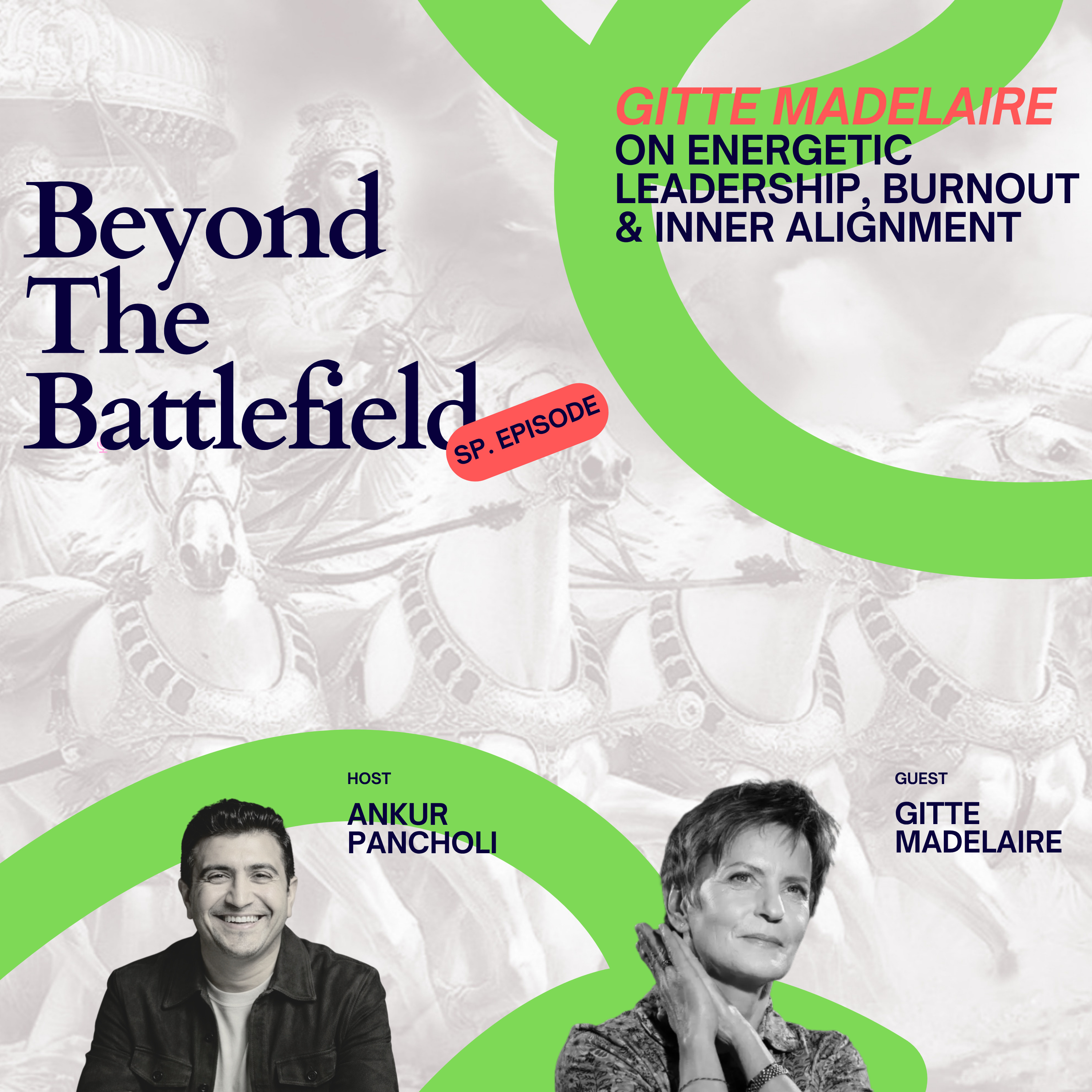
Gitte Madelaire on Energetic Leadership, Burnout & Inner Alignment
Tonight's Episode
In a world obsessed with AI, dashboards, data, and constant performance…
are leaders losing connection with the one intelligence that matters most — their INNER state?
In this deeply transformative episode of Beyond the Battlefield, we explore one of the most important leadership conversations of our time through the lens of the Bhagavad Gita, modern leadership psychology, and energetic awareness.
Bhagavad Gita teaches that before Krishna guided Arjuna’s strategy, he first transformed Arjuna’s STATE of mind. And today’s leaders face the same challenge.
Our guest, Gitte Madelaire, shares powerful insights on:
✨ Leadership burnout and inner alignment
✨ Decision-making beyond data and analysis
✨ Why intuition is a leadership capability
✨ The hidden “energy” inside boardrooms
✨ Ego, fear, stress, and emotional overwhelm in leadership
✨ AI vs INNER intelligence
✨ Why burnout is often not a workload problem… but an alignment problem
✨ How leaders can pause, sense, and lead from clarity instead of pressure
This episode bridges Bhagavad Gita wisdom with modern leadership realities, helping leaders understand that true transformation begins within.
If you are a founder, executive, entrepreneur, manager, coach, or someone navigating pressure, uncertainty, burnout, or high-stakes decision-making… this conversation will stay with you.
🎙️ Topics Covered:
• Bhagavad Gita and leadership
• Energetic Leadership
• Intuitive decision making
• Leadership burnout
• Conscious leadership
• Inner alignment
• AI and human intelligence
• Emotional intelligence
• Boardroom psychology
• Leadership mindset
• Meditation and awareness
• Leadership transformation
• Strategic foresight
• Human-centered leadership
• Leadership and spirituality
The Bhagavad Gita reminds us:
“You do not transform leadership by changing the battlefield outside first…
you transform the leader within.”
A heartfelt thank you to Gitte Madelaire for bringing depth, honesty, and practical wisdom into this powerful conversation.
🎧 Listen now on your favorite podcast platform.
📩 Share your reflections with us: [email protected]
🔗 Explore the Beyond the Battlefield companion GPT link in the description.
#BeyondTheBattlefield #BhagavadGita #Leadership #LeadershipPodcast #ConsciousLeadership #AI #FutureOfLeadership #Burnout #EmotionalIntelligence #SpiritualLeadership #Mindset #LeadershipDevelopment #EnergeticLeadership #InnerAlignment #DecisionMaking #Meditation #HumanLeadership #SelfAwareness #LeadershipTransformation #Entrepreneurship #ExecutiveLeadership #BhagavadGitaForModernLife #AncientWisdom #Podcast #PersonalGrowth #ModernLeadership #Intuition #InnerIntelligence #Mindfulness #LeadershipMindset
Welcome back to Beyond the Battlefield, where we explore not only the battles leaders face outside, but the quieter, deeper battles unfolding within. Today's episode begins with a question every modern leader must face. When you make a decision, where does that decision really come from? Is it only data? Only analysis, Only strategy? Only the pressure of what everyone else expects? Or is there another intelligence within us, quieter, subtler, but perhaps more truthful? In the Bhagavad Gita, Krishna does not begin by giving Arjuna A checklist.
He does not begin with a strategy map, he begins by shifting Arjuna's Interstate because a confused Interstate can distort even the most logical decision. And this is where today's conversation becomes deeply relevant for our AI driven age. Our guest today, Gita Madelaire, brings a powerful and refreshing perspective to this challenge. Gita is a futurist, author, keynote speaker, facilitator, mentor, and the founder of Energetic Leadership. Her work speaks directly to one of the biggest leadership questions of our time.
How do we build businesses that are not only smarter, but more human? And today we explore something very powerful together. Why? Leadership failure is often not a skill issue but a state issue.
And why the future of leadership may depend not only on artificial intelligence, but on inner intelligence. So stay with us, because this conversation is not just about how leaders think. It is about how leaders sense how they show up and how they transform the invisible energy of a room, A-Team and a future. Let's begin. So welcome, welcome to Beyond the battlefield Gita. We are I'm I'm really happy to have you here with us. And I was going through your energetic leadership. You you deliver a lot of talk and your book and many think about right.
And here you talk about how when modern life design collide with old leadership habits and in beyond the battlefield, we try to apply ancient wisdom of Bhagwat Gita to the modern leadership. And with this conversation, I'm I'm really excited and looking forward something very interesting will come up out of it. So first thing just I want to understand that before any big decision, something, something sift inside us and we readily talk about it. So we see this often, very often today, leaders sitting in an important meeting, everyone looking at them for direction, for decision.
But inside there there's some agitation and doubt is going on. And in Bhagavad Gita, Arjuna was in a similar moment. He was capable experience, but internally he was unsettled. So Gita, from your work in experience, what is really happening inside those kind of leader at that moment? In leaders, when they are in doubt, I think if you are not in doubt, you will find it very easy to make decisions. But we have not come that far yet as humans and leaders here on planet Earth. So I think we are still struggling with that.
We are trained by education, by our, the way we have been raised by our cultures, by by everything that we should figure everything out by thinking about it and we should then make our decisions from our, I call it rational mind, and also maybe from our data. We have lots of data, we have lots of analysis, but what we are lacking is really the, the intuitive part of us. And we have had or we have the intuition with us from we are born because of, you know, the way the system works, the education system, our cultures, we have been told we have been raised to sort of suppress our intuition.
And that's a big shame because when we are using both our rational mind and our intuitive power, we are able to make much better decisions because we are judging from a holistic point of view. So we were talking about the decision making for leaders today. And it is really, with all that's going on in the world, decision making for leaders is really, really important. And from where do you take your decisions from? From what base do you take your decisions? So you can use a lot of data, you can use a lot of analysis, you can use your Excel sheets and what have we.
So we have a lot of rational knowledge, but what we are lacking really is our judgement power. And one part of that is not just our knowledge from from from data, it is also from what I call foresight, being able to understand what the future looks like. So, So what is what is actually happening in the horizon all over the world, but also in your country or in your industry or within your team or something like that? So how do you take trends and apply them in your work and especially understand them in the sense that what consequences do these trends have on skills or competencies that we need to to practice or learn?
And then the third thing, you know, we have data, we have foresight and then we have also ourselves and using both our rational mind, our data and foresight, but also using our intuitive power. And that is something that has not been, we have not been raised told how to do that. But in India, we know that you're very good at that and has been able to do that for, for thousands of years. And, and, and that history and, and all kinds of proof of that is, is also both spoken and written, which is very inspiring for others in modern leadership.
Yeah, you're right. So the culture was set in India in a way that we we can utilize our inner power, we can keep our inner self active, we be self realized. That's how the culture and rituals have been made. But but the first thing you said that the way we had been raised, the way we had been trained in schools and many other places, that's that is what not helping us to get again tuned back to our and wisdom, right? And that's where the point you said that inner power, the the the inner self-awareness is, is important.
And then in the corporate world as well, we have been trained to think better, analyze better, decide faster, right? But but rarely we ask what the state they are while making those decisions. So so portion is always uncovered, untapped or not looked at. So if if you when you go through Bhagavad Gita, you'll understand that Krishna also didn't give Arjuna A framework first. He sifted his state of mind first so, so instead of giving him easy answers, he is started giving him on a situation where he can shift from one level to other level rather than just start following those checklist.
So I want to understand one more thing that in your experience, in your work, how much of the leader she failed actually because of the state issue and not a skill issue? I have a very good example. We have a National Bank. Yeah, in Denmark, like a lot of countries have a National Bank. And in that bank there's a lot of economists. I had a meeting with Thomas Hart, who is an economist and also a director in in the bank. And he has written a book and he has also written articles. And one article really hit me because it said we forgot to look out the window.
And I went to see him and I spoke to him and I said, what? What happened? They were not good enough in looking out the window, understanding what the head of them, and they were not good enough also at using their intuition. They looked into the data and the models and everything, and they were not able to predict the inflation crisis we had in 2021. But some of the colleagues of him in the US, Blanchard and Summers, they were very good at predicting and they predicted inflation crisis because they both used their data, their models, and they also looked, they, they also looked out and they understood what was happening.
And they also, and that's very important. They put it all together. And then they, you know, they had listened, they had sensed, they had also seen. And then they made a decision with themselves that state of mind they were in. We believe that this crisis will come. And that was what they went out and said. So the state of mind is really the decision maker. Sometimes we have, sometimes we have, you know, if you dare to, to follow that state of mind. But the the problem is that we are not, we dare not to follow it.
We try to follow what what the the man or woman next door believe we should make us a decision or what we have been told or what we think is the right thing. So that's the state of mind we are in is really important. So if we make decisions from a fear based based foundation, then we will also make decisions that are are not wholehearted and and wise. Yeah. You really bring out a right point that most of the time I had also seen people take decisions by you know, someone who what the other person beside me is doing or what my leader is doing right.
And then it gives a bigger responsibility to the leaders that they take right decisions. So someone who is observing also follow the same thing, lead by example. And if the leaders are not putting right example, they are also following something, then we can understand what will the state of the person who is taking decision at the end of the queue. And and and you talked about they're not looked out. The bank did did not look out of the window. And that's also an important because you if you don't understand what is happening around you, how the trains are changing.
And that's where I even even we have covered one episode which talks about our mind. So mind is very beautiful. It is it is your friend and it can become your enemy. So mind is designed to interact with external world and give you an understanding that something is changing and change inside, right. So if you, if you can see, you know, even dinosaur bigger than that, there were many creation, they did not exist now, because they don't have mind. They they were programmed in a fixed way to work, right?
They, but our mind is open and we can program the way we want. And and that's where that window example is very right that if we are not able to interact to external world, understand the changes and correct our cell book and recalibrate ourselves inside, we can't succeed over there. So and that, that takes me to the next thing that and I'll get an example when at one point I walked into a boardroom. No one has said nothing, you know, and many time I'd say not even one time, you can feel there is a tension or there is a confidence or there is some resistance.
Nobody said that anything but you can feel from the ambience over there and I see most of the people ignore this, but but it's shape everything what that follow so so in that situation, how should a leader understand and work with this invisible layer of energy? Well, that's a good question because when you when you walk into a room, yes, we can sense it. And especially if we are a little open also to really sense that. But some people will be very stressed that they don't even sense it. One way you can work with it is that, and this is where I use in my work with, with leaders and people I work with the, with the trends, you know, so you can talk about something that is not vulnerable, that is not scary.
So when you talk about trends, you know, how do we see the future? And I have sort of listed them and you can start both. Is it it, is it, is it relevant for their company and for the boardroom? But what will happen is that people will always start to try and and not try, but they will start talking about both the business but also their dreams, their frustration. So you will get a lot of good dialogue coming from from talking about how the horizon, how does it look when we look out the window. So it says.
So it's sort of a sneaky way to get to those areas of the talk that is more for some people dangerous to talk about and then you will have a way of addressing, OK, now we have heard these things and you have said this and that. Should we try and continue talking about and prioritize this and that? So that is, that is sort of a more a way of having it on the agenda where it's not totally visible on the agenda. You can also address it, you know, full speed and say we need to talk about what is happening in this room.
And then an example could be, which I use very often also right now we have 2 crises going on in the whole world, two energy crises. And the one, the first one, the energy outer energy crisis is the one that's playing out now in the Middle East with oil, gas, all that. But we also have the inner energy crisis that people are stressed, demotivated, not engaged, not thriving all the way to being sick, autoimmune system sicknesses and all that. So and if you are in a boardroom, you should be able to talk about everything.
If you are not able to do that, you should not be in a boardroom. So you're right. So you know the last point you talked about that inner energy crisis. Now what I see this this reflect as in so, so there has to be symptoms of inner energy crisis, right? And the symptoms most of the time in corporate leadership is burnout. They feel, I have seen a lot of leaders, they are picking right decisions, they are very skillful, but end of a day they burnout, right, They feel exhausted and their leaders, they, they are in the same situation, even more stressful situation, but they take decisions, right decisions and they don't feel stressed, They don't see burnout.
And for that you rightly said that there has to be a discussion in the boardroom about in a state of mind as well, because that is the one which make difference in any decision. And what what we what Bhagal Gita talks about it is that how do you balance that? And there are type of people, as I said, someone who can feel stressful, someone who doesn't feel stressful. So for that burnout, how you balance between the outer energy and inner energy? Someone who is having, you know, flow of inner energy which is overflowing, he will run a lot, but by end of the day he will tired.
And someone who is very lazy, he doesn't have that much of inner energy. So outer energy takes inside. So that's how burnout comes up when you who covered it very well that this has to be a point of discussion in any boardroom. That inner state of your mind, inner energy has to be aligned with that your activity. Otherwise you are not in the right place and even though you are not able to take a right decision. You could make the comparison when you sit in a boardroom and you talk very much about AI.
Right now, I'm sure a lot of boardrooms talk a lot about AI. Yeah.
And that is very fancy and you use both a lot of time talking about it. You lose, you have put it into the strategy, you lose use a lot of money on it. You change your strategy, you change your customer journey, your value propositions and everything. The human, the humans who are going to deliver all this in your company. Do you talk as much about humans and how they are going to thrive as to talk about technological like AI and, and these kind of advancements? So, so it in a way it is really, really simple, but for a lot of reasons, because we don't like to talk about ourselves and how we are fearful about things or what have we.
So we don't even understand that when people have burnout, we don't go into detail why. Why did that happen? And you could say burnout is really, instead of feeling ashamed of being burned out or because a lot of people do that, it is really what I say, congratulations, your system, it's like a computer. Your system is failing. It is telling you to stop because something doesn't work. And it's not that you don't work. It's the environment you are in. That's one thing. But it's also people's ability, you know, the individual person to to take responsibility for our own life.
Just like the Gita, like started the story says, you know, he's going to war and he should, you know, start shooting. And I don't want to shoot my family and friends on the other side. So it's the same thing. I do not want to be in this boardroom because we don't talk about what is important or if it's an employee. I don't want to be employed in this company because I don't I feel sick and I don't want to feel sick or be sick and eventually get burnt out. So, so we always have a choice, but we don't always take the decision.
Yeah. And if you that you describe rightly describe how Arjun was not ready to fight with his family. And if you look at the 1st chapter first few verses, it very well explained that Arjun has confused his emotional overwhelm but with that logic and that logic feels so right today as well that every excuse he was saying for not fight. If Krishna was not there, I'm sure someone like us would have agreed and asked him OK you don't fight you're right right. So he was trying to give all the logic which was.
Confused with his emotion and there are moments in leaders life as well. They know something which is not right. They're so, but they were right that because of speed, pressure, expectation, inspiration, any other thing. Why this the the leaders are, you know, including this Internet signals. You talked about that there has to be a discussion of about human alongside the technology. But still we see that, you know, people still misread this Internet signals. How do how to correct that? How do we correct it?
I think that the people all over planet Earth are trying to correct it in many, many ways and we have a lot of power in the world. So you can do a lot by just the first thing is by being good to yourself, to whatever is needed to calm your nervous system to well-being, you know, both physical well-being, mentally well-being and what I also call spiritual well-being. So if we don't have all three of them, we are we are not, we're not whole. If we don't do something, you know, if we are just forced to do something which is not meaningful, then we don't have our soul, our spiritual part of us with us.
And that is just not meaningful and it will not, we might be stop being sick and whatever. So in order to do something, you need to look after yourself and you need really hard to listen and to hear or see with your eyes and to sense with your body. And very often we are good at that, those three things. But the last one, the 4th 1, then we don't dare to take the step and believe that OK, in this boardroom where I am, I should either address the issue or I should resign. We don't dare to do any of them.
So we just sit there and play the same game as as all the others. And we wait. Someone will come and take the decision. Yes, but if you are in a boardroom, you don't sit in a boardroom, you work in a boardroom. And so you, you have to make decisions and you have to make the decisions because in a boardroom I expect that you are also responsible for a company and other people. So it is part of your responsibility to make decisions and they might be tough for you, but you know, personally to sort of, OK, should I speak up or should I resign?
But maybe it's the best thing or it's the best way to sort of get some people noticing that that shift is is is relevant. So, you know, I I the two point what you say just how that stuck in my mind. One is boardroom. It's not just a meeting room where we work, right. And I would say that boardroom, we work as well as we, we are there to contribute. And that is where and, and boardroom is not your office. When I'm sitting in my office, I am in my role. But when I'm in boardroom, I am in a community, a group of the people, A-Team, where I will contribute as per my ability and my capability.
And that's where you know, yagna or the fire ritual, if you had seen somewhere is very well explaining to Bhagavad Gita that how and and I tried to articulate into modern leadership that how someone should be doing a yagna in a reference room or a boardroom. And how you know the community ritual happens in a real life instead of just following a ritual which we follow. And the other point what you say that if we are not aligned in internally where mind is all right, there will be a lot of health issue.
And that's a serious, serious. Today people ignore that part that whatever I do, I eat, I do exercise, I will keep myself healthy. But mind is something which which is very important to keep healthy. If your mind is not healthy, you will start finding a lot of physical diseases, health issues into your physical body which people don't understand today. Oh yes, we have a lot of mental, we call it in here. I'm from Europe, Denmark and we call it mental diseases. So like people have a lot of it's, it's like you have a thought, it creates a feeling or emotion and it creates then an action.
And if you are in the negative spiral, you know, negative thoughts, negative emotions and then negative action, then you can sort of you just go down the drain and, and that is really what's happening. So we're all sitting in this, a lot of people are in this big pit hole. And if we keep behaving like we have done until now, we will all end up down there. So it is important to have brave people who are able to balance both the physical, the mental and the spiritual health to sort of pull out all the others so we be all be on, on, on the right side of the whole.
And nature works in a way that whatever you give, it will amplify and give you back, right? So if you give negative energy, the negativity is going to amplify and come back to you. Only if you give positive energy, the positive energy will amplify and come back to you only. Only this is the thing. Energy only amplifies and come back. Rest of the thing doesn't amplify. You spend, I will not sure you will. It will increase or not you invest, it will amplify or not. But energy for sure is going to come and amplify.
And you also talked about 1 thing which I missed to discuss that the three areas where people have to work, intellectual part, that physical part and the spirituality and and all three are important. And that's where if you go through the Bhagavad Gita, you'll understand that first five chapter talks about action, commitment and detachment. 6th in the chapter which is a bridge which talks about meditation the first time in the whole humanity meditation is stopped over there thousand years ago and complete procedure.
Following to that, the 6th chapter talks about all intellectual knowledge, the knowledge in a way that your mind will blown up right and your mind will be open so much and and the last six chapter talks about spirituality. So it says that everyone has one path and out of these three anyone path can suit to anyone. So it talks about whole human ability to become successful, become self realized whatever way you like. If you you don't have money, don't worry you you can contribute with the physical health.
If your money, you want money. If you don't have money, you don't have physical. You can help your intellectual poets, a lot of scriptwriters, they are intellectual. They just write and and express their ability to the society create something, right And then you can't do anything. Just follow the spirituality, get into your own realization and you enrich that right. So, so in a real situation, if I will have to make a decision or some leader has to make a decision which will impact people's life, like maybe that decision will impact future of the organization.
Sometimes it is more impactful for the society, right? Many politician or many big leader have to take that kind of decision. Now outwardly they need to appear composed, right? But but internally there is a discomfort. If it is a big stake, there is a discomfort, right? Even sometimes resistance because the decision is not aligned with your correct so. So what would it look like to for someone to handle that bombing from a aligned energy state? If you are, if you are not aligned as a person, how can you be aligned?
So let's assume that you would like to work in this company. We assume that, but you are a little bit off track. I always say that it's always good to be calm and to be still and just like in the guitar, you know, like, but for some people it is, it's really advanced to meditate. So the first thing is can you be calm in a, in a way for so like if we have the boardroom, the boardroom has discussed a topic and they're going to make a decision. So if it could be some kind of a tradition when they take decisions that after the dialogue, they have one minute where it's all quiet.
So they just align with themselves. Now we're going to make the decisions in, in 2 minutes. Am I against it or will I say yes? So how is it? It's not my head saying yes or no. It is my aligned energy system. And from there they take the decision and then they respect. And because then you should also as an individual be able to put away your ego. So it's your energy system that's take the come with the answer because you can actually you sense it. Your body will sense if you are able to listen properly within.
Correct. So you're right. So in modern workplace, what happens is, you know, reward, they reward very quick responses, constant accent, always being on, always being available, always being active, right? And they are being rewarded well. But to clarify, the clarity often needs space, stillness, right? And that's what even in Bhagavad Gita, the meditation comes at Chapter 6 and it was beginning of the Chapter 6. It talks about that you have to keep everything aside. And that's why from Chapter 1 to Chapter 5 talks about alignment and then it asks you to come.
If you are carrying noise inside your mind, you can't meditate, right? And and so, So what Krishna does is slow down as soon before asking him to act. So before you want to act, first slow down. Understand what is confusion you are carrying in your mind the different things you are carrying your mind, right? And that's and that's that is what you rightly said is missing today. People don't take pause under this situation. They they want to continue with the momentum, but they don't want to take pause.
That's a very, it's a very specific example and people can understand it. But what we what I would love to see is that we make a lot of analysis in companies. We have a lot of data and we like that because it's easy to understand. But what if we also make make what I call energetic analysis? So you have your customer journey, you know how your customers are coming, you know all the touch points, but do you also analyze how the employees are reacting? You know, how is that energy in each of the touch points?
One thing is you have described how you ideally would like it to be, but are you willing also to make an analysis where you find out how is the energy? So sometimes we can make surveys within the company and also with the customers and we put it all together. But are we really seeing the true picture? No, we are not seeing the true picture. So I hope we can get there in years to come where we also are able to make those analysis and talk about them. So how is it, why is it that this touch point here which really should be building loyalty and value and everything And we are struggling with this specific touch point in our customer delivery.
And eventually if you have a customer delivery where the customers don't like the product and they don't like the delivery and then then they will disappear and then you will have no company because. So we have to understand what's changing in people right now. Correct. And sometimes, you know, what I understand is the decision looks very logical, but actually it is driven by to need. There's a need to prove something right, to be right, to be seen, to be visible to the people. And we we think about that into deciding something other than deciding what is right.
And, and I always say that Gita and Krista always guide that it's not about right or wrong. It's about what is right right now, right? It's not something I'll be more visible. I'll be seen by everyone. I'll get something out of it, right? And that's what Arjun was also trying to convince Krishna, which is all logical reasoning. And it was actually, if you look at overall journey, Arjun was trying to hide is different kind of ego behind those logical reasoning, right. There are and and there are many blind spots for us as well.
So. So in your point of view, how does ego shows up as an energy distortion in leadership? It shows up when, when people and you can, you can nearly when they're not true to themselves, when they're trying to follow, you know, the herd or the group and, and you can you can sometimes see it in their face. You can see it in their body language. You can if you are like I am. If you are sensitive person to energy, you sense it, but if you are then asking a question to that person where you can actually see that it it's it's not working.
It could also show up in people keep doing something that makes them sick. You know, burnout. You know, you can have one burnout. Then they'd do the same job again the same way. And you know, there's it, it's like I call it that. We're being told to to do something differently and we won't listen. And this is actually our ego. I call it the ego sitting here on our right shoulder, because that's the sort of the masculine energy and it's nothing to do with, with gender, but it's the performance energy telling us, OK, Geeta, you are weak.
If you don't do this, you're a weak person. You don't want to be weak and you don't want you. You need, you need the prestige and you need the money or, and this ego is sitting here shouting in my ear. So there's a lot of ways that we can see it and, and actually in in India and with the Ayurveda and where you have all the steps where the this is the first sign of some illnesses. And then it's like then you have the second. And so we get so many signs and we don't and we. Don't and and and when you talk about in India, we have a lot of ritual and process has been said to kill your ego.
And if you if you, if you observe most of the religious places are designed at a higher place on a hill. And at that time you need to walk above with a very difficult road, right. So home server, yeah, you are how many, how much money you owning? But to reach there, you have to walk that path and higher the ego. People used to walk very on the high altitude and that that's where, you know, keep your ego in check. I will not say it will remove, but it will keep your ego into check always whenever you are doing.
And people used to do that. Now things have changed. It is modern life. People use even helicopter to reach to those places. People use ropeway and a lot of transport options available. Yeah. So but in the little it's AI just want to comment because I find that sometimes we are scolding our, you know, the ego to be something really, really bad. It is not because the ego is also here to protect us. But if we are not, if we are not having our soul with us, then it becomes too dominant. So yeah. So I want to understand any practical experience you had where you have witnessed that leader didn't learn anything new, but it simply become aware of their inner state, their inner energy and all of a sudden we have seen a change how the leader LED.
Yes, sometimes it is really when people get ill or sick or burnt out that is. That's one thing. Another way of of seeing it is is through dialogue that suddenly when I have sessions or workshops and you give a safe space to talk about things, but you talk about something that is not yourself and then suddenly it's like some will get wow, an epiphany. OK, there's something here that I have not seen or heard or understood before now. And it's through dialogue. It's like we are mirroring just like you and me now, but also in a group that, and it can also be that suddenly you read or hear something from someone else.
Then it can be that you changed because an employee comes to you and say you are very manipulating leader and you cannot understand it because you have good intentions and you are very outgoing and you have visions and yes, but not all your employees wants to be. How can I say it into very much development work. Some employees just and it's in bracket, you know, because it's good. They just want to be there doing what they're doing and not being part of very sort of, you know, strenuous development work.
So it's also you as a leader being able to really see your employees and then listen. So it can be a real gift when someone comes to you and are open there to be open. Then of course, it can be that you get fired. That's also some kind of crisis. It's not a health crisis, but not necessarily so or you lose your job. It doesn't have to be your because your behavior or results not bad, but just the reorganization, you know? Yeah, that's that's part of the life, right? Yes. So there's so many, many ways that we get to be tested, move up in our development.
I, I am, I'm, I'm getting a lot of insight from you and I, I feel we can talk for hours and hours and I'm looking forward to do that. But lastly, before we close, I just want to bring one more perspective that Krishna did not remove Arjun from the battlefield, right? So most of the time people when say I will not decide or I will not fight or I will not be there, they actually want to run away from that battlefield. But here Krishna as a leader did not remove him from the battlefield. He changed Arjun how he showed up in it.
So, so most of the time we carry those kind of baggage, those kind of thought in my mind that if I'm doing something, it may impact others, right? And there is the same way Arjuna saying that I can't fight with my family, they're my family. I grown up with them how I can fight with them, but at the time we forget right there were skill doesn't stay there because my mind is not in a nice state. So in if if you were guiding a modern leader today, when those leaders should start with with their strategy or with their inner state and how do they start and which point which will bring that awareness of their start?
I think we have to start with the, the inner work that is the most important thing as an individual, but also as a team and organization and even as a society. And I think when we, when we look at the world, this inner work is also a way of, of nourishing our democracies. So it's all the way, not just in your own life, in your at your workplace, but it's also a way of. Looking after your country so that you have democracy and you have your free will and law and order and all that. So that's that, that's, you know, the sort of the big, big picture of it.
But why is it that you should should do it yourself? For me, it's, it's really simple because it makes you more joyful. It makes you unstoppable in a healthy way, in a, you know, joyful way. And it is really the best way that we can give something to our both ourselves, our family and our organization. And then also so, so when people say that it's so difficult, you know, I don't have any money. I cannot give. We can give our good energy, our inner work that is this a huge gift for, for humankind on earth.
And we are called humankind because we should be kind to ourselves, to others. Very well said, Very well said. And beyond the battle, we'll talk about a lot of philosophy and psychology from Bhagwat Gita. Try to apply a lot, a lot of practical example, but when we talk people like you, we we really understand that how practically in a modern day this thing is being applied. I'll not say how to apply, but you had given an example that how the things have actually applied, how people will show up and it gives a very grounded experience in a real life.
We are not going to go fight every day, but but my fight is within myself and people around me where I need to bring them together with me and then grow together. That's what Geeta is trying to say. But you explained very well today. Thanks. Thanks for sharing your insight today with us. We are really grateful for you joining with us here. Thank you very much. So we would. As we close today's conversation, one thing becomes very clear. The future of leadership will not belong only to the fastest minds or the loudest voices, or even the most advanced technologies.
It will belong to leaders who are deeply aligned within themselves. Because, as Geeta reminded us today, burnout is not always a workload problem. Sometimes it is the soul telling us that something inside is no longer aligned. And that is exactly what Krishna was helping Arjuna see on the battlefield. He did not remove the pressure. He did not remove the responsibility. He transformed the state from which Arjuna responded to it. And maybe that is the invitation for all of us today. To pause before reacting, to listen before forcing, to sense before performing, and to remember.
Leadership is not only about managing systems outside us, it is about mastering the invisible world within us. A heartfelt thank you to Gita Madalaire for bringing such depth, honesty, and wisdom into this conversation. And thank you for joining us on this journey beyond performance, beyond pressure and beyond the battlefield within. If this episode resonated with you, share it with someone who may need this conversation today. Like subscribe and follow Beyond the battlefield on your favorite podcast platform.
And we would love to hear your reflections, your questions, or the battles you are navigating within. Write to us at Beyond the Battlefield at Outlook dot in and don't forget to explore the Beyond the Battlefield companion GPT link in the description. Until next time, lead with clarity, lead with awareness, and most importantly, lead from within.
 Apple Podcasts
 Castbox
 Castro
 Goodpods
 Moon FM
 Overcast
 Pocket Casts
 Podbean
 Podcast Addict
 Podcast Republic
 Spotify