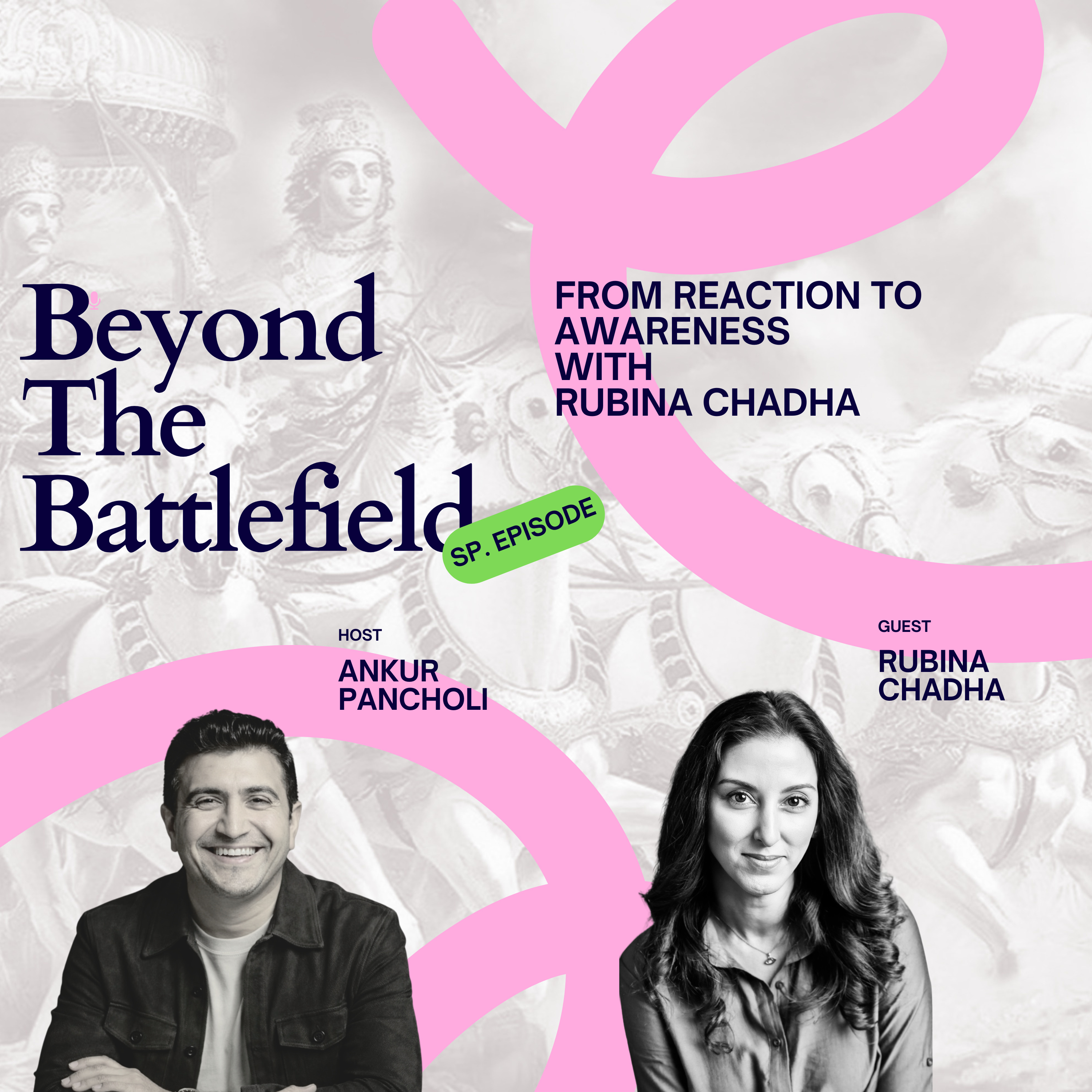
From War of Reactions to Inner Awareness with Rubina Chadha on Leadership & Bhagavad Gita
Tonight's Episode
The Bhagavad Gita has guided leaders, seekers, warriors, and thinkers for thousands of years — and in this deeply reflective episode of Beyond the Battlefield, the Bhagavad Gita comes alive through a practical conversation with Rubina Chadha on awareness, breath, emotional regulation, mindfulness, and conscious leadership.
Because the Bhagavad Gita was never only about war.
The Bhagavad Gita was about the INNER battlefield.
And even today, the Bhagavad Gita speaks directly to leaders, entrepreneurs, creators, parents, and professionals navigating pressure, uncertainty, stress, emotional overload, and constant decision-making.
Rubina Chadha Instagram
Rubina Chadha, founder of Inner Design, brings a deeply grounded and lived perspective to this conversation. Her work focuses on helping people stop living by default and begin living by DESIGN — through awareness, mindfulness, nervous-system regulation, conscious breathing, and inner alignment.
In this powerful dialogue, Ankur and Rubina explore one of the deepest questions of modern life:
Why do intelligent, capable people still react unconsciously under pressure?
Why do leaders freeze, overthink, burn out, or repeat the same emotional patterns — even when they “know better”?
Drawing from the timeless wisdom of the Bhagavad Gita and Rubina’s transformational work through Inner Design, this episode explores how transformation begins not with external control, but with inner awareness.
Together, they unpack:
• Why awareness matters more than information
• How breath reflects emotional and mental patterns
• Why nervous-system regulation affects leadership clarity
• The difference between reaction and conscious response
• How stress compresses awareness and distorts decision-making
• Why mindfulness is practical — not philosophical
• How Krishna guides Arjuna by first transforming his INNER state
• The symbolism of Krishna, Arjuna, the chariot, the horses, and the reins
• Why conscious leadership begins before the decision itself
In today’s AI-driven world, we have more information, tools, frameworks, and strategies than ever before. Yet internally, many people feel overwhelmed, reactive, distracted, emotionally exhausted, or disconnected from themselves.
This conversation reveals why.
Because information alone does not create transformation.
Awareness does.
Rubina beautifully explains how breath becomes a doorway into self-awareness, emotional intelligence, nervous-system balance, and inner stability. The episode bridges ancient wisdom with modern neuroscience, leadership psychology, mindfulness, and conscious living in a way that feels deeply practical and relatable.
The battlefield may look different today:
• a boardroom
• a difficult conversation
• parenting stress
• startup pressure
• burnout
• uncertainty about the future
• emotional overload
• AI disruption
…but the INNER battlefield remains the same.
Subscribe to Beyond the Battlefield, leave a review, and write to us at [email protected].
Also explore our GPT companion here:
Beyond the Battlefield GPT Companion
#BhagavadGita #RubinaChadha #BeyondTheBattlefield #InnerDesign #Leadership #Mindfulness #Awareness #Breathwork #ConsciousLeadership #EmotionalIntelligence #SelfAwareness #ModernLeadership #SpiritualLeadership #NervousSystemRegulation #PersonalGrowth #KrishnaWisdom #Meditation #MentalClarity #AILeadership #MindfulLiving
Write to us: [email protected]
🤖 Explore the Beyond the Battlefield Companion GPT:
https://chatgpt.com/g/g-6845186212588191ae7aa9e327bebc9a-beyond-the-battlefield-assistant?utm_source=chatgpt.com
https://www.linkedin.com/in/ahpancholi?utm_source=share_via&utm_content=profile&utm_medium=member_ios
https://www.instagram.com/beyondthebattlefield.gita?igsh=YW4xZzllYmtmdjIy&utm_source=qr
Welcome back to Beyond the Battlefield, where we explore not just the battles leaders face outside, but the invisible battles unfolding within. Because sometimes the real pressure is not the deadline, not the meeting, not the conflict. It is the state from which we respond to all of it. In the Bhagavad Gita, Krishna does not begin by changing Arjuna's battlefield. He begins by changing Arjuna's inner state, his perception, his identity, his mind. And today's guest, Rubina Chada, brings that same wisdom into modern life and leadership.
Rubina is the founder of Inner Design, and her work focuses on helping people live not by default, but by design. She works with awareness, breath, mindfulness, nervous system regulation, and inner alignment, helping leaders understand what is really driving their actions beneath the surface. And this conversation is powerful because Rubina is not just speaking from theory, she is speaking from lived experience. Together, Encore and Rubina explore why capable leaders still freeze under pressure, why awareness matters more than information, why breath can become a doorway to clarity, and why true leadership begins before the decision in the state of the person making it.
This episode is for every leader, entrepreneur, parent, creator, or seeker who is ever asked why do I react even when I know better? Why do I repeat the same patterns? And how do I return to myself in the middle of the battlefield. So take a breath, settle in, and join us for this deeply practical and reflective conversation with Rubina Chadha on awareness, inner design, and leading from within. Let's begin. Sabina, welcome to beyond the battlefield and today's truly special to have you with us.
I know, I know the subject what we are going to discuss. You had been not reading through, you are living through it. And and in Bhagavad Gita, Krishna doesn't begin changing Arjuna situation. He begins shifting his inner state, his perception, his identity, his mind and your work. The inner design also speaks about something very similar. Yeah, that's why life is not shaped by what is happening outside, but by what is the design within, Correct. So today I'm really excited to explore what really drives us beneath everything we do, especially as a leader navigating our own battlefields.
And when we look at today's leader, there is a constant doing this is an execution responsibility, but very little reflection on what is driving that action from within. So, Rubina, when when you observe leadership in today's world, what is actually driving most of the action? Thank you, Ankur. I'm so happy to be here and have this talk with you. I think that, you know, we see leadership starting to break down because of bad strategy. And So what you're talking about as the intent, intention and we'll call it the mind stuff, those activities that are happening, it's that intention or that strategy that's behind it is not really what is breaking it down.
It's because there's an internal instability in the moments of pressure and that's where the breakdown happens, you know, so no matter what, we can keep tweaking the strategy, but what doesn't happen or we can keep changing our intention. But until we have that internal stability, this is what obviously was taught on the battlefield, right? And we don't in real and our day-to-day lives also we don't really learn them by concept or by book or by reading or studying it. It actually happens in the battlefield.
Our battlefield only difference is like in the conference room or conference table, that's the battlefield that we are facing, right? So, and when we look at the battlefield world, Christian, as you know, we're having a conversation in the battlefield today, it looks very simpler. But when you are into situation, whether it is a war battlefield or a confluence roof or any personal situation, the situation remains same. The inner battlefield remains the same. That dilemma remains same. Sad whether I'm doing right or not, not right.
And Arjun at that moment in the battlefield was also not lacking any skill. He was not lacking knowledge, right? He was but, but he was completely conflicted. And. I find that very interesting. Even today as well. We see highly capable leaders who seems very clear externally, but internally there is a hesitation, there is a doubt. So why do you think this inner conflict still exists even though there are so much external clarity, competence, knowledge, everything is available? So you can have the right answer, but if your state is off your delivery, your timing, your decisions, everything shifts right.
For me, what I've seen personally is that it didn't come from theory. It came from living in those environments where stakes were high and realizing that what was happening inside me mattered more than anything happening outside. And that's where inner design, the work of inner design comes from, is bringing that awareness to people. It's not even bringing a knowledge. It's not a huge deep wisdom. These are ancient wisdoms, but actually applicable, you know, applicable awareness, applicable practice.
And that's where we we want to shortcut that. You know, everybody wants to be idea person, but nobody wants to be the action person. So I have all these great ideas, you take the action for me. No, that's actually not the life. And that is what we are taught from this ancient wisdom. We've seen this as an example because for aeons, for centuries, everybody's mind, every human has been in that same position, right? So Gita, you know, talks about the battlefield, actually is pointing us back to the internal battlefield.
It's the action is important, but the state which the action comes from is again and again being told that state of where the action is coming from, again, again, is being pointed out in the Gita. Steadiness is not something you decide in the moment. So I'm going to be steady now I've lost my steadiness. We don't decide that. It just slips away and suddenly we're like, how do we become unsteady? How did this happen? How did I get here, right? So it's something you have to train in your system. You know, today we see all of these high profile athletes and professionals in all kinds of sports and we see them on the field, but we don't see thousands of hours they have done in practice.
They don't advertise that right? They don't show their failures. They don't show every failed miss, every failed goal, every you know, we're not looking at this, those failures which we have in our life. Every of those goals that we don't meet actually are training us for that success in the moment when we are actually on the field. So if we change this mindset by understanding it, see, mindset is another thing that people are taking to this other level. So let's listen to these highly impactful mindset.
You know, that's good. It's inspiring. And, you know, you feel like motivated maybe. But again, the practice is yours. You have to say yes, I'm going to dedicate myself no matter what. I'm going to fall down. I'm going to get up, I'm going to dust myself off and I'm going to go again hundreds of times, thousands of times, however much time it takes me to meet my destination, right? And that's part of that whole journey that we have in life, you know, And I think that nobody's really taught us this.
We don't grow up with this in school, even in home. So Gita is something that you know has been sitting there. Yes, maybe families tell us maybe in school or in society, we hear that you should read, you shouldn't understand. But when you see somebody telling you, you should understand. That person also should be wise, right? Like with your grandparent or something that you've seen. And they say, Oh yeah, I faced a lot of struggles in life and this got me through. So I really appreciate what you do here is breaking it down for people to understand day by day as you're living it.
Because we don't have to wait till we have a grandparent telling us or when we are children, we may have been told that, but our childhood memory is different from our actual practical implication or implementation as an adult. We need to implement this as an adult, right in the High Peak times of our life. And so, you know, I think the work has to be met in a very practical way. So this reminds me something which when I was learning Gita, a lot of people in my family came and said that what's going to change?
What's what's, what's going to change around you and when. I've gone through once, twice, twice. I was not ready at that time when they asked me the question and I was quiet because it's it's not right to respond someone what you don't know. But when I complete learn and started living, what I've realized is that nothing is going to change outside. But a lot of things change inside me. The way I was looking around me, the people around me has changed. Even the people I was looking them as, you know, kind of my competitor, my enemy.
I still believe them. They are my competitor, they are my enemy. But the approach to them is changed. Last week there was a conference going on and I need to, you know, shout on someone, which is very close off my colleague, but he was not performing. So I need to shout in front of 280 people. So yesterday he called me and said that I, I just wanted to understand what happened. I said I don't have any problem with you, I'm going to fight you again with you. But on a very next moment, we'll have a dinner with the family because my role in that conference room in Battlefield was different.
And now you're calling me. It's a different, better role line. But again, you know, Gita points out something very deeper, which I have learned very hard that most of our action are not truly conscious. They are, they are. They arise from conditioning, from pattern we have accumulated over time. And maybe Gita says on multiple birth right, which which a lot of people doesn't believe in incarnation, but Sanathan says that there are incarnation and there are a lot of stories around that. So in your work of inner design, we speak about living by design versus living by default, correct.
So when you bring this together, what does default living looks like versus living by design? And especially when the highest performing leaders who appear very intentional on the outside. Yeah, You know, a few things that I noticed what you just mentioned to unpack there is that first of all, you're talking about in the reaction situation, right? In the the situation you have you decided I have to yell at this person, I have to call out something injustice or inappropriateness and I have to bring that attention to that.
There's two things there, right? That's a really conscious with awareness like you pull the bow and arrow and hit the mark with a, you know, on the target. So that's having that is not coming from a place of reaction. And I think that what we, what we realize is that a lot of us come from action reaction or unaware of action. And the unconscious reaction comes back to us. And so noticing, you know, teaching people for me with inner design is to notice their breath patterns first, right? Awareness, first of all, in general, awareness, whatever you can notice, notice that whatever you can awareness, have awareness towards, notice that if you can become aware of the sight that you have around, all of a sudden you become aware of the sounds that are happening.
You're aware of something outside of you. There it is. That's mindfulness. But something we have with us that we are carrying, that marks our life is our breath. And that breath is always with us, right? If it leaves us, we're no longer alive, that's the end of it. So that also is something we can have access to modulate. We can modulate our brain waves consciously. We cannot modulate our heartbeat or digestion or anything. Our breath we actually have access to say, I can breathe in and breathe out.
And if we forget, it's still happening. Thank goodness for that, right? So when you notice this breath pattern, actually it's linked to our thought pattern. And as soon as you change the breath, thoughts also change, right? So when somebody feels overwhelmed, their breath becomes short, it tightens, speeds up. And this is an entry point to realize that from there we can regulate this nervous system that we have. This is communicating to our brain and our body, right? They say that whole gut and brain connection and you createspace, then the clarity can come online.
Then you say, oh, I realize something, you know, clarity is it's not something that can be forced. It's something that emerges when the system settles. And so talking about from the point of view of that awareness and how to use which different skills and different tools you have is that, you know, if you're going to yell at somebody, people will say, wow, you were so unconscious. Or you mentioned even after we, I have this, you know, offset of emotion onto you, we're going to have dinner after.
So this awareness that you know, things are passing, time is passing, emotions are like waves in the ocean, they're also passing. You can't just catch one wave and stay forever on there, right? And so with pressure, we find that time and awareness becomes compressed. We feel that we say this statement, I'm under pressure, right? So everything is being compressed. And then people move into this reaction and they're not in a conscious decision making place. The biggest thing for leaders is your whole life is made out of decisions.
Making those decisions consciously is how you build the steps, stepping stones of your life. And so actually you don't need better thinking. You need regulation first. So you coming from a regulated place, you coming from an aware place and saying, I know I'm going to pull this, shoot this arrow at this person and then I'm going to move through it again. I'm going to be able to have dinner with them is actually showing this in life, you know, you cannot access clarity from dysregulation. You had the clarity, so you were regulated.
Correct. And that's what keep on communicating that you are not going to gain anything. What you have to do, you have to lose what you had accumulated and acquire for for a couple of years, right? Maybe a couple of birds. And we don't know how we are acquiring all of those things, right? And something which you said moment back that the, the kind of work you do, which is actually practical because we have been told that you should read Gita, you should understand that. But when you read, it's still a knowledge today, right, how to apply practically.
And you say that the breathing techniques, the breath which which stays with us. That is something which really people need to understand today that you can acquire a number of knowledge you have today AI, many other information. A lot of podcasts are going on. A lot of books has been published on multiple thing, right? But still, if you don't apply and that's what beyond the word Metafield also want that personally, when I learned that I wanted to apply and then when I applies it, it can be applied at multiple places.
But but let me start with corporate leadership in in in in chapter 5. I spent almost a month to define how do I articulate Jagna into conference room right. Jagna, which we do is ritual for years. But but articulating there from conference room and someone who can listen that episode of Jagna all 12 Yagna has been articulated. I, I took, took it took a lot of time, but you know, when it grows now I can understand and people can understand that actually when you are in a conference room, you are into contribution in order to fight in the same way AGNA does.
And the other thing what you talked about breathing, when people get overwhelmed, they're burnout, how breathing can help. And that is also one of the AGNA which which which is your work, what you are doing right. So yes. Right. So, so moving forward the ideas of action and might keep on expanding into Gita and Krishna speaks about how action are saved by deeper forces, by impression tendencies and we talk about unconscious patterns which we are not aware, right. So which means that what we think is a decision and you say just a couple of minutes back that may actually be continuation of something older, right.
Yeah. So. So in your experience, what are those unseen patterns that quietly shape the way we think, decide within us, even even without realizing that? You know, it's not about being calm all the time. So we think that we should gain calmness and it's just stable and going to stay like that forever. This is about becoming aware of your state in real time and having that ability, the power to shift it and direct it the way that you want it to be. Inner stability means that you can pause before reacting, right?
Sometimes we say that think before you speak, just like take a pause before you react. You can feel what's happening without being overtaken by it and then acting with intention instead of urgency. You know, it does not about, you know, disconnecting. Detachment doesn't mean disconnect. It's the ability to act without being consumed by the moment. And the moment is like everything that's happening around. We don't have control over that. We know that. And especially in places of that high pressure that we're talking about.
So when you notice your breath without changing anything, noticing that you can even slightly slow it down, take a deeper inhale, extend your exhale, this alone begins to create a shift in your state. Just such a simple momentary thing, right? From there, you can actually have access to choice of your next action. Leadership is not external performance. It's an internal responsibility. This is what truly leadership is. So when you know that your state impacts your whole team, whatever the state of being that you have, it's going to impact everybody around me, my communication, it's going to impact everybody around my decisions.
It's impacting everyone. This can feel a burden. People feel like so much is on my shoulders if I make this decision, that person is affected in their life, in their home. But you can turn that pressure part of it around and say, wow, I'm so empowered. Every decision I make is going to have a good ripple effect. That's my intention. But how do I put that into action is through my state of being is by aligning to myself 1st and I can align to the others, right? It's not like self-care or people say fill your own cup.
Yes, yes, you need to do that, right? But you need to know that, OK, I'm in control of my situation all the time because I have access to it. And I don't mean control from this external force, right? Something has to have control over me. But we have lost actually with something has control over you, you've actually lost control. You have a sense of agency over your own self. First of all, your faculties, your whole way of being we're talking about, right. But if how do you have access and control over that?
You have to first have access and control over what state of mind am I in? Do I, can I control my thoughts? My thoughts are running wild, right? Like horses, they're just dragging me here and there. We have to have that hold on to the reins and pull the horse and say, OK, this is the direction we're going to go. We are going to be like this. And then horses, especially right in Gita is also symbolic. But horses have a great power. They also have a great sensitivity. They're one of the most sentient beings on our planet.
And all along you've seen horses along with humanity throughout civilizations. Doesn't matter where they're not like only this region had horses and this region doesn't have throughout humanity. Everywhere there's been humans, there have been horses. And we even use their terminology like. A workhorse, I can do a lot of work. I'm like a workhorse or my car has a great horsepower. So all of these terminologies are with us. And what's not looked at a lot of times is that sentient being how sensitive horses are.
You know, I grew up my guruji used to tell us this message when we were little, you know, we would say sit down and be told we have to meditate in my home. I was raised infused with meditation. That was very important part of our life. My parents didn't ask us, did you finish your homework or did you pass the test? They said, did you meditate? These were when we looked out. You know, we're kept a check on that. And so I was told this story, you know, like when life gets hard, you know, a horse needs to drink water, right?
They are going to go to that water truck when they are going to drink the water that's available to them. But as soon as they start to drink, that sound comes tick, tick, tick, tick, right. The wheels are refreshing, the water is pouring in and the horse is very sensitive. We know that you can get a horse and they're very skittish and they may kick you in the back or whatever. You have to be careful, right? So that sound disturbs the horse. Tick, tick, tick, tick. And they, he's just held to us.
Tick, tick, mepani pina. So what does that mean in life? You know, you have to do, you have to attain, you have to get what you need and there's going to be disturbances constantly on the side to take you off track. And with those disturbances, you have to attain your goal. So I think this is a huge message, you know, through everything in our life and water, like with a symbolism, it's like water to drink. Water is life sustaining. So you have to do action. That's our life sustaining thing. We are we know we're on the planet of karma right with Karam, you have to do something we're not in the planet of just like I don't know, just respond relaxation No, we have to do we have to take actions right and so that real work is not controlling everything outside the horse cannot control there's a tick tick set now I only drink in the tick tick stops or I'm going to break the mechanism No, the real work is being in that leading yourself first.
If you are truly a leader, you have led yourself and through that, others will look at it and we turn around and we help others. You know what, this helped me. This is the way I'm leading myself. You also lead yourself. This is a better way to get our whole team with more impact, right? Showing them this is simple. I do the simple thing and this is how I'm leading myself authentically. You also lead yourself and we'll go in the same direction. And I think that people feel that they actually have a sense.
They feel that before they understand it. So these conflicts that we see, they can settle on their own. When people begin to sense you are really wow, I like how you handle yourself, right. We say that sentence that means something has to be handled. It cannot be just mishandled. It cannot just be running around. It has to be handled. And so I think that presence is what people really trust. We really trust presence, not just expertise. We really, when we stop and think about it and each one of you guys out there is in the audience, listeners can think about somebody that you trust and just for a moment think, is it just their expertise or there's something deeper that you feel they I have an access to?
I also feel I want to have access to that right? Right. You put a lot of things with a very good perspective. I'll tell you that when we go through verse by verse, unpacking every verse, bringing those things in a practical life. But the way you have articulated all of those aspects of in an alignment also is a very good example you brought tonight. And that's a symbolism in the cover page of Bhagavad Gita. And the way I have learned the five horses are 5 senses, sense organs, not senses. The rains are senses and Krishna is your mind and Arjun is the warrior or a passenger in a car or in a chariot.
Now, now think about a situation today. And and that's what I really appreciate the work. What you do that the soul it is Arjun, soul is Arjun, this is in our body. So this reflects with the body and play it with the body. Soul is sleeping then mind will go anyway and horse has powerful right? And if mind is sleeping then you can imagine what is happening around us. That's where what you do when awaken the mind and awaken the soul and and that's how the whole vehicle goes in a direction. If soul doesn't give a right direction to the mind, mind is like you said, right.
It will come up in in a microsecond, thousands of thoughts will come up. And that's how the meditation is a practice of living a practice on other directions. So you are you have practice to thought, bring out multiple thought in multiple situation. Meditation get you that right and that's for and it's not easy. That's what I say that the way you work right. I heard that there are 120 ways of meditate. We don't know which is right for me. Right, right there is yes, yes. Right, right. So that's why, you know, when you come up, we come up and come up with an idea, innovation, the way we, we can help people to bring their alignment back, right?
Ultimately, we are going like you say, we are going back to our self again and again. And, and Gita also suggests awareness brings clarity and, and multiple time it has been explained that it is almost like, you know, lighting a bulb and, and turn on the just that that is where it will come up. But in real life, I've seen that even after people become aware of their patterns, they still fail back to them, especially when the moments are under stress. So I've seen that, you know, even personally, I've been to many retreat, many places on those two 3-4 days, we added realization.
Oh my God, this is something which I was missing. And I'll practice now in a daily basis. But when I come back home, come back on the job and stress comes up, I go back to that pattern. Exactly, exactly. That's exactly true. And this is what I created in her design for. So while you're at the desk, you know, you're at the computer and the things are coming, emails, whatever is all this stuff. And then the thoughts are happening. What do I do then? Nobody has told us that when you're on the retreat, what to take home and do or OK, you go to the yoga.
You know, I always love that analogy. Like people are rushing to yoga. I think Zarna Garg says it's so cute in her her comedy, she says, you know, people are rushing with their yoga yoga mat rushing, rushing. She said if you're rushing to yoga, you're doing it wrong, right? But actually in the yoga, we feel great. 60 minutes, 90 minutes, whatever it is. Then we get up, we roll up our mat and we leave and we go sit in traffic. That's a real yoga. It's not what we did for 90 minutes when we got in traffic.
Do we start cursing? The people started like feeling pressure and tension or we got, you know, banged into and how did we react? All of those things. That is the yoga, but they didn't tell tell us that when you roll your mat, it's going to start. That's going to be the beginning of your practice when you go out there. Actually, this was just like the warm up. That's a warm up session, right? And or you come from the retreat and you landed back from your plane and then again, you're in that same situation of stress and this and that.
How do you integrate that? What is it that you're bringing? Is there some method that you can have that's with you all the time? That's why I think it's powerful to do with your breath. And you talked about that. You know the soul and the mind, right, Krishna, Arjun. So when you have actually that friendship, that's important. They need to be connected. But some people think meditation means like close eyes and shut up that monkey mind and those thoughts. And like the mind has to stop. Stop the mind, stop the mind.
No, that's very unspiritual. Actually. We are not just the soul. We are not just the mind. We cannot have these two at each other. They cannot be at war. See, they were in partnership. That's how Gita came, because these two were together. If one is sleeping or the other is sleeping, we have a problem. So that partnership, that relationship, that friendship, thinking of it as they are friends and 1 is going to guide the other. See how key that is? 1 is the guide, like some people have it switched.
The wrong one is guiding, right? So you have to know which one is Krishna who has to guide. And also the soul says that I'm not going to do anything. I'm not going to lift any weapons, which is true. That's what it is in our life. We are the soul and we came to this life to learn through lessons in that other space when you're on the other side, when you've passed on. This is what I've heard. I have not experienced it, right? But from that understanding is that over there is nothing but peace and stillness.
And we are one and we are in the light and we don't actually, maybe there's a that stillness is so much that there's a vacuum or there's a void or there's a missing that I'm not having these emotions. Why do we reincarnate over and over again to have these, to feel the beauty of being in life. And also that comes with pain because life has this duality, right? So knowing that if you are in pain, if you're suffering, you are alive. This is the gift. If you can really catch that, it's very subtle that this actual pain indicates that I'm alive here and how to transform that attachment to the pain or the feeling of the pain or the suffering is to come into the awareness of like this is also something, right?
And we know that the good times come, they pass. Bad times also they come and they pass, right? And one day we all leave this. It's not to be like, Oh my gosh, can I extend it? How much longer can I stay? I didn't do all the things, but you know, you'll come back. At least we have that right. We know we'll come back, right? So at least with awareness, some awareness, hopefully you build that awareness in this life now and here so that this life can have some awareness and then maybe the next time you have a little increased awareness, right?
This is what we believe every time if there's a growth souls. Growth so you don't have to worry about you have to just walk the path one step towards this awareness is is enough. So you talked about two 2-3 things which you know, recall a lot of thing in my mind. Number one, you said that we need to re anchor to experience this thing, right. And that's what we we say in in beyond the battlefield multiple times that even God has to experience something or speak something there to come through US.
Then this space is the stillness. There's nothing if you want to experience even you want to see something, see the beauty of the world, you have to take a birth. You can't see everything from there, right? And that's what whatever we create, I say that it is happening through me, not by me. That's self realization, the next step towards self-awareness. And then you talked about there are two people and there is to be oneness. So there are duality in life, right? And Vedanta talks about Adhvita, they don't talk about oneness, they talk about non duality.
So between you and me or Krishna and Arjunth, if one goes right, then there is a oneness. But it says that both of them will not be there. What will? There is only a no one and a gainer will not be there. What will remain is the only knowledge. That's Adwita, non duality, right? That's oneness has to come. And that's where you know the meditation, the technique, what you teach. Help us to have oneness between soul and mind. That's how non duality is like when we reincar, when we take the birth, there will be pay.
The pain can be in any form. It can be in form money and stress and get in the form of pressure and then you will also have a lot of joy. The awareness will let us know that what to see and what not to see, right? So so that's how it go and then then moving forward, Krista also differentiate between conscious action and the reaction driven by those impulses when you are not aware and in leadership also high pressure Bombay conflict deadline ancillary, they often do not give us time to pause, right.
So in those moment what is really happening internally because we need to achieve, we need to perform. We do not get a time to pause you and give an example of we are doing yoga and then going into traffic and then building the stress, right? So where is the pause? So when someone react instead of responding, what must be happening inside? So you know that pause, sometimes we feel like we are equating that to time. I need time to pause and they're not one in the same and they don't have to be together.
So we don't have to think that pause needs time or only if you have time, then you can become aware of this instantaneously. You have awareness. Sometimes we we notice this, right, the gap between our maybe words or reactions, it becomes shorter, right? And so if you can just shorten that little gap of like catching yourself, Oh, I said this. Oh, I'm sorry, right. So sometimes we say something and we may take a week to come and say I'm sorry last week I said this thing, right? And all week we have taken to process this thing.
OK, I was thinking about it or I didn't realize I was that much unaware that it took me one week to come back and realize that I set this in motion and I need to make a recorrection in my my action, right? So other times we notice as soon as I did something or I said something immediately I became aware I have just done the wrong thing and sorry can come faster, right? So within that day, or maybe it's an hour, so bringing that comes with a pause if you don't think of it as extending, but you're shortening that reaction time, right?
We can still call it reaction time, but it's just that awareness. Immediately you can say something that came out of your mouth and you can say, oops, I didn't mean that I need to take that back. So this awareness comes with practice and it comes in that practice. What we're practicing is awareness in order to access awareness in the battlefield, right? In order to access the awareness, we have to practice something just like the sportsman, right? The sportsman are practicing soccer, for example, and they practice thousands of times.
That's why when they're on the field to play the game, they know what to do and they can access that because it's a training of that for them, it's a physical training for us, it's also physical training. And with the physical comes the mental, right? It comes together. All of them are linked, body, mind and spirit. They're all linked. And so it just comes with this overtime. So when you have the opportunity to practice awareness, practice that you can be aware. You can also practice unawareness.
We know that, right? People are scrolling all the time. We take our device and we are like, OK, OK, OK, this is practice of unawareness. Especially now, they're like so much AI slop and there's so much other stuff out there. Yeah. So it's OK if you do it. I'm not judging you. I don't judge anyone. I'm not perfect, but say, OK, I'm going to limit that. I'll have 10 minutes of unawareness and I at the end send a timer and say OK I'm done right? Yeah. So we give ourselves that access, give ourselves also the access to say just for 10 minutes I'm going to observe.
Maybe I'm just looking at the tree outside and birds and what's happening. I don't know. What's going to happen is what happens, right? I don't know. I don't know that bug came over there or I didn't know the wind was going to blow. I know this was going to happen, and in that we sense awe and we realized the wonder of life that's happening around us. Just like that, the magical wonder can happen with the people around us in our common situations. When we stop, pause and take this awareness and observation, things shift that we were not aware of because we were caught up here.
So we just pause that we just pause the mind. OK, Like you said, the soul is guiding the mind now, right? The mind didn't become it's not wrong. It doesn't have to shut off. It didn't have to become completely quiet. It's just paused and then they resume and then you know which thing to use when, right? Just even a cook in the kitchen, in the kitchen, we, we all have to cook and we have to know what to use when not like put the put the gas on or you know, like the gas is running but the flame is not ignited.
What will happen, right. So you have to know what needs to happen when, when to put the oil, then when to put the spices. If the spices get too heated, they're going to burn. If you put the vegetables in too early or too late, the cooking is not going to be the same. So that amount of sequencing is part of awareness. It's part of observation. It's a learned habit. Then you can see, you know, we all have aunties that are like, wow, they're so fast. They're making roties. Oh my gosh, I, I don't know how to keep.
They've done it so many times. So that's how they can make that right. So this everything in life is that it's a practice. So you decide your practices. OK, I like to practice this. Oh, some people, they like to practice running. Running can be a meditation. You said it, hundreds of meditations are there. You can do physical meditations, you can do whatever at different activities with awareness and find some and maybe make some of your own too. And you know, call me and say it. Inner design. I found this new one I made.
Can we make it in a program? You're right, actually those patterns, those habits for multiple years is, you know, pulling us again back into those situation. And when we meditate and you, you, you have a lot of technique, but the simple technique, what Kita says that just bring thought at one level. If it goes come back, just strain your mind. Like like you also said that you don't have to lose the thoughts. Thoughts will come, right? Only the direction of thoughts has to change, right? So you are trained to become anxious, become pressurized into stress situation.
Now you practice your mind to be calm and still in every situation, right? It's simple but I don't know it would have so simple. You and me. We are not talking today too much on this, right? But yeah. There is also strong belief I'm coming back to the corporate and modern leadership, not only corporate in family that especially among leaders that letting go of control, losing identity might reduce that performance. That's believe they are carrying right and almost like I'm holding everything tightly then on otherwise the things will fall apart.
So I need to hold everything I kind of micromanagement. So why does this fear exist? What is what is this really protecting within us? You know what I think that is? I have seen that this is passion. We think it's fear and or insecurity, but it's passion. You know something I love so much. I have become so identified with this, my success, it feels so good. Why should I let this go? Why should I go to yoga? Why do I need to go to a retreat? I love my success, it feels good. I created something from concept.
I had these ideas, I had this passion from inside. I wanted to bring in the world and now I'm creating and now it's happening, but stresses are happening with it and I don't know how to handle the stresses. I want to knock them off because I'm going in the direction which I really I'm passionate about. So this passion has become lopsided, right? It's become imbalanced and to feel that drive to create something, you know, in leadership, it's beautiful actually to rise to that place. It's not because of ego and mind.
This is an opportunity people have found and they don't want to let it go. And I'm saying don't let it go. Don't hold it because you know what? You've come to that achievement and it does feel good and it feels right and you are blessed in that situation. But you can't hold the sand that's slipping, right? So because it's that slippery sand. But if you put your hand like this, you can catch the sand, right? So what does this show? This shows support. This shows clutching. Same thing. Sand is there.
Sand is going to go out and come out the bottom. This way is support. So this way, that support is open and we see this open hand. It's also sharing. Let's share. Right. Real leaders, like I said, we have a team we want to share. It's not a pressure, right? There's no grasping. It's there. If it lands on your hand, they say that if it lands in your hand, right? So you can hold it, you can observe it, you can have that. And having this openness is opening your mind that I have something in my hand, this opportunity.
Now I'm holding it. The fear, yes, it's there. Will it run away? Will it fall away? So I have to balance it correctly. I cannot run fast and it's going everywhere, right? So having that pause, the awareness, pacing yourself, understanding that it's there, being understanding, observing it, this is only going to allow it to grow and stay with you. So those are the qualities you keep with leadership is saying, OK, I want a sense of openness. I do love what I'm doing. I'm very passionate about it. I'm so grateful.
This drive that I have, this vision I have is going in the future direction is having growth hunt. As long as it's there, I'm going to observe it. I'm going to only enjoy it when I'm observing it. When I'm holding it, I can't even see it, the sound, it's just going away and I feel more scared and it's I don't know how much is left, right? So understanding that's exactly how we live, right? And feeling and knowing that this came and landed in my hand, it's going to stay for some time and everything is going to end.
But while it's there, while I'm in this situation, how can I better enjoy this, right? If it's passion we want to enjoy, boy, that passion of the, of the work that we've created. And so the way to enjoy it is sharing it open, taking the pause, being an observation of it, and trusting that there is a level of trust that comes. And the trust is not like on something outside or something inevitable, you know that that actually makes it difficult. So if we say, oh gosh, something scary is happening.
So let me close and let me start to you are definitely going to lose that and you're not going to even observe it. You're actually going to tighten up and you have locked it out now. So getting the chance to see it. As you know, life is an opportunity and life also ends. So everything in life is going to come with opportunity and also they may end. If you can understand that and say how long I have with this, I don't know again. So we measure things in time, right? If I have to take a pause, this is taking away my time, but I don't want that time of my work to end.
So this conflict is happening internally, right? How can you change this completely? Can you regulate it? Can you come from a place that's clarity? You will know when you are open, when you are regulated, when you're in that pause. You will actually know what to do, what actions to do instead of reacting to the environment constantly. And that is something that comes with it. We know that, you know, many gifts come with awareness, with observation. That's one of that is knowing that. So when you have that knowing, where's the knowing coming from?
It's not outside there, right? It's not constantly like we're using our senses, like you said, the horses to run outward, right? But they have to be also held inward, right, which is the reins of the horses. So instead of constantly looking out there for validation or not validation or this formula works and that formula doesn't work, pulling it inward those senses for a moment to see you tap into something that tells you intuitively, instinctively, and you see that in leadership. You feel that people, wow, they have a good instinct, right?
It's not just a good luck. They know when it's the time to act and they are not in reaction to the environment. Why we have to ask, that's a huge question. Why when we see those leaders that we know are instinctive and have good instincts and have a good pattern or rhythm, they're not in reaction. That's a big clue. Yeah, correct, correct. And then when the drains are in your control, the sense organ will behave the way mind what and that mind. So we talked about pattern, multiple diamond that keep on reminding me the horses and the pattern and the way we had been trained, organ has been trained like you talked about scrolling right now, even though today I don't need to check any mail, but in a day 20 time, I'll pick up my phone.
That's a pattern. It says unconsciously it has been, you know, I'm burning into my lifestyle now because generally we used to check mail once in a day. Now, because I have a habit, right? So those mind wiring has been it is wired now. Now how do I break that right? That's what we are also talking about. And and we're talking about pause stillness, right? Kita also talks about state of stillness, where the mind become quiet, not forced, settled right? And in your work also you speak about in an alignment right?
So. So how does the stillness look like beyond just silence and absence of activity? How so if someone will feel that I'm still what it will look like? That's that flow state. Everybody's seeking for that flow state, right? They want to have that peak performance. It comes from flow state. We hear all of this. This is really like very much trending, right? You said that the habit of us let's, for example, you know, checking our e-mail constantly, our notifications on our phone as this habit, we made it unconsciously.
So that's the sport we're playing, right? This is the game we've chose. I'm going to take the sport of checking my notification. And we've become so good at that because we practiced it daily, daily, all the time. And then more and more. It fed into us and it we also fed into that. So breaking the habit sometimes becomes sounding harsh. You know, it actually starts to sound harsh. Oh my gosh, this is a bad habit. We have to break it. The more we are resisting against it, the more it's pushing back on us too.
And this is, this is also the nature of how things happen. So replacing it with a different habit, right? I don't have time to meditate. I don't have time to sit down. I don't have time to sadhana and all this stuff. Forget about that. But what if I had a habit every hour and we can say, OK, I'm 5 past the hour, I just stop and I take a deep breath, I relax my abdomen, I relax my shoulders, I take a big sigh even 1 moment and I say, fine, see you in another hour and do it again. This is just like our notifications.
Actually our internal notifications will turn on and then in the time that we are in performance, right? Because part of this battlefield that we have in leadership is that we are in performance constantly. We know it, we feel it right? But before we have this performance, do we have presence of that? Have we trained ourself to come to the performance with presence? You know, you see that many talented, let's say performers, actors and performers, You can see them, they come in and sometimes you hear after, oh, they just went into the spontaneous thing.
They just did improv and it came out so much better. Even the writer and the director, they didn't see this opportunity. The artist came with something, right? The actor came with something. So that is how we live our life. Actually. We are actors in the play. We know that this life is Allela. We are in the drama of it and how we take our part. It's our choice. We think that we are so conditioned from outside that, you know, I am a factor of my parents, a factor of the school, my education, my degrees, my labels, my titles, all of those places.
That's who I am. We can choose, right? Just like actors, one day they're acting this way and the next day there are different character. We build our character. That's why they say character is important. It's built over time, over practice, over habits. For example, the phones, notifications. This can become part of our character. This can become part of our personality. We have to pause and think, do I want this? Is this that important to me? Maybe yes, it's that important. Something that I practice and that is what I want it to be part of me, right?
This was my decision was that I want to live a conscious life. And to me, consciousness is being in this practice while I'm busy, while it's hectic, while it's falling apart, while there's all kinds of dramas happening out there. How do I I get there? And it was day by day and that was, you know, what I found? And I said, people need this, they're in stress. And for me that one of the biggest expressions was the creative expression. You know, we are creative people. We don't have to think we are quote to quote artists.
We have to have a talent and that talent is what makes us creative. We are creating our life. We are creating our patterns, we're creating our habits. Everything is in our hand to choose. And so you can create your own path you. That's why I say it's inner design. You design your life from the inside. This is what I'm going to do. This is what I want in my life. This is what I want. I want to get to that goal and to reach there. I have to walk this path and I want to design this path by myself. It's, you know, really empowering and every small little decision, choice, habit, whatever pattern that we have, that's what builds those steps so we can take it out.
We can say, you know what, this part I don't, I don't need that. Let's put that to the side and put something else instead. So instead of thinking the habits need to be broken, what habit can I have instead? Maybe every time I feel like picking up my phone before I do that, I'm going to just take a deep breath. I'm going to close my eyes for a second and just give my senses a break. I'm just going to look outside the window and I'm just going to appreciate nature that's out there. Whatever might be right, Small tree, small plant on my desk.
I'm just going to just look there first before I look at my phone. What will happen? Whole frame of, of mind will change, right? This is where we have to look and we have to design our life. We have to say, OK, I'm happy with my success. Like for example, you said, right, leadership and people and they don't want to let go of their success. No, no, I'm not saying don't let it go because you have built something beautiful and it's maybe it's very needed or whatever it is, there is, you know, it's valid.
So while you're doing this, it's the how. It's not even the what you're doing how you can put some awareness into it. You know, Sid talked about one of first thing that, you know, this is a drama, this is the movie and we are the characters, right? And, and to realize that it takes a lot of time for me as well. So, you know, there was a story that in a village there was a father took a son to theater and they got late around 5 minutes. The movie was already started and he was surprised to see a lot of people moving on the screen and everything.
So he said this is this real? His father said no, just not real, this just a movie. He said no, this is real because the kid was not able to understand that this is real or not. The reason is that he has not seen the blank screen before the movie starts. And that's what we are. We have not seen that space before the movie star. What we have seen is only a projection, right? Yeah, you're right. Yes. We've only seen the projection. We have not seen that blank screen which was there before the movie star right.
So Geeta was spoken in the middle of the battlefield, right, Not in the isolation or not in a piece. We are still in a peace conference. So why since say it's a piece, right, right, which make is incredible relevant today. My leaders are constantly getting uncertainty and change pressure, so why do you think this inner clarity becomes even more critical in such an environment? I think the battlefield is not going anywhere, right? This life has always conflict. It's always going to have conflict.
And pressure is part of leadership. You know, like you said in a movie, right? And we're all characters. And, you know, you want to be the hero of your life and you want all those villains to move away, right? We don't want those. But actually there's a quality that's needed. We need that friction that's there in order to see how like out shining the the hero can be only when the villain gives an opportunity for that hero to outshine, right? So our life is like that, that every conflict. It doesn't have to be a person as a character, your villain can be your notifications for your e-mail that's coming on your phone.
This is your villain. So this is giving you the chance. Like what choice are you going to make? Here it is. This is that chance, whatever it is, right? Small vices, big vices, big challenge, whatever they might be. Pressure is part of leadership and it's not going to leave. But how you meet it, how you meet this challenges can change completely. You only have access to that each person can learn to regulate, to pause, to act from clarity and you know, decide I'm not going to react to this environment anymore.
And then you design how you show up in your life. You design, oh, today doesn't matter. We have that sometimes I'm having such a good day. I feel top of the world. Doesn't matter who comes on my path. I'll handle that right. I can smile to everything somebody wants to spit on me like doesn't bother me. I feel above that. And this comes with practice. And actually, the more we have the mindfulness, the more we have something that the breath can raise our prana and we can feel above of those things that bother us, right?
So that part of it is just, can we do this? Can I design my life to show up like this every day and I'll forget? It's OK, We all are human. We forget. I forget also, some days I'm a little more tired or this is happening or that is happening. We have all these goodness. We are you know, we are going to be affected all the time by our environment, our food, our water or situations, whatever it might be. And other people are being affected and close by. When we see our loved ones affected, we also feel affected, right?
So these are just like the waves in the ocean. But when you go deep beyond the waves, ocean is still, it's the same ocean, right? So when you say like, how do we do this? It's the same you that's on the external conflict. It's the same you internally is in peace. So when you see this dynamic, this dichotomy, this, you know, it's not separate me. I'm in conflict on the surface. I'm in situations, I'm in stress and there's a part of me just knowing there's a part of me that's at peace while I'm in stress.
This is the right Krishna. Arjun are in the same chariot. They're not in the separate one. He's not like I'm staying back on on the base. I'm staying in the tent. You go like I'm going with you, I'm going with you. I'm not picking up a weapon, I'm not doing anything. I'm just there. I'm just present. And so when we turn our own face back into the part inside of us that's present, that's witnessing us through this, this is the key. This is the key. So again, whenever we talk, I feel very energetic.
It's it's very interesting conversation we are going through. But before we close, I have one last thing to discuss with you. So if we bring everything together from the point of Gita and what we discussed today and everything you have lived through your own journey. So what does true it truly mean to live and lead from within, other than from everything happening outside? I'll leave it to one word, and that one word is not a concept, OK? It's awareness, right? Awareness is a practice. Even if you have this word, maybe you write it and put it next to you somewhere.
Awareness, it's an action, it's an activity, it's a state of being. It's all of those things. So just if you have, you know, the choice, the decision, this is what I would say is to lead from within. This is how you you lead your life from within. This is how you're going to lead other people's lives. This is how you're going to live, and this is how you're going to build your own inner design. Right. So you're right and I was also thinking about that thing. One thing which if someone has to take carry out from today's conversation is realization and awareness and bringing awareness about the pattern, awareness about the habits, what we are doing right.
Only if we start with awareness, things will start changing. I have personally seen that you must have seen that in your life. I had seen in my life, I have changed by bringing those awareness that what mistakes we were doing, for example, phone or whatever we are doing in a daily life, it is unconscious. We don't want to hurt someone, but because of the pattern, because at work I am supposed to get Gracie one someone that happened so much in eight hours in next one hour at home as well or in a car as well.
That pattern continues. If I'm aware things will slowly settle down. It's not going to change overnight that we know, right? It's not going to change. But like you say that it's a path you take one step, it will keep on changing. It's a journey what we are going through and journey for multiple lifetime, not this lifetime. So bringing awareness is something which you are right, is, is, is going to change and help all of us. So Rubina, thanks, thanks a lot for joining us today. It was so exciting.
And I was, I was so engrossed that I didn't look at the clock what was happening around that. But I wanted to discuss few more things, but the time limits as. So thank you. Thank you very much for joining us today. Thanks a lot. And maybe this is the real reminder from today's conversation.
The battlefield may not disappear. The pressure may not reduce. The uncertainty may still remain. But our relationship with it can change. When awareness enters, reaction slows down. When breath deepens, clarity returns, and when the leader within becomes steady, the world outside no longer controls every response. Rubina reminded us beautifully. Leadership is not only external performance, it is internal responsibility. It is the ability to pause, notice, regulate, and choose. A heartfelt thank you to Rubina Chada for bringing such depth, honesty, and practical wisdom to this conversation.
Thank you, Rubina, for helping us see that we don't have to escape the battlefield. We have to learn how to meet it from within. And to you, our listener, carry just one word from today. Awareness before the reaction. Awareness before the decision. Awareness before the next step. Awareness. If this episode touched something within you, share it with someone who may need this reminder today. Subscribe to Beyond the Battlefield, leave us a review and write to us at Beyond the Battlefield at Outlook dot in and don't forget to check the GPT companion link in the description to continue exploring these reflections in your own life.
Until next time, keep leading from within.
 Apple Podcasts
 Castbox
 Castro
 Goodpods
 Moon FM
 Overcast
 Pocket Casts
 Podbean
 Podcast Addict
 Podcast Republic
 Spotify