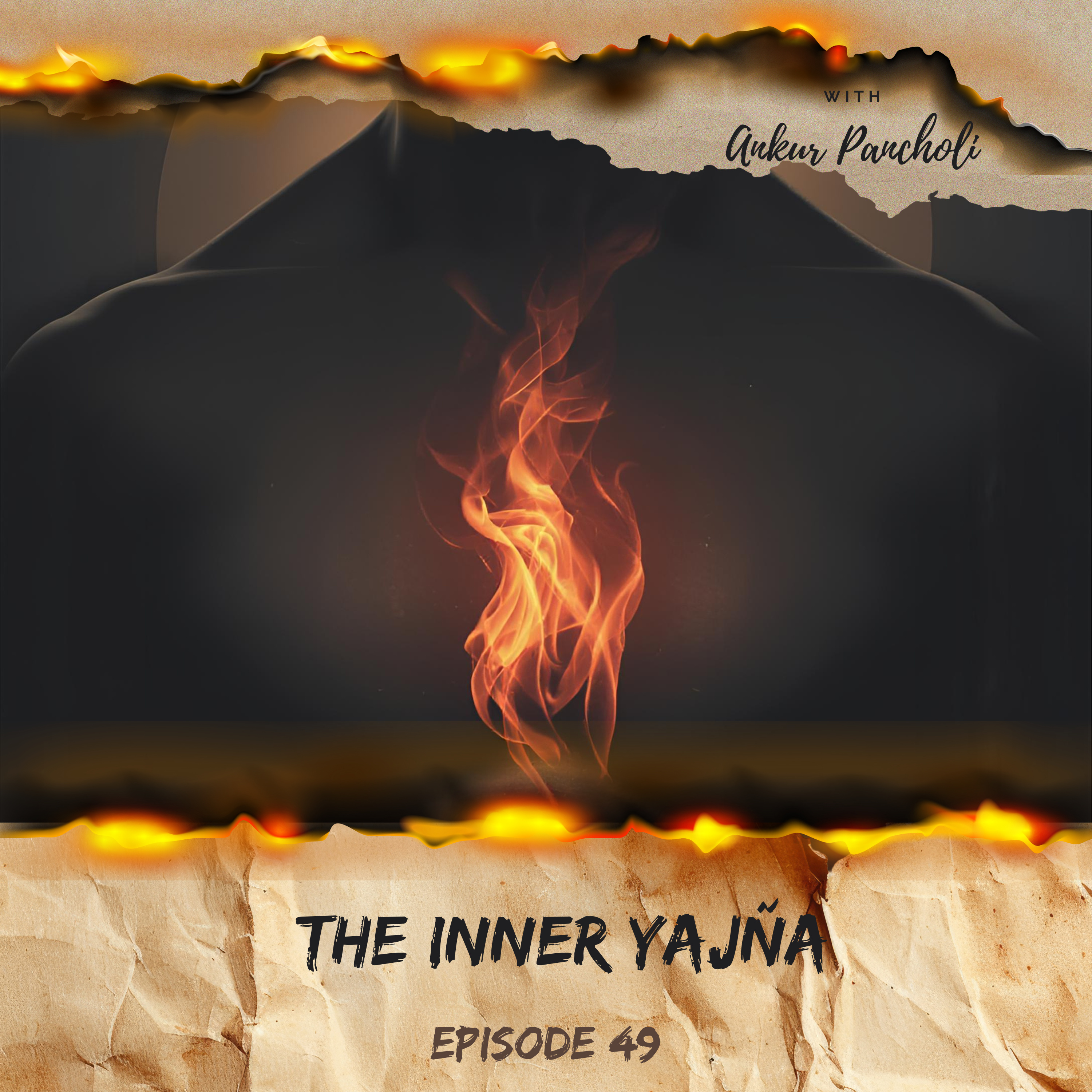
Episode 49: The Inner Yajña — Mastering Your Senses Before They Master You | Bhagavad Gita Chapter 4 (27–28)
Tonight's Episode
Bhagavad Gita leadership wisdom turns inward and razor-fine in Episode 49 of Beyond the Battlefield, as Krishna reveals that the real battlefield is not outside — but within.
What if the most decisive wars are fought before action begins?
In Bhagavad Gita Chapter 4, Verses 27–28, Krishna makes a radical shift. Yajña is no longer about fire rituals or outer offerings. It becomes an inner sacrifice — where senses, reactions, and impulses themselves are offered into awareness.
Jessica opens the episode with a quiet but unsettling observation:
Most leaders don’t fail because they lack intelligence — they fail because reaction arrives before awareness.
As Ankur unpacks these verses, a subtle architecture of the mind is revealed:
• reaction happens faster than thought
• senses hijack decisions before intention forms
• discipline without awareness becomes brittle
• awareness without discipline becomes drift
Through a cinematic conversation — and Vik’s evolving journey — the episode exposes why smart, experienced leaders still make reactive choices. Not from weakness, but from unexamined sensory momentum.
Krishna’s teaching is neither suppression nor control through force.
It is mastery through understanding.
Verse 27 shows the first offering:
the senses — sight, sound, taste, touch — placed into the fire of awareness.
Verse 28 deepens it:
impulses, habits, and overstimulation themselves become the sacrifice.
The Bhagavad Gita delivers a leadership insight as practical as it is profound:
you cannot control what you have not first observed.
Modern parallels sharpen the relevance:
• leaders overstimulated by dashboards, alerts, opinions
• founders reacting to pressure instead of responding from clarity
• professionals exhausted by constant sensory input
• teams burning out not from work — but from unfiltered reaction
Episode 49 shows how inner yajña works in practice:
• distraction is not fought — it is understood
• impulse is not crushed — it is seen
• awareness becomes the fire that burns without violence
The core realization lands softly, unmistakably:
when awareness arrives first,
reaction loses its grip.
This is not philosophy for withdrawal.
This is psychology for decisive, conscious leadership.
For leaders wondering why focus collapses despite knowledge…
for professionals caught in impulse-driven decisions…
for anyone sensing that burnout begins before action…
This episode delivers one of the Bhagavad Gita’s most liberating truths:
You don’t act differently because you try harder —
you act differently because you notice earlier.
🎙️ Beyond the Battlefield is a cinematic leadership podcast that decodes the Bhagavad Gita as a human operating manual — practical, psychological, and deeply relevant in the AI age.
🤖 BYB Interactive-GPT Companion
Explore inner yajña, sense-mastery, reaction vs response, and how Bhagavad Gita wisdom transforms modern leadership:
https://chatgpt.com/g/g-6845186212588191ae7aa9e327bebc9a-byb-interactive
📩 Write to us: [email protected]
🔔 Share, subscribe, and continue the journey — because once awareness shifts, action follows.
Last time, Victoria realized something quietly unsettling. That yagna is not only about what you give up, but about what you offer moment to moment. And once that insight lands, you start seeing people differently. Welcome to Beyond the Battlefield, and today's episode continues Victoria's journey not through his actions, but through what he begins to notice. In the previous episode, Yaznya moved inward from outer fire to the senses themselves. So if the senses can be offered, hotels can be. And that question follows Victoria into the world, into meetings, into conversations, and into people he begins to notice for the first time.
And now Krishna moves deeper still, from outer action to how we respond to the world. Listen carefully. Some seekers offer all the actions of their senses and even the movements of breath into the fire of self-discipline, a fire illumined by knowledge. This verse is not about action outside. It is about your reaction inside. What happens the moment the world touches you? Imagine someone sitting quietly at home. Suddenly a smell comes from the kitchen. The eyes haven't moved yet. The feet are still resting, but the mind reacts.
The nose receives the stimulus. The mind says, I remember this. The intellect says I like this. And immediately the organs of action are activated. The feet start moving. The hand reaches for the spoon. So the action didn't begin in the kitchen, it began the moment the stimulus was accepted. This is what Krishna is addressing. He says the offering is not the food. The offering is the sense itself. It does not mean harming the senses. It does not mean closing your eyes forever. It means restraining the senses by blocking unnecessary stimulation.
In the beginning, this restraint happens through willpower. You deliberately choose what you see, what you listen to, what you consume. But willpower alone is not enough. So Krishna adds, illumined by knowledge, you must understand why you are restraining. As knowledge grows, something beautiful happens. The senses stop pulling you. This is called pratyahara. Not suppression, but freedom from temptation. And Victoria notices this too. The fewer distractions he feeds, the quieter his decisions become.
Today just notice 1 stimulus and ask do I really need to respond? Victoria doesn't step into the story today, he steps back and starts watching what unchecked living actually does to people. Victoria overheard Kabir his keen at his work. My day never really ends. Even when I'm home, my mind keeps scrolling. News, messages, Opinions. His eyes never rest, his ears never rest, and slowly, neither does his mind. I thought I was tired because of work, but that wasn't it. I was tired because of input.
He didn't quit his job, he didn't escape life. He just stopped feeding every stimulus. You don't need to control the world, just control what you let in.
And Victoria notices something unsettling. Kabir didn't fail because he was weak, he failed because no one ever taught him where to place his senses.
Up to now, Krishna has been helping us see how reactions are born, how senses pull the mind, and how awareness creates space. And now he widens the lens. Some people offer material resources, some offer disciplined effort and austerity, some offer yogic practice, and some offer study and understanding. All of them are sincere. All of them are committed. This verse is often misunderstood. People think Krishna is listing spiritual techniques. He's not. What he's actually describing is how different people respond to life.
So Krishna isn't telling Arjuna what to do, he's explaining why people act so differently even when they're sincere. Life gives the same stimulus, but the response varies. Verse 28 is not about ritual, it's about response. Life touches you a demand, a crisis, a responsibility, a need, and something from you moves back toward life. That movement is Yajna. This is where Kabir's story moves forward, not sideways. He sat in his car, engine off, phone still in his hand. He had just finished a long meeting.
2 problems, 1 limited budget, multiple expectations. Earlier in his career he would have reacted instantly. Now he noticed the pause. Everyone is asking something, but how I respond will decide the tone. He noticed 3 impulses arise, not theories, but real tendencies. Yagya 1. Dravya Yagya Kabir sees giving. One team needed resources, time, money, visibility. His instinct was to give quickly. Some people respond to life by giving. When responsibility comes, their natural response is dravya yagnya, offering resources.
But Krishna adds something important. If giving inflates the eye, it stops being yagnya.
Yagya 2 Yoga Yagya Discipline and restraint.
Another impulse rose. Structure rules. Discipline. Kabir knew this mode well. Tighten the process, bring order, reduce noise. Yoga yajna's response through discipline, through restraint, alignment, integration. But without surrender, discipline becomes rigidity. Kabir saw it clearly. Now discipline could heal or quietly suffocate.
Yagya 3. Gyan Yagya Understanding.
The third impulse was subtler. Understand the system, see what's really happening. This was enquiry, listening, learning. Some people respond through knowing, through study, reflection, understanding. But Krishna draws a boundary here. Knowledge that feeds superiority is not yajnya. He didn't choose a yajnya, He noticed something deeper. Each response was valid if it wasn't owned by ego. This is what Krishna is freeing us from. Comparison. No one path is higher. No one response is superior. What matters is whether the response is offered or claimed.
So verse 28 isn't asking us to copy someone else's path, it's asking us to respond honestly, without pretending, without performing. When the eye steps aside, response becomes sacred. You don't need to change your life, you just need to notice how you respond. Do you give? Do you discipline? Do you inquire? Let that response be clean and life itself becomes yajna.
Response, not action. Today Krishna didn't ask us to become someone new. He asked us to look more closely at what we're already doing, not for effect but for honesty. Verse 27 showed us how life enters through the senses and how awareness can soften our reactions. And verse 28 reminded us of something deeply human, that there isn't one sacred response to life. Some of us respond by giving, some by discipline, some by inquiry. What matters is not the form of the response, but whether it's offered or owned.
When ego steps aside, even ordinary responses become meaningful. A brief breath. And perhaps that's the real relief in Krishna's teaching. You don't have to imitate anyone else's path. You just have to respond honestly. In the next episode, Krishna takes this one step further. He speaks about action that looks right on the surface but feels empty inside, and why faith, not effort, becomes the turning point. Thank you for listening to Beyond the Battlefield. If today's episode helped you notice your own responses, share it with someone who might be carrying quiet pressure.
Subscribe, leave a review, and write to us at Beyond Thebattlefield at Outlook dot in and don't forget to explore the GPT companion link in the description. Until next time, stay aware, stay honest, and let life itself become your teacher.
 Apple Podcasts
 Castbox
 Castro
 Goodpods
 Moon FM
 Overcast
 Pocket Casts
 Podbean
 Podcast Addict
 Podcast Republic
 Spotify