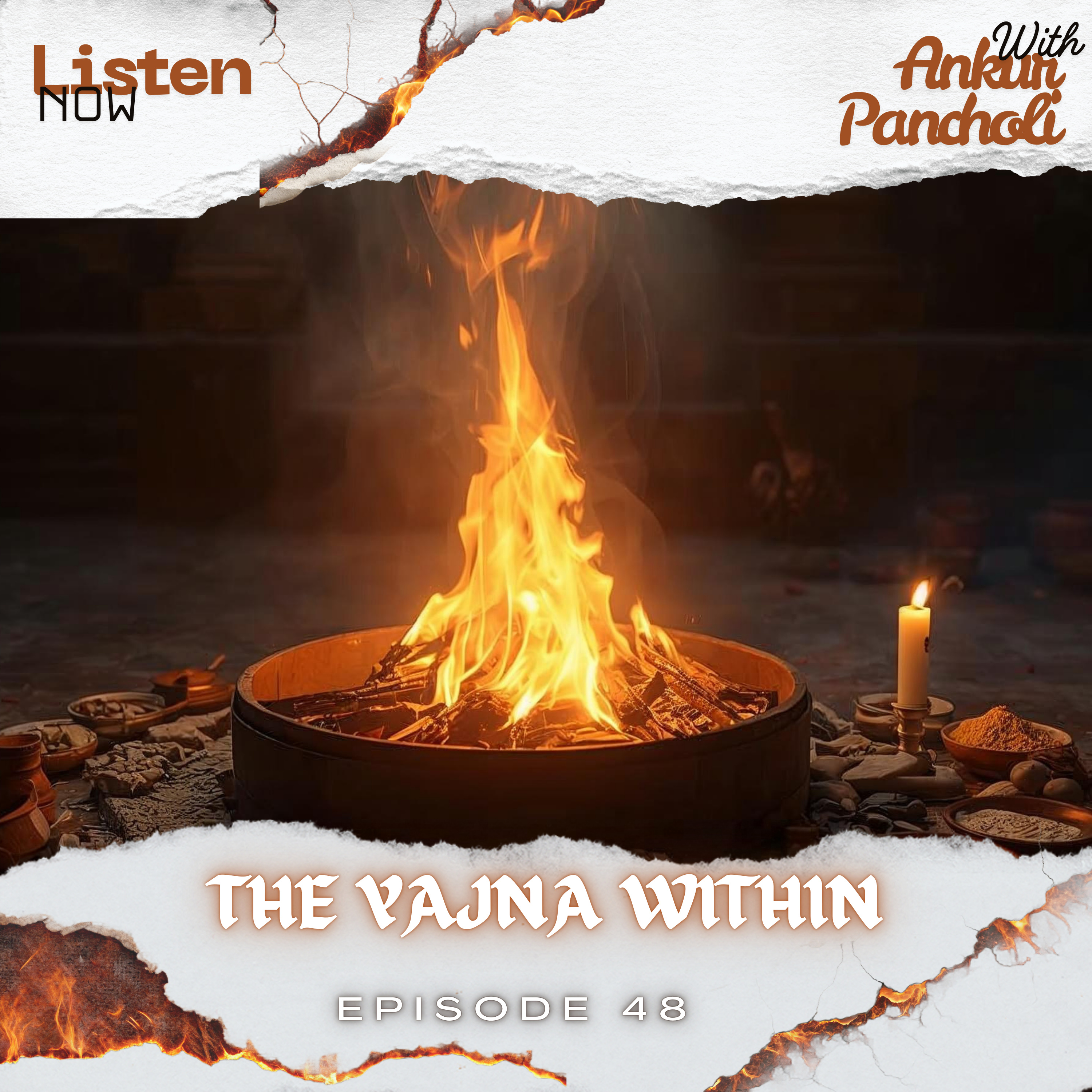
Episode 48 — Yajna Within: The Gita’s Forgotten Science of Inner Sacrifice(Bhagavad Gita 4.25-26)
Tonight's Episode
Bhagavad Gita leadership wisdom turns inward and incandescent in Episode 48 of Beyond the Battlefield, as Krishna reveals the forgotten science of Yajna — not as ritual fire, but as inner transformation.
What if Yajna was never about ghee, grain, or flames?
What if the real offering was you?
In this episode, Jessica and Ankur journey into one of the most misunderstood teachings of the Bhagavad Gita — where Krishna reframes sacrifice as a radical inner discipline, not a religious ceremony.
Moving beyond fire altars and symbolism, Episode 48 explores how desire, impulse, fear, and ego themselves become offerings — burned in the fire of awareness.
Jessica opens with a quiet provocation:
What if nothing outside needs to be given up… but something inside must be?
As Ankur unpacks Krishna’s teaching, two distinct paths of Yajna come alive:
• Devayajna — outer ritual that disciplines action and intention
• Brahmayajna — inner sacrifice where identity itself is offered
One trains behavior.
The other dissolves the doer.
Through cinematic dialogue and modern leadership parallels, the episode asks piercing questions:
• What does it mean to offer the doer instead of the deed?
• How do the senses become gateways to liberation instead of bondage?
• Why does inner sacrifice complete what outer action begins?
Krishna’s insight is unsettling and liberating:
action alone does not free —
but action offered inwardly does.
Modern parallels sharpen the relevance:
• leaders exhausted by constant striving
• founders trapped in identity-driven ambition
• professionals disciplined outwardly but restless inwardly
• teams acting efficiently yet lacking inner clarity
Episode 48 shows how conscious action, when offered as Yajna, transforms:
• pressure into presence
• effort into equanimity
• work into inner freedom
This is not spirituality for withdrawal.
This is Yajna for life, leadership, and the modern battlefield.
The core realization lands like firelight in silence:
when the ego is offered,
nothing else needs to be sacrificed.
For leaders seeking mastery without burnout…
for seekers wanting action without bondage…
for anyone ready to step into the inner fire…
This episode delivers one of the Bhagavad Gita’s most transformative truths:
Freedom begins when the offering turns inward.
🔥 Step into the fire…
and discover what must truly be offered.
🤖 BYB Interactive-GPT Companion
Explore Yajna, inner sacrifice, Karma Yoga, and how Bhagavad Gita wisdom reshapes leadership and self-mastery:
https://chatgpt.com/g/g-6845186212588191ae7aa9e327bebc9a-byb-interactive
📩 Write to us: [email protected]
🔔 Share, subscribe, and continue the journey — because leadership matures when the fire burns within.
Fire has always fascinated us. How it glows, how it dances, how it transforms, whatever it touches. But in the ancient world, fire wasn't just heat and light. It was a metaphor for interchange. A spoon of ghee, a handful of grain, a silent offering into the flames. Simple gestures that symbolized something far more profound. The act of letting go. The act of surrender. The act of burning the eye. And whether we know it or not, we do this every single day, sometimes consciously, most times unconsciously.
And in today's episode, Krishna takes Arjuna and us to the next layer of this mystery. After showing the outer yajna and the yajna of ego, he turns our gaze inward to a fire that burns every moment of our lives. The yajna of the senses. Because the senses don't just bring information, they trigger reactions. What you see, what you hear, what you taste, what you smell, what you feel. Every stimulus can become a gateway to bondage or a gateway to liberation. Tonight we explore verse 25 and verse 26, two of the most subtle, most transformative teachings on how to offer not just objects, but reactions, impulses, and desires into the fire of awareness.
Welcome to episode 48 of Beyond the Battlefield. Today's battlefield isn't outside you. It's the one between impulse and awareness. Let's step into the. Fire.
Before Krishna speaks of the highest Yagnas, he takes Arjuna back to something ancient, older than kingdoms, older than temples, older than even the stories of gods. A fire. A simple fire around which a community gathered. People brought whatever they had A spoon of ghee, a fist of wheat, a pinch of flour, a small wooden stick. No one looked at the size of another's offering. No one measured devotion. No one kept score because the truth everyone understood was simple. It is not the amount you offer.
It is the you inside the offering. And that truth hasn't changed. Only the fires around us have. And when the offering touched the flame, the fire leapt upward, dancing for a moment, as if saying, I receive your gift. Stay with this for a moment. But here's the secret, the part that history forgot. The ghee and the grain were never meant literally. There were symbols. Symbols pointing towards something we must eventually offer from the inside. Yet over centuries, people fell in love with the symbol and forgot the meaning.
And so Krishna, seeing Arjuna lost in his own ocean of confusion, reopens the meaning of Yagnia with one of the most layered verses in the Gita. And with that understanding in place, Krishna finally gives Arjuna the language for something humans were already living but not yet seeing clearly. Some yogis worship through outer offerings, dev Yagya, Others perform the highest yagya, Brahma Yagya, by offering Yagya itself into the fire of Brahman. So outer yagna is the ritual, the ghee, the grain. Yes, but deeper outer yagna, the training ground, the ritual teaches.
4 things. One, let go. When you release ghee into fire, you practice releasing attachment. Two, serve without counting people to give, without comparing, without ego, keeping score. Three, shift from possessiveness to participation. You don't guard your ghee, you share it. 4 Create inner readiness. Outer ritual warms the soil so inner transformation can take root. But the rishis knew the danger. If people forget the inner meaning, the ritual becomes empty. People start believing that God actually needs ghee, grain, fire.
The symbol becomes the reality. And so Krishna gently reclaims the truth. The Jnani performs the yajna differently. He does not offer objects. He offers the one who clings to objects. He does not offer ghee, He offers greed. He does not offer grain. He offers fear. He does not offer a flower. He offers the identity that needs applause for offering the flower.
So the real Yagna is burning the eye. Yes, offering the ego into the fire of awareness. In this Yajna, the offering is Brahman, The fire is Brahman, the ACT is Brahman. The one who offers dissolves into Brahman. This is Brahma Yaji, the yajna of wisdom. But why does Krishna talk about both? Why not jump straight to the highest? Because both are necessary. Outer yajna trains your habits. Inner yajna transforms your identity. Outer yajna disciplines your actions. Inner yajna dissolves your attachment.
Outer yajna purifies your life. Inner yagna purifies yourself. Outer yagna helps you give what you have. Inner Yagna helps you give what you are. So outer Yagna is the journey, Inna Yagna is the destination. Exactly. Krishna is offering Arjuna the full map, from ritual to realization, from symbol to truth, from offering objects to offering the ego. HR had organized something called the Unity Circle. It wasn't a crisis meeting. It wasn't a blame room. It wasn't politics. It was a space where leaders brought their presence, honesty, care, and clarity into a shared fire of conversation.
Everyone came with something to offer, just like villagers once carried ghee and wheat to the sacred flame. Mira shared an observation about how teams were feeling overwhelmed not to accuse, but to help Victoria see the emotional temperature. Rihanna offered data not as ammunition but as insight, a contribution to the collective understanding. An older manager, Arvind, offered a story from 10 years ago when he faced similar structural resistance. His offering was experience given without ego. A younger team lead offered a question, the kind of pure, curious question that can only come from a sincere heart.
This was outer yajna, everyone bringing what they had. Not perfect, not polished, but offered with sincerity. No one compared offerings, No one asked who gave more. No one tried to shine. It was the modern equivalent of ghee, wheat and grain placed into the shared fire of understanding. The symbolic outer yajna was working. It was training, maturity, humility, listening and non possessiveness. But something more profound was happening inside Victoria. While people were offering their insights, their clarities, their concerns, their lessons, Victoria felt a very different offering rising inside him.
His inner doubter whispered. Defend your decision. Fix the misunderstandings. Prove you're right. But deeper than that, another voice emerged. This is not the fire to throw explanations into. Offer the ego that wants. To be seen as right. And Victoria realized something vital. The Unity circle was not a threat. It was his outer yajna, A symbolic fire to practice presence, humility and listening. But inside him was another fire, a quieter but stronger flame. The fire that burns defensiveness, image making, and the need for personal validation.
This was inner yajna, the real offering. Outer yezhna equals learning to participate without ego. Inner yezhna equals offering the ego itself. And for the first time that week, Victoria felt both fires working together. He listened. He didn't interrupt. He didn't try to control the room. He didn't collapse either. He simply showed up with the best offering any leader can bring, quiet, steady eye that is willing to melt.
And there is the teaching of verse 25. You can offer ghee, or you can offer the one who clings to the ghee. You can offer grain, or you can offer the fear that keeps you guarded. You can offer rituals, or you can offer the ego that demands applause for doing the ritual. 1 Yagna purifies your life, the other purifies you, and both are needed.
Now Krishna takes Arjuna deeper into the yagnya of the senses. Up to now we saw yagnya of offerings, yagnya of ego, yagnya of identity. But in verse 26, Krishna shows the yagnya that happens every second as life touches your senses. Some offer the senses themselves into the fire of restraint, Others offer the objects of the senses into the fire of the senses. Two yagnyas, again like in the previous verse. Yes, but now at a much finer and subtle level. Think of the senses as 5 gateways through which the world enters you.
Sight, sound, smell, taste, touch. Normally we leave as if these gateways are automatic, uncontrolled, demanding. But Krishna says each sense can become a fire of purification.
There are two approaches, Hut yog and bhakti yog. First Hut yog, the path of restraint. Here you offer your senses themselves into restraint, meaning you don't let the eyes wander everywhere, you don't let the ears chase every sound, you don't let the tongue chase taste, You don't let touch demand comfort. It's discipline, like shutting the door and saying no, not now. This feels hard, like a tight discipline. It is hard. If you slam the brakes on a bicycle, you may fall, but yoga is like that, powerful but risky.
2nd bhakti yog sublimating the senses. The second approach is softer. Instead of rejecting the senses, you redirect them. Whatever you see, you practice seeing the divine behind it. Whatever you hear, you listen for the sacred rhythm in sound. Whatever you taste, you taste with gratitude. Whatever you touch, you feel consciously. Whatever you smell, you experience fully. So the senses stop being trapped and become teachers. Yes, let me give a very simple example. A child who loves doughnuts passes by a doughnut shop.
His eyes light up at the pink frosting. His nose smells sugar. His tongue remembers the taste. His mind says last time. That was amazing. His hands reach out instinctively. The senses send signals. The organs of action respond. This is how desire works. Now if the child suppresses this entirely, he suffers internally, that is, forced restraint, the hatha yoghbad. But if he learns to see the doughnut, smell it, taste it internally, feel the desire and stay centered, then the desire burns gently in awareness.
So the offering is not the doughnut, but the impulse itself. Yes, the impulse becomes the ahuti. This happens to us every day. You see luxury online. Desire rises. Notice it. Offer the desire. Someone speaks harshly, the sound hurts. Offer the sting. A hospital smell triggers memories. Offer the fear. Stress leaves a bitter taste. Offer the tension. An uncomfortable space makes the body contract. Offer the contraction.
And as. Krishna revealed this yagnia of the senses far away from Kurukshetra in a very modern battlefield. Someone else was learning the same lesson, Victoria. He didn't know verse 26 by name, but life was teaching him the same yagnia Krishna was describing. It was late afternoon. The room felt heavy, the kind of heaviness that does not come from workload but from unspoken tension. Victoria had stepped into a cross functional alignment review, a meeting he already sensed would be difficult, And then the senses awakened, hearing the first fire.
Victoria, we need to understand why your restructure created so many downstream escalations. The tone wasn't respectful, it wasn't gentle. It hit the ear like a spark on dry grass. Reaction rising, a sting, a tightening of the jaw, the urge to defend. Victoria inhaled quietly. He let the sting rise and offered it into awareness before it became words. The ears became a yagna now sight. The second fire, a slide appeared on screen. A large red box highlighted his key decision with the caption Structural vulnerability introduced here.
That image felt like a verdict. Reaction, rising heat in the chest, embarrassment, irritation, a pinch of self doubt. He saw the slide fully, no denial, no collapse, and let the visual trigger melt. In the fire of restraint. The eyes became a yajna. Next, smell. The third fire, a burnt smell of stale coffee drifted in. It carried exhaustion. He hadn't eaten lunch. He hadn't rested. Reaction rising. Fatigue, irritation, mental fog. He noticed the smell, noticed the pull toward frustration, and allowed it to dissolve gently.
The nose became a yagna. Then comes taste, the 4th fire. Stress climbed up as a metallic taste spread across his tongue. Reaction rising, a surge of anxiety, the body's quiet alarm. He recognized the taste as emotion, not prophecy. He let it pass through awareness like smoke rising from incense. The tongue became a yagna. And finally, touch the 5th fire. His palms were warm, the fingers trembled slightly, his heartbeat thudded, not violently, but insistently. Reaction rising, fight, flight, impulse, urge to react, urge to regain control.
He placed his hands together gently, felt the warmth, felt the tremor, offered the sensation into inner stillness. The skin became a yagnya, and in those few minutes Victoria unknowingly performed both yagnyas. Krishna described path 1. Hatha yog, restraint. He restrained impulses, letting reactions burn in awareness instead of turning into words or actions. Pay 2 Bhakti Yog Sublimation He allowed each sensory experience to be seen, heard, tasted, felt, without attachment or avoidance. He didn't suppress the senses, he didn't indulge them.
He offered them. A quiet strength emerged inside him, not the strength of dominance, but the strength of presence. He was in a meeting, but also in a yagna. This is exactly what Krishna means. You don't need a sacred fire for this Yagya. You only need the space between 1 impulse and your next reaction. If you can see, hear, smell, taste, touch with awareness instead of attachment, you've already begun burning the inner noise that clouds your clarity. That is the yagya of the senses. And sometimes that yagya happens in the middle of a meeting with fluorescent lights and burnt coffee in the air.
It begins with a flame outside you in a simple ritual where ghee melts and grain disappears. But as Krishna reveals, the real yagnya is the flame within. When you offer a reaction instead of expressing it, that is yagnya. When you offer desire instead of chasing it, that is yagnya. When you offer fear instead of hiding it, that is yagnya. Your senses become doorways, your awareness becomes the altar, and every moment of your life becomes a chance to burn a little noise and uncover a little clarity.
And as we saw in Victoria's experience today, even a meeting room with bright screens and burnt coffee in the air can become a temple when you bring awareness to what is happening inside you. In the next episode, we continue this journey into the inner fire, Krishna's teaching on prana control, and the deeper yugness that shape your leadership and your life. Until then, keep noticing, keep offering, keep refining. You are the altar, you are the offering, and you are the one who watches the flame.
Thank you for listening to Beyond the Battlefield. If this episode touched you, please share it. Subscribe and write to us at Beyond the Battlefield at Outlook in. And don't forget, your GPT companion link is in the description to help you explore all the verses we've reflected on today. See you next time inside the fire.
 Apple Podcasts
 Castbox
 Castro
 Goodpods
 Moon FM
 Overcast
 Pocket Casts
 Podbean
 Podcast Addict
 Podcast Republic
 Spotify