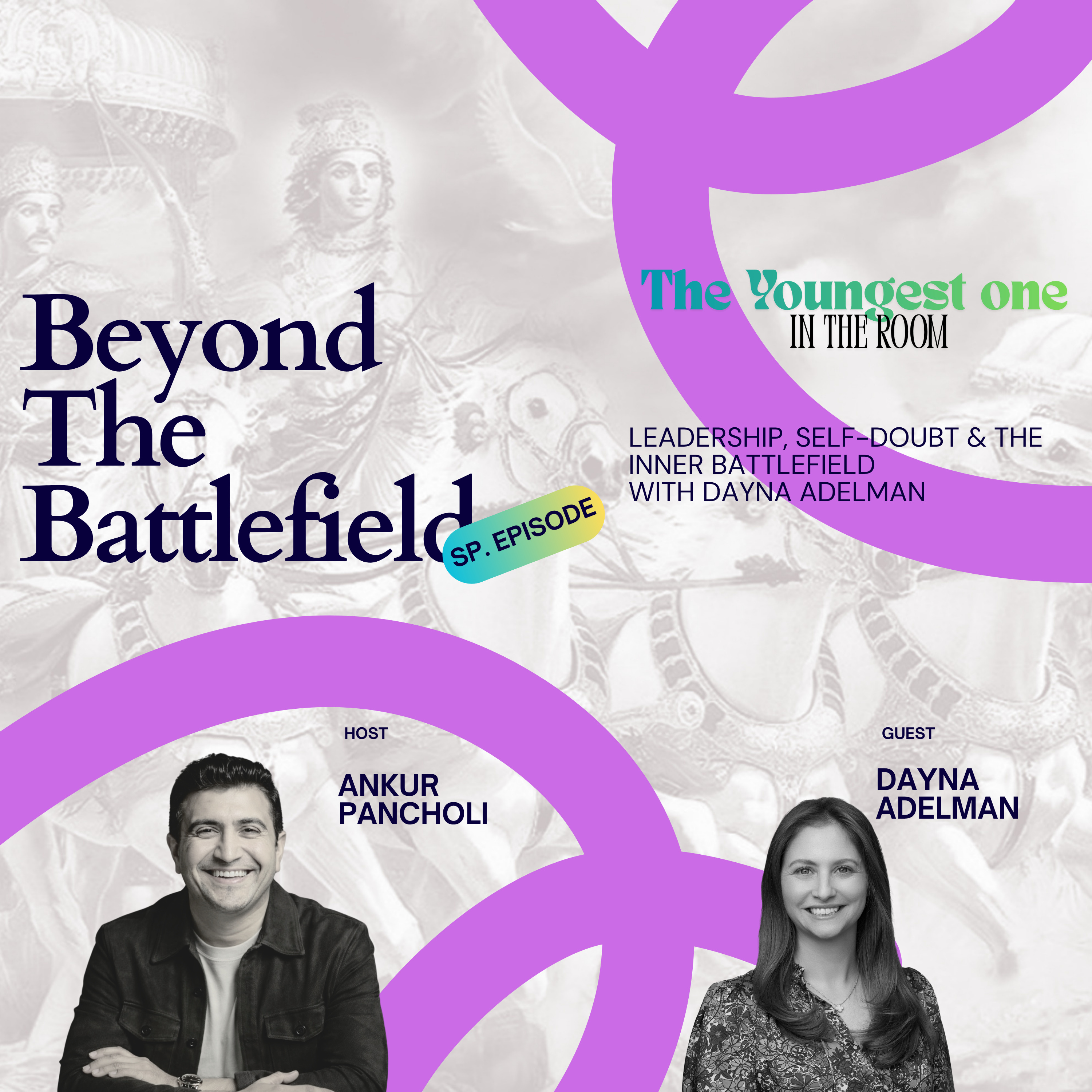
The Youngest one in The Room l Leadership, Self-Doubt & the Inner Battlefield with Dayna Adelman
Tonight's Episode
Why does the Bhagavad Gita still resonate so deeply with modern leadership? Why does the Bhagavad Gita feel more relevant than ever in today’s boardrooms, startups, and leadership conversations? In this powerful episode of Beyond the Battlefield, we explore how the wisdom of the Bhagavad Gita mirrors the invisible emotional struggles leaders face today. Through the lens of the Bhagavad Gita, this conversation unpacks self-doubt, burnout, ego, vulnerability, emotional overload, and authentic leadership. The timeless teachings of the Bhagavad Gita reveal why the greatest battlefield is often internal — hidden beneath performance, confidence, and success.
In this deeply reflective conversation, Ankur Pancholi sits down with Dayna Adelman — global corporate affairs leader, storyteller, and author of The Youngest One in the Room — to discuss the pressure leaders silently carry every day.
What happens when capable people walk into boardrooms while internally questioning themselves?
Why do so many leaders feel emotionally exhausted while trying to appear composed, intelligent, and in control?
And in an era of AI, automation, comparison culture, and constant pressure… how do we remain deeply human?
Drawing parallels between Arjuna’s breakdown on the battlefield of कुरुक्षेत्र and the realities of modern corporate life, this episode explores vulnerability, burnout, women in leadership, reverse mentorship, emotional intelligence, self-awareness, psychological safety, attachment to outcomes, and the courage to say:
“I don’t know.”
Dayna shares honest reflections from her own journey of being the youngest — and often the only woman — in leadership rooms across multiple countries and cultures. Together, Ankur and Dayna unpack why true leadership is not about controlling people or performing confidence… but helping others rise while remaining authentic to yourself.
The conversation also explores leadership in the AI era — why intelligence alone is not wisdom, why awareness matters more than information, and why human consciousness, discernment, and empathy will remain irreplaceable in the future.
If you’ve ever:
• struggled with self-doubt while leading,
• felt emotionally overwhelmed despite external success,
• questioned your place in the room,
• or tried to stay authentic in a high-pressure world…
this episode will deeply resonate with you.
Because the battlefield is never only outside…
…it is always inside.
#BhagavadGita #Leadership #AuthenticLeadership #Burnout #SelfAwareness #WomenInLeadership #AILeadership #EmotionalIntelligence #BeyondTheBattlefield #ModernLead
Write to us: [email protected]
🤖 Explore the Beyond the Battlefield Companion GPT:
https://chatgpt.com/g/g-6845186212588191ae7aa9e327bebc9a-beyond-the-battlefield-assistant?utm_source=chatgpt.com
https://www.linkedin.com/in/ahpancholi?utm_source=share_via&utm_content=profile&utm_medium=member_ios
https://www.instagram.com/beyondthebattlefield.gita?igsh=YW4xZzllYmtmdjIy&utm_source=qr
https://www.linkedin.com/in/dayna-adelman-8887a118?utm_source=share_via&utm_content=profile&utm_medium=member_ios
https://www.instagram.com/dayna__adelman_writes?igsh=MXVyZG05bjNpdml5bQ==
What if the biggest battle in leadership is completely invisible? Not the market, not the competition, not the economy, but the quiet voice inside asking, Do I really belong here? How many people today walk into board rooms, conference rooms, leadership meetings while silently carrying self doubt? They look confident externally, but internally their mind is noisy. Fear of saying the wrong thing. Fear of not knowing enough. Fear of being exposed as the youngest, the newest or the least experienced person in the room.
And that is exactly why the Bhagavad Gita still feels deeply relevant today. Because 5000 years ago, on the battlefield of Kurukshetra, an undefeated warrior suddenly lost trust in himself. Arjuna had never lost a battle, but standing between two armies, he froze. He looked at Krishna, his mentor, his guide, and said, I cannot fight. And what is extraordinary is that Krishna does not shame him for breaking down. He does not ask him to pretend. He does not ask him to perform strength. Instead, the wisdom of the Bhagavad Gita begins the moment a leader admits, I don't know.
And maybe that is exactly what modern leadership needs today, because somewhere along the way, leadership became performance. A performance of certainty, a performance of confidence, a performance of emotional control. But beneath that performance, many leaders feel exhausted, disconnected, and alone. And joining us today is Dana Adelman, A storyteller, global corporate affairs professional, and author of The Youngest One in the Room. Dana has spent much of her career as the youngest and sometimes the only woman in the room.
She has lived and worked across four countries and three continents navigating pressure, self doubt, leadership, burnout, and the journey of finding her authentic voice. So today we explore vulnerability, burnout, ego, self-awareness, AI, authentic leadership, and the invisible pressure leaders silently carry every day. Because the battlefield is never only outside. It is always inside. Welcome to Beyond the Battlefield. Welcome to Beyond the Battlefield and thank you very much for joining us today.
I I'll just give a context of what we do with this podcast and it will help both of us to take the conversation forward. So Bhagavad Gita was spoken 5000 years back on a ground of a battlefield where between two armies, one of the warrior who has faced countless battles and he has lost none of them, has stopped trusting himself and froze in between the armies. And he asked his charioter. He was his mentor, his friend who choose to become a charioter. And there is a story behind it. We will talk sometime.
But he asked his charioter that I can't fight. And at this time his mind has become noisy externally, nobody can even fully see the battle what is happening inside him. And that that's what, you know, sparked an idea in my mind that that is every day every one of us are going through such kind of battle. And many time I talk to my team within my group, my family that today we are afraid of sending 1 e-mail. Similar way this warrior was not ready to shoot 1 arrow where he has won. He has not lost a single battle in his lifetime.
And this remind me and very beautiful title of your book, The young one, younger one in the room. So when we walk into an impounded boardroom or conference room, people expect certainty, confidence, clarity. But internally, there may still be a doubt, Pressure, fear of not being enough, right? And sometimes we often enter into the room as as as the new. One, I've seen a lot of young leader getting into the conference room. So have you experienced that gap between an external expectation versus your internal reality?
Absolutely. And I think, as you pointed out, it's one of the most natural feelings, especially when you're first entering those rooms early on in your career, there can be a lot of self doubt. Why am I here? What can I contribute? I don't want to say the wrong thing. I don't want to say something stupid. This cycle of thought in your mind can just flow and flow and flow. But upon reflection, there is a reason why you've been invited to be in that room. And I think once you understand and accept that, there's a lot of power that gets unlocked in that notion.
Your role as the most junior person might be there to take notes, and that's totally fine. You might be there to drive part of the conversation, to give a presentation. If you can figure out why you've been invited to the room. That then changes the mindset and shifts from that internal struggle of why am I here? What do I have to offer? How can I contribute to this is my role. This is why I've been invited. I've earned a spot here. I I've been invited is the keyword. I'm wanted here and I'm going to show up and be my best self and operate from that place of confidence as the best as I can at this level in my career because someone wanted me here.
When it comes to. Inner battle, right? And when I say inner battle, there are multiple things going on in the never mind. And what excited me about Bhagavad Gita is not only this is just an opening of the scripture where there's such a context and there is a big story. If you have heard about Mahabharata, this is just a part of a Mahabharata beginning of the Mahabharata battle and. What happens is you know when you are into those. New rooms. When I say new room there are multiple things we can talk about where you have been trying first time and most of the time.
As a young leader we try to appear as strong but many times if we keep on trying. Appear as a strong it become exhausting and that's what was happening in this battlefield as well. Arjun who was the warrior, he keep on giving an excuse and logical reasons. But he should not fight. And today I always say that today you and me will agree to those reasons. And if you read the book you will say till the Krishna comes and speak, speak UPS. We will agree that he should not fight. Now in many corporate environment today leader feels similar pressure to always look compost intelligent, confident and emotionally in control and.
Overtime, what happens is you know that leadership itself start. Becoming a performance and you know, appearing as confident, appearing as compose, appearing as a leader, everything in I'm controlling every emotion that start becoming performance so. If if you've seen those kind of leader, have you seen that, you know, slowly disconnected from themselves because they spent too much energy in managing perception or this is something of style which we need? Today, Yeah, I think it's a really interesting point.
And I've seen a progression in my career from leaders, how they thought they were supposed to show up versus what actually makes an effective leader. And having humility, having vulnerability are such important qualities and traits. And in my early career days, I maybe could have been fooled by some leaders who were always acting or in that, you know, presentation mode. But now I can tell right away when a leader is just, you know, playing the part instead of actually being the part and you and then you start to see right through and then there's a breakdown in trust.
If you're unwilling to be vulnerable, how can I trust that you actually know what you're doing? So I think to answer your question, yes, I've seen all different types of leaders. And in today's world, I think it is super important for a leader to be able to say when they don't know something, whether it be a new technology that they just don't have experience with. Very few people today, maybe people are dabbling with AI and the tools, right? But there are very few people who I work with who are in my industry who are experts.
It's so new. How can you be? And it's always evolving and changing. So I'm just using this as an example. If a leader were to get up there and claim they know everything about the tools really, you know, and, and then all of a sudden everything else that comes out of their mouth is do I believe that? Do I trust this person? So I think vulnerability is a huge part in being a strong leader today. And I think it is obvious when when you're not being vulnerable
and and when you say that, you know, many leader come up and say that I don't know this, that's not wrong. And in the. True. Teaching of this Bhagavad Gita starts when Arjun comes up and say that I'm surrendering it to you, I can't fight, I don't know and please help. And that is something as a leader, we we should learn to and, and, and I we we say that reverse mentorship a lot of. Young generation now join say someone with 2025 years of experience should not shy away to learn from those people as well.
They bring out a lot of new understanding, new perspective. The young generations, young leaders perspective is different than what you and me had or maybe our leaders have today. So so accepting that I don't know is. Something which you know very important to understand and that's where the everything Start learning starts. The. Beginning of learning start. When I say I don't know. If I say that I know everything, that's a certain ego I'm carrying with me. This is making sure. That I'll not learn.
Yeah. And I think to add on a little bit further, the concept of team and teamwork is as old as the ancient scriptures say when they talk about, you know, the the army going to the battlefield. If the general was capable of defeating another army on his or her own, they wouldn't have a team. But that's not the way it is. You you go to the battlefield with a team, with an army, you go into the the boardroom with a team and everyone has a role. Everyone has a purpose. So more than ever, it is so important for leaders of today to recognize and help everyone rise in their role.
It's if you want to be an individual contributor that that's fine too, but then you shouldn't be in a corporate or or team environment. What I see that, you know, even an individual contributor is a leader. Leader doesn't mean you manage people. Leader means that how do you lead yourself first? And one of the concept what we discuss is not leadership, but followers. And in the scripture, it has been identified that when you are a leader, it doesn't mean in In a family you can be a leader. In a friend you can be a leader.
Leader doesn't mean that people follow you. Leader means that you understand your team. Listen, who is following you and they are what? Level and if you look at this learning, whole leadership learning, Krishna starts from this level. So basically deliveries. He doesn't underestimate Arjuna that he doesn't know anything and he. Started with a very friendly word at the time when you you know in a very harsh word, but you can only speak to your close friend. That's how he started learning. But slowly understand that this fellow is not getting what where I am.
So he comes down to the level where he is and he goes up to the bottom, up to the level where you know pretty the individual in this world can understand. So if if if people have gone through a complete 700 verses, they can understand that there is something for everyone, every individual to be successful in life. Yes, so so that's how I had also learned the leadership that it's not about that you can control many thing. It's about how you enable people to do everything right. So one of the thing which what you and me are doing, which we're discussing last time and that's what you know, excite me also about what you do like, like you said that you you create, you wrote a book and you you wrote a book.
So what I feel and I started this podcast and many times I was telling to someone in today morning that how it is going. I said that I don't know how it is going. It is it is happening to me. I've never thought that you and me are going to discuss today one year back, right. So the same way you also created a book. I don't think you are thought that at the beginning of the career you are. Going to do this and. No one thing which I want to understand and that's what everything what we discussed, we discuss about the inner battle.
We say that battlefield is never outside, it is always inside now. So help me, help me and everyone to understand what has transformed inside you when you started the book and completed. The book. Yeah. This is such a good question. And it's a conversation I I love to share because I think most people assume if you write a book, you had an intention to write a book. That was not the pace for me. The book started as a very deep series of personal reflections that I was doing with a coach over time.
And she was encouraging me to write down different stories from the first decade of my career. Sometimes it was about identifying what gave me energy, what drained my energy. And I was at a crossroads in my career where I was trying to figure out what do I really want next? So this was done as an explorative exercise for myself and that was it. And so I had a bunch. And I do love to write. I'm a communicator by nature. So I was having fun with this assignment. And little by little I started to think, you know, it's interesting.
People write memoirs, a professional career memoirs at the end of their career or when they've achieved a certain level of status, you know, maybe they're very well known in a certain community and they get a book deal and they tell their story. But I'm, I'm just a regular person who has lived human experience and I've learned along the way. And so I started thinking at one point maybe someone would enjoy reading this. I used to keep A blog when I lived overseas and I would get really positive feedback on the stories and, you know, people who who followed the experience.
And so I had this idea at some point in time to start to structure it as a book. And then I completely stepped away from that because going back to vulnerability, it's my personal story, you know, it's highs, lows, everything I've learned along the way. And to share that with the world, that's a very big and bold step to take. I didn't think I wanted to do that. I was worried about it. What if it's not well recepted? What if it limits career prospects down the road? So many things could potentially go wrong.
And over time, through some coaches and mentors and some close colleagues, there was a lot of encouragement. No, I really think people would like to read your story. People gravitate towards other human stories. And while my story is different from your story, there are elements and red threads that connect all of us because it is, it is human after all. And so I finally was talked into pursuing publication and I, I made my publisher wait quite a bit of time. I think it was 6 to 8 months where the, the offer was on the table.
And I said, you know what? I'm, I'm getting cold feet. I don't know if I want to do this, but it ended up being an incredible journey, first and foremost for myself because it was a self reflective, driven journey that brought a lot of clarity to my life and to how I wanted to lead my life moving forward. And then it's brought so much joy in in sharing it with other people. And if you want to read my story, it's in the book, right? It's there. But I think the best part of the experience now after publication has been hearing other people's stories and finding the commonalities and learning from other people.
And so that has been a completely unexpected but joyful part of this journey as well. I think I can resonate many things, what you are saying. And it is similar to what I did, but I had one learning which was I would say now it is very grounded into myself, but I wanted to experience that. So one of the learning is about attachment. And when we say attachment is that can you be committed while internally detached with the outcome. Now we talk about commitment into leadership multiple time and when you and me are on the job.
And we have a responsibility and we are committed to that. But ultimately we are looking at the outcome, correct outcome for myself, definitely there will be outcome for the organization and the team for we work. But in in a in a such somewhere there is an interest. Of individual as well individual as an eye. Right now that's. Where you know, I was. Falling short of getting that learning out of it right. So when when in a similar. Way I used to keep a lot of notes, a lot of nanny when I'm travelling in aircraft, there is no signal.
So you keep on noting a lot of small notes into my iPad notes and iPhone notes and multiple places. I thought I'll bring it to some form and this is how this this, this form it came in. But one of the things which similar way you say. That you know, whether you're able to do, whether to complete, whether you will have, you know, job and both of things will go on. I was talking to my wife. She said that you should try if doesn't happen doesn't you're not losing anything, but that commitment of not getting anything detached with the outcome, for example, to review and me are committed for this recording.
Now that's where there is no individual outcome, but this outcome is going to help a lot of people and and that's where this this learning. I want to practically apply and definitely in a business. In a job, in a role, you can't do this. And that's where this is comma. But but I think I think that's where I was, you know, able to resonate with what you say that how things get transformed of an individual. And there are a lot of blind spot open up into me. And I want to, you know, acknowledge that I used to say that I'm very calm.
But when you get into this where you are committed, but you know that outcome is not for you, a lot of blind spot will come up about ego, about fear, about greedy, being greedy. A lot of things will come up and those things will get purified, right. And that's where last time we were discussing that one of the example I told you. Does the sun ask how many GW energy you have produced yesterday? Sun will rise every day, right? That's what things things move, moving. Forward one thing which also we have learned and I want I thought I'll discuss with you today.
And one of the profound learning is, you know where Krishna says that better to. Be in your Dharma even though it is imperfect, rather than being a Dharma of someone else which is perfect now that is. About when we say Dharma, it is actually your path, your role, correct? And I've seen that today a lot of leader and leadership culture it constantly pushing about imitation. So so people copy communication style. That language, that branding, you know, sometimes confidence and the perception of confidence.
So. Have you gone through such phase where you felt in pressure to lead like others around you before only trusting your own nature Nature. Voice yes, I have it's oh, this is such a deep question because I'm doing my own reflection as you posed the question. I think in the early days you find leaders who you really admire and sometimes to your point, it's natural to just try to copy them. I like that I'm going to try that what happens if you just copy without adding your own spin? You fall into a trap because you're not that person, you're your own human being.
So you need to find the balance of what is it about that person that I admire? They show up with confidence. OK, well, why is that? Is it because they're a deep subject matter expert? Is it because they have a special skill for holding the attention of a room? How can I learn from that person and identify the skills that I admire? But figure out what is the Dana approach to bringing that to life. You know, So what happens from person A is not going to look like the same for me. It's going to be a version of that, but my own version.
And I think similarly, it's important to do that with leaders who you you don't want to copy. So what are some behaviors that you are observing over time that you would say is poor leadership? And then, and I do write about this a little bit in my book. It's, it's almost like that phrase like, oh, I'm, I'm turning into my parents, right? Like everything that drove you crazy about your parents when you were a child. And then you get to a certain age and you find you're, you're operating like your parents because it, it's what you know, with poor leadership habits, sometimes you end up transferring them without realizing it because that's what you know.
So it's equally important to be able to recognize the poor traits of a leader as well as the positive ones. And in both instances, determine what am I going to do with this information and how am I going to proceed as an individual and put my spin on my leadership style, What I have learned and had gone through, Almost everyone has gone through that. You know, when you see someone performing well, you try to imitate, whether they're film stars, whether they're your seniors, your mentors, your leader, even your parents, like you likely say.
And we try to imitate. And that's how you become your personality in a yourself. You know that you are not that right person, but because you you're seeing success other getting successful over there, we try to follow that path. And then that that's what happened, that we become a mixture of multiple personality and we forget what we are. So, so one thing which we had also explored. And then Bhagavad Gita Krishna explained that why you should be follow even an imperfect path because your inner self so So the discussion came in when this warrior Arjun say that I will not fight and he start talking like a vice person, like a teacher.
So that's where, you know, Krishna said that your own Dharma or your own role is a warrior on a battlefield. You can't become a teacher and you are trying to imitate that teacher quality because you are fear, You have emotional overload inside and that's why you are trying to find out a way, right? And then, then. It explains that how human composition is. What are the different nature composition you have passion, goodness and laziness kind of thing. So so these are the three things which all of us carry based on the composition of that our nature defines.
And if I am passionate and and I become a teacher, it's going to be a. Problem if I'm aggressive and become a teacher, it's. Going to be a problem. And and I'm very calm. I'm a vice person. I can't go and fight a war. I start giving listen, someone in the War One field, which is not right thing. So that's how personality impact and that's what I, I wanted to understand that that how this is becoming in a common thing in modern leadership. Today. Now. Then moving forward what happens is you know one of the discussion which is very fascinating which I always look into is that Krishna has never asked Arjun to run away from battlefield or he has never asked that the things will get changed, we can go and negotiate, he said.
That pressure will be there, your responsibility will be there, the uncertainty will be remain. And you can't renounce the world most of the time when at least in my family in India had seen that Bhagavad Gita is always talked about renouncing the world. So when I started practicing, he said you are going to renounce. He said. If you really understand, there is not a single place where it has been told that you leave the battlefield, you stay there, you fight. And that's where, you know, today many leaders try to solve banal to productivity systems internally simply they are disconnected from meaning, purpose and themselves.
So, So what do you think burnout has become, you know, common at every leadership panel. And I've seen that everyone you know talking about burnout, is it about more about workload or some something different inside which is misaligned, which is killing this burnout? That is a wonderful question and it's a tough one to answer because I do think sometimes it's situational and cultural as well. Tell you a quick story. When I I'm American and when I first worked overseas, the first place I worked was in Netherlands.
And in the Netherlands, the concept of burnout is recognized and it is a clinical diagnosis. And, you know, companies recognize if a diagnosis has been made and arrangement, arrangements can be made to, you know, rehabilitate an employee who is to have a burnout. So I come from the US where, you know, this was almost a decade ago that I was in the Netherlands. Never I knew what what the term burnout meant, but not in a corporate sense because that doesn't exist. It didn't exist in the US. This was pre pandemic.
We were no one was talking about burnout. You, you just come from New York hustle culture. Go, go, go, go, go. You work 20. And so I didn't believe it at first because it was such a foreign concept to me. And over my time there, I started to realize, wow, the Dutcher on to something here. This is real and this is true. And this is something that can't be swept under the rug. And when I came back to the US, it was even more front and center. And then we we headed this the world headed shortly into the pandemic.
After that, upon my return to the US and I, I was able to recognize and spot burnout so much more clearly in in myself and others. But I was in a culture that again, still didn't allow for that. I think there are a lot of different elements to to burn out. The 1st is awareness, right? Of I am actually burnt out. And then you need to figure out why are you doing work that you actually enjoy, but it's just too much and at, you know, too crazy of a pace. Can you make an adjustment or are you really in the wrong place?
Have you changed or has the environment around you changed and it's no longer a match? It's draining your energy more than giving you energy. And I, I think those things are not mutually exclusive. I really do think it can be a combination of, of multitude of elements, which actually makes it such a difficult. It's not cut and dry. And then you add the, the, the cultural layer to it and that can make it difficult as well. Is it accepted and acknowledged or is it brushed under the rug as if it doesn't exist?
So that's a, it's a multifaceted question. I believe you're right and it is multifaceted and it has multiple dimension of banal what we call. In India is yajna. Yajna is a ritual where? The community get together, there will be a small, well kind of thing, very small, not a big one. People will sit around and there will be fires and people will contribute grains, ghee and lot of. Things over there now over the years I have understood that this is just a ritual. Recently, maybe couple of months back, I really understood when I deep dive into this what is nice and that you said it has multi facet.
It has well different ways of years now already explained 5000 years back and this year's now and it's very well resonate with your book. So it's about the first years now. We we just talked about it's a conference room. So I had created it took a lot of time for me to articulate into modern day and explain it to corporate with the conference room. So in conference room when multiple people are there, one of the things which become burnout is only one person speak and he rest of the people do not contribute do not.
Add any value. And at the end that leader get burnout. So yagna yagna the first yagna explain is that to contribute when you are in a conference room, there is No title, no rule. Everyone is equal. Based on your learning, your capability, you contribute. If you have smaller wealth, you add less grain, you have more wealth, you add more grain. That grain is an example of ego. Don't carry all of those things. It was just in practice ground to explain people at the time. So this is 1 banal, one face of banal the other faces when that leader perform too much in a day, he doesn't understand that he has exhausted the energy.
He's not aligned with what is happening now after 768 hours and he need to he feels that I'm, I'm doing a lot of thing. I want to do more, but my body, my energy is not helping me out. And that's where those meditation first meditation discussions started over there. Like so there are 12 different ways how burnout can impact any person. It can be 12 together, it can be one individual or maybe multiple together like you rightly say, right? And that's what we it was very simply explained, but all, all the time, even today, you ask 90% of the Indian about yezhina, they'll only talk about rituals.
Hardly 10% know that this is a real human behaviour which is being controlled and help people to learn that. Don't get into the trap of burnout before, before they see you over there. So, so this is what mine is saying. But I think technically you had explained culture. And then language and a lot of things which come across when, when and that's in banner with outcome, outcome, although something right now one thing which which also surprised me today and I'd seen many leader doing that. I'm still figuring out how do we crack that, but maybe.
We can discuss between you and me today that many leader silently carry a lot of emotional weight, and that weight is about you know, everything depends on me if I. Stop controlling, everything will fall apart. So Krishna's idea that suffering increases when ego start believing everything depends on me. And that's where, you know, I see that someone wants to hold. Everything together kind of micromanagement or macromanagement of the team. Everything should be controlled through meals, otherwise everything will be fall apart now.
It may be right in some of the type of people you have, but I'm just talking about a leader. This can be one of the leadership. Styles for an example. But taking that style, many leaders silently carried a lot of emotional weight and that responsibility holding the team together, culture, outcome, people expectation eventually that leadership becomes emotionally too heavy. So have you seen that invisible pressure in leadership? Where people are capable but slowly become so exhausted and carry too much internally.
And have you ever yourself ever seen that getting into that kind of plan? I absolutely have. In the spirit of vulnerability, I have been there and it's a very uncomfortable place to be when you realize I, I put myself in this position, you know, and now how do I undo the damage both for my own sanity and for the sake of my team? There was a story recently, actually, I was sharing with a former colleague. We were reminiscing about the early days of the pandemic and she and I were on the task force of the, the company I was working for at the time.
So we were in charge of the crisis management. And that was both internally and externally. And with that came a lot of responsibility. At the time, I was in a, a senior position, but I wasn't on the executive team and everyone else on the task force was on the executive team. So naturally a lot of colleagues were coming to me with questions because they didn't want to go to the CEO or the CFO or the name your, your, your functional lead. And so I was overburdened with my own day-to-day work that I was still responsible for the tasks of the task force, and then the additional onset of the questions and queries coming to me from my peers and my colleagues.
And it took me, I thought I had to do it all. I thought I had to. It was my responsibility to save the employee base of the company. Not correct, I can tell you that. And it didn't go very well. It led to some really exhausting days, long, long days, nights, weekends. And I hit a wall at some point where I said I just can't, I can't do this anymore. And even though it was 2020 and everyone was stuck at home, I did take a few days off to step back and close my laptop and sleep and eat and reflect.
And I think looking back on that moment, it was terrifying for so many different reasons. There was a Again, context is important. There was a lot going on in the world that was out of control and no one knew. There was no playbook for any of this. But the learning there was the same as learning would have been under normal circumstances. There are X amount of employees at this company. There's never a moment in time where it's all sitting on your shoulders. That's that's not the way a company functions.
And you're right, it does lead to ego and heightened thoughts of importance. And that's not, that's not a great headspace to get in either. That's pretty dangerous because that's only going to lead to the burnouts and the crashes and you know, whatever you want to call it and you know it could do some reputational damage as well. Yeah, hard, hard lessons learned from from the battlefield, I guess I would say. And I just I just want to add if we continue with this, you're also making a making a big damage to the team because your team will not develop and one of the only responsibility of the leader is to build more leaders.
That's what I see That's correct. And and you're you're take essentially taking opportunities away from other people because who are so selfish to hold on to it because you think it's your responsibility. Maybe it's your responsibility as a team to get the task done. But the way in which it gets accomplished, that's always up for debate. So, yeah, every one of us, including myself, has gone through this phase. Only difference is the person who has stuck into this phase. Has become now habit and he started believing he or she started believing that this is the only leadership style which will help us to grow and and that habit is is is something which.
Are very damaging and and that's where we also discuss about awareness only self-awareness. That's it just me aware that what you are doing slowly the habit will go away. If that's the awareness is not there, it will it will become a big, big, big disaster some point of time. Yeah. And it's interesting with awareness because I think in my younger years, I thought I was pretty self aware and I think realize I was actually not. And that was a big eye opener. That was a big learning in itself. And once you unlock the self-awareness, it's a very humbling moment.
And, you know, I do think there's a shift in a lot of people's careers where when the self-awareness does get unlocked, and that's usually around the point in time where you're going from being a member of the team to leading the team. And I will say I never thought I would enjoy being a leader as as much as I do because it means giving other people the chance to rise. It's not, it's not about me anymore. And in some ways, it's been very, in addition to being humbling, it's, it's a relief like tearing, tearing the burden.
But, you know, you obviously find ways to put pressure on yourself and in other ways always. But But yeah, I think it's a really tough, harsh moment when the mirrors held up to you. But it's so crucial in order to make that transition from, you know, individual contributor to or to to becoming, you know, a leader of a team. You're right. And so many times my team or people around me said that. How did you learn people manager? Because you had been an individual controller for years. I said that still I don't know only thing I know is that be good to the people and what I try to do is I see everyone equal and one of the learning which I had maybe some other time we can discuss maybe full episode on that.
Seeing yourself into others which always we see that, you know, try to get into others shoes. But seeing others into yourself, that is something which is you know, make it 360° connect between you and others and that's where you know the real leadership starts. It's not about leading and controlling people. Now one one thing which which we we keep on discussing that in the battlefield, Arjun was not physical week. He was the most competent, most skilled warrior, but he was having he was in its emotional overload.
Now being a woman, I I want to bring one of the perspective today that many women leader today, Kerry. Many lot of invisible emotional pain together they they have a pressure to being capable calm, likable strong emotionally aware of everything around them, but rarely having that space of simply be the human because can you can help us to understand more on that so so do you think that today the leadership spaces generally. Allow those kind of vulnerability you talked about that a couple of minutes back, right?
And do many leaders still feel that pressure to emotionally self protect all the time? That is a deep question as well. I don't think there's one answer to that. I think it's very, it's very situational. Not every company or organization operates the same unfortunately or or maybe fortunately. So you do have different environments where there is psychological safety to be yourself and be your true self. And then you have a lot of organizations out there where they're stuck in decades past and not psychological safety doesn't exist.
And I think the burden for anyone or female, but particularly women, it depends on what environment. If you're not in a supportive environment, it's going to be a recipe for disaster. And I think unfortunately, there are still many environments that are not supportive to, you know, the, the plight of, of women, men and women are different. And you know, 1 is not more intelligent than the other. I don't mean that, but we are, we are different and that's OK. And there's so much research that shows when you have gender balance and all types of diversity balance, those are the teams that thrive.
So I think as a society, we need to look at the research and the data and figure out how to bring everyone along and create environments where everyone can thrive, not just women, but make sure we're not shutting them out because we continue to operate the way we did 100 years ago. And you know, times have changed. We've, we've progressed. I think we've progressed, we're trying to progress. So really it's a, it's a topic near and dear to my heart. And like you said, we could have a whole conversation just on on this question alone.
Yeah. So for me. It's all of a talent. If I am look at, I look people equally with the men, women or whom several it is. They are the talent and they are the resource and very useful resource for the organization. But everyone has a different aspect of their life. Forget about gender diversity, even with the same gender, everyone will have a different personal life, they have a different impact. You can't expect that everyone can equally perform, even their skillful because their emotional state changes every time.
And that can be anything. And if you being a leader, if you don't understand that we state your people are going in, not even your direct people, people who are getting influence from you. So and that's where you know, the understanding comes. We can make a number of policies and rules around that. But if we just make one change into ourselves that see everyone equal, see yourself into that others and see others into yourself, things will become more smoother rather than, you know, following policy.
One of the thing which we discussed is that you can make a number of policies, but people will only follow what leader do. They will not open a book and look at those policies. You can keep going by doing training refresher every time, but they will only follow that under this situation what he has done, that's what it it follows and and then then the next thing comes up is how? Do you see when see see in this this battlefield, everything was under pressure. Because war is announced, armies are ready and this warrior is not fighting.
But under this chaos, Krishna keeps himself very calm, trying to understand. Someone's problem? He. That fellow asked. Arjun asked. 74 questions throughout this conversation and not enough one question. Krishna was into anger more or any other that kind of thing now. When you talk about boardroom or conference room, sometimes leader create pressure and some create clarity. So what do you think people will emotionally remember most about that leader? Yeah, I think if you make someone feel uncomfortable, they're going to remember that.
If you create that psychologically safe environment for someone to to thrive, they will remember that as well. And you know, there are a lot of leaders who they're so focused on the wrong things. And when I in my mind focusing on the wrong things, you can't just be focused on the business objective without understanding the human element of the people in the room. Not everyone operates the same and not everyone's going to be motivated to deliver on the business objectives in the same way. So I always think it's quite terrible when you get into a room and you have a leader kind of just calling people out, you know, making them look stupid, asking for things that could have been in a private conversation or, you know, sometimes proving a point that this person doesn't know anything.
Or, you know, like, what good does that do anyone? It's going to make the person feel terrible. They're going to have no motivation to perform. They're made to feel ashamed and you've you've got nothing out of them in terms of business results. So I don't understand why anyone would see that as, you know, a successful management style personally. But you said something earlier that I think is key and crucial and something I like to talk about. It's about listening. So, you know, you get into the room with your team, give them the yes, have an agenda, keep the conversation on task, but given the opportunity to share.
And as the leader, figure out how to distill what you need from that. And if you don't have that, be smart about the follow up questions or take the conversation into a more private forum instead of, you know, publicly shaming someone in in front of the full team. But I do think it starts with listening because another thing you said and I, I, I like to agree with, I think we can find commonality with with anyone in any circumstance. You just have to listen for that cue to grasp onto and to be able to foster that connection.
But I do think it's possible even with someone, they could be opposite spectrums in terms of politics values, but you both work at the same place. That's that's a commonality. So it's your job as the leader to figure out what is that commonality and how to bring that out and use that to drive the relationship and the conversation, right. And I had personally gone through this phase. I'm an introvert person and I don't hesitate to accept that. And I hardly communicate to people if I don't have anything to do with them.
And introvert people get energy from inside, extra people get energy from outside. There's nothing wrong about it, both of them. But. When it comes to. Communication right, I have never hesitated any point of time and I now now with this podcast, I'm getting requests and be trying meeting multiple people with different discipline. See idea of this podcast is just to translate that wisdom into modern day leadership. But now I'm meeting a lot of different leadership. So. A different kind of leader.
Last week I was discussing with one of the innovator in the United States and now. What you say that you know, there's something common between all of us which we don't have awareness to identify and I would say that most of the people. I have talked including yourself, right. We were able to make that connection and we were able to make multiple conversation together, not only for recording, but also for individual connect. Yeah. And, and, and it's a different age group. I think you and me are maybe similar group, but I'm talking to very younger and very older people as well.
And that's where your point comes up, that it has to be a connect which comes up right between 1:00 and another. And once you identify that connect, we all are equal. One of the metaphor which I keep on saying that if you have a car, right, every, every car runs on gas. The gas is common in everyone. The car is different. That's what we are. The soul is common. That's an energy is common between you and me and everyone. Only your car is different. There is no gas in the car. Car will not run. Gas doesn't decide speed and direction.
It is a driver who decide your mind, who decide the speed and direction. So, so, so that's where there is a commonality between all of us. We just have to have that awareness and vision to find out. Yeah, I, I fully agree. And I think that's one of the most powerful learnings that one can have, because once you understand that, it unlocks a world of possibility, right? Yeah. So before we sign off, one thing which is very. Common today you just touch upon today in this age of communication and then human aspect together.
So one thing we repeatedly keep on discussing that intelligence alone is not a wisdom. Yeah, right. So when AI has come up, now machine can analyze. They can write, predict, automate many thing, even communicate and Krishna deeply teaches us always about consciousness, praises and awareness. Now between both of this. World. I'm sure consciousness and awareness will win, but how do we bring that to realization of the leaders that the AI and the technology? Should help us or we should not become, you know, the servant of those technologies.
Yeah, this is also a topic we can have a full conversation on. But with this topic in particular, I always like to remind people what we're seeing now is just the next evolution of the way that we're going to be living in the future. And so if we think back to the turn of the last century, the introduction of machines in factories, there was a world before those machines where humans were doing all the work with their hands. Now the machines came in and presumably they made life better for those humans.
Quality of life went up, efficiency of business went up. There were a lot of benefits, but at the time, I can only imagine the the factory workers were terrified that they were going to lose their job or they were not going to have the right skills to be able to ever make something of themselves again. And you Fast forward 100 years, 150 years, look where we are today. Well, that wasn't true. We just evolved as well. So I think what's exciting about the introduction of AI and all this technology, we are on the cusp of a gigantic evolution of of humans.
And I don't know what my job is going to look like in five years. I don't know what it will look like in 15 years. And of course that's scary because human nature, we want we want to know we want certainty. But it's also exciting because I think when you give in to the fact that you don't know what you don't know, vulnerability, you gain a sense of confidence that you'll, you'll figure it out. They figured it out back then. We'll figure it out in the future. And I think the machines have proven to make our, our lives better and more efficient.
And maybe it frees up time so that we, you know, we're, we're not a slave to the devices and we can go do other things. Maybe we actually go back to a simpler way of life. Maybe we get rid of burnout because of AI, who knows? Yeah. So I'm, I'm personally very excited to see where this all goes. Uneasy at times for sure, because I am I am a human. But overall excited and positive about what's to come. So only thing which. Which I feel that if you if you want to this my personal experience and personal learning and lot of things I've covered about AI from this NCD wisdom as well that.
It won't able to. Emulate your subtle intellect. So whatever AI does is they're bringing a lot of analysis about the gross intellect information, what you have accumulated stood and it can, you know, create a lot of new thing for you. But the power of reasoning and asking question to yourself will not come up. So I keep on telling everyone one example that you open up a Google map, ask for a location of your office. It gives two or three option. If your Internet is alive, you will choose an option which is more safer even though it is longer, but your Internet is not alive.
You will land up selecting only the shortest route, which might be very narrow, may not be a good Rd. You may end up damaging your car correct now. That's where the human angle remains in all of this technology. Even though AI comes up, there will be something which you need to decide if you don't decide. It will not move the way you respond. It will respond back to you. That's the law of karma. That's how AI works. It's the law of karma. You the kind of prompt you write, it will respond. I agree, and that's exactly it.
I know a lot of people refer to the AI as the copilot, right? Well, that implies there's a pilot and the pilot is us, and we will always be the pilot. We need to be the pilot. So yeah, I fully agree with. You. Dana, thanks a lot for joining us. It was a very you know, I I was engrossed totally into the conversation, didn't looked at the clock and it happens multiple times with me. But thanks again for joining joining us today on beyond the battlefield. I'm I'm really looking forward few more conversation which will definitely be able to Co create many things together.
Thank you. Thanks a lot. Thank you so much. I really enjoyed chatting with you today. What I personally loved about today's discussion is that it reminded us that leadership is not about pretending to be fearless, it is about becoming honest enough to see yourself clearly.
Today we explored burnout, ego, self-awareness, authentic leadership, AI, reverse mentorship, and the invisible pressure leaders silently carry every day. But underneath all these topics, there was one common thread, the courage to stop performing leadership and start living it. And maybe real leadership begins the moment we stop asking how do I look strong and start asking how do I stay true to myself while serving others? Dana, thank you again for bringing so much honesty, reflection, and humanity into this conversation.
And to everyone listening, if today's episode resonated with you, share it with someone who may be silently fighting their own inner battle, because sometimes one honest conversation can change the way a person sees themselves. If you enjoyed this episode of Beyond the Battlefield, don't forget to like, share, and subscribe. And if this conversation sparked a thought inside you, write to us at Beyond the Battlefield at outlook dot EN. And do check the GPT companion link in the description to continue exploring these ideas more deeply.
Until next time, remember, the battlefield is never only outside, it is always inside.
 Apple Podcasts
 Castbox
 Castro
 Goodpods
 Moon FM
 Overcast
 Pocket Casts
 Podbean
 Podcast Addict
 Podcast Republic
 Spotify