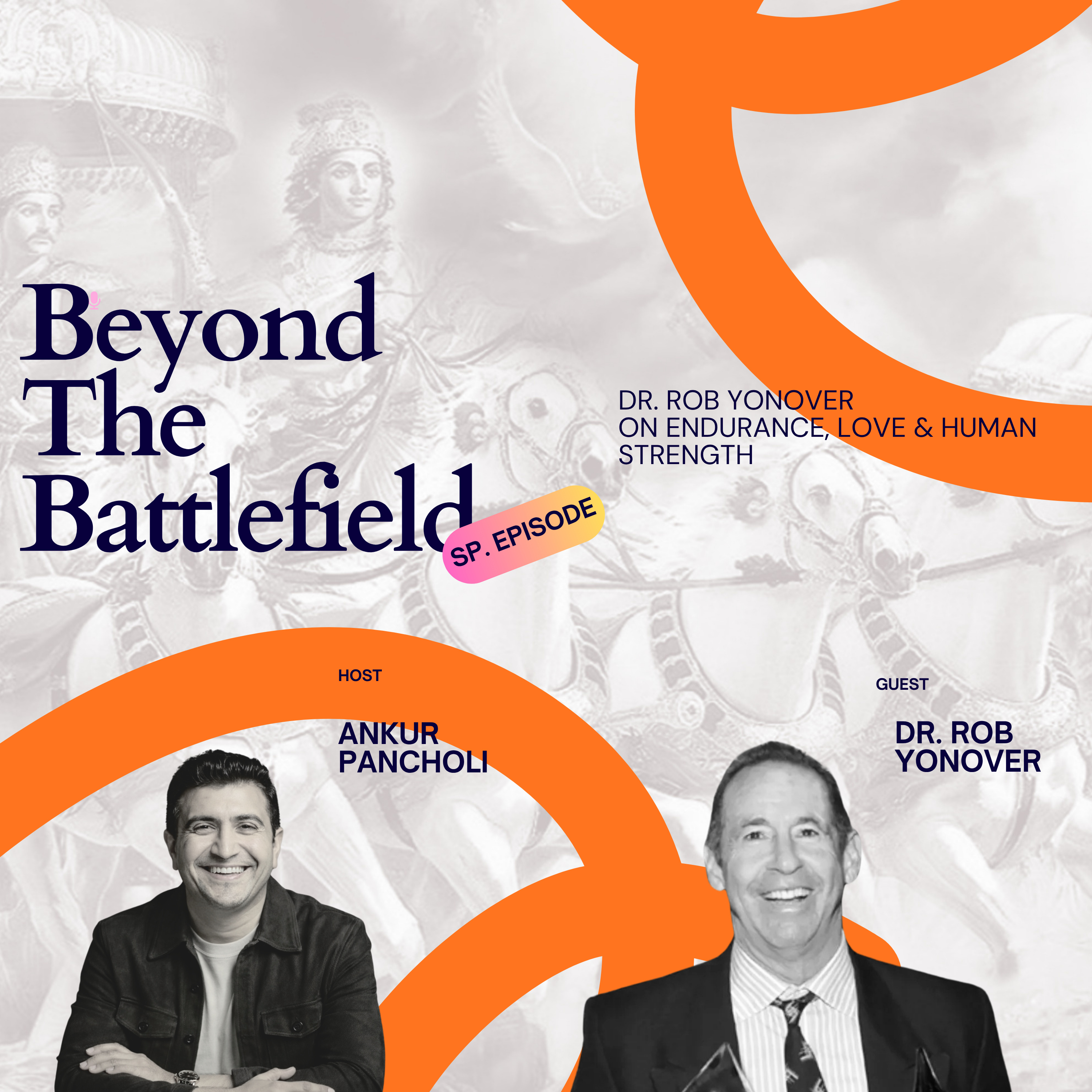
The Battle Nobody Sees | Dr. Rob Yonover on Endurance, Love & Human Strength
Tonight's Episode
Researched Intro for Dr. Rob Yonover
Dr. Rob Yonover is a Ph.D. geochemist, volcanologist, inventor, author, and survival technology entrepreneur. He is best known for creating the SeeRescueStreamer, an emergency signaling device designed to help rescuers locate people lost at sea or on land. His work has been connected with military-approved survival technology, Shark Tank, and rescue-focused innovation. His background includes research linked to deep-sea exploration, NASA Johnson Space Center, MIT lab work, and ocean-based field experience.
But today’s conversation goes far beyond invention. For nineteen years, Dr. Rob cared for his wife Cindy after multiple sclerosis left her paralyzed from the neck down. Behind the public story of science, surfing, Shark Tank, and survival technology is a deeper story of love, endurance, responsibility, fatherhood, and quiet human strength.
SEO Description
In this powerful episode of Beyond the Battlefield, Ankur speaks with Dr. Rob Yonover — scientist, inventor, volcanologist, Shark Tank entrepreneur, survival technologist, and caregiver — about the invisible battles that shape human strength.
Dr. Rob shares his extraordinary journey of caring for his wife Cindy for nineteen years after multiple sclerosis left her paralyzed from the neck down, while also raising children, facing financial pressure, inventing life-saving survival technologies, and continuing to show up every day.
Through the lens of the Bhagavad Gita, this conversation explores resilience, Karma Yoga, caregiving, fear, endurance, love, failure, innovation, and the power of meaningful action when life feels overwhelming.
This episode is for anyone silently carrying responsibility, supporting someone they love, facing uncertainty, or searching for strength in the middle of life’s hardest battlefield — the one within.
Keywords
Bhagavad Gita, Beyond the Battlefield, Dr Rob Yonover, resilience, caregiving, human strength, Karma Yoga, leadership, inner battlefield, survival, Shark Tank inventor, MS caregiver, emotional endurance, purpose, love, adversity, mental strength, spiritual leadership, life lessons, personal transformation
Hashtags
#BeyondTheBattlefield #BhagavadGita #DrRobYonover #Resilience #Caregiving #KarmaYoga #InnerBattlefield #Leadership #HumanStrength #Survival #Purpose #SpiritualLeadership #EmotionalStrength #LifeLessons #Transformation
📩 Write to us: [email protected]
🤖 Explore the Beyond the Battlefield Companion GPT:
https://chatgpt.com/g/g-6845186212588191ae7aa9e327bebc9a-beyond-the-battlefield-assistant?utm_source=chatgpt.com
https://www.linkedin.com/in/ahpancholi?utm_source=share_via&utm_content=profile&utm_medium=member_ios
https://www.linkedin.com/in/dr-robert-yonover-732b84?utm_source=share_via&utm_content=profile&utm_medium=member_ios
https://www.instagram.com/beyondthebattlefield.gita?igsh=YW4xZzllYmtmdjIy&utm_source=qr
back to Beyond the Battlefield. Today's episode begins with the truth most people never say out loud. Sometimes the strongest people you know are quietly exhausted. They are still showing up, still smiling, still solving problems, still taking care of everyone else while internally carrying a weight nobody can fully see. And maybe that is the real battlefield of life, Not the battles outside, but the ones fought silently within. Imagine this. You are building a beautiful life, raising children, chasing dreams, planning the future, and suddenly everything changes.
The person you love, the person you imagined growing old with, becomes paralyzed. Not for a week, not for a year, for 19 years. And every single morning after that, you still have to wake up, still have to earn, still have to lead, still have to stay strong for your children. Most people would break under that pressure. But our guest today kept moving. Joining us today is Doctor Rob Yanover, a scientist, inventor, deep sea volcanologist, survival technologist, Shark Tank entrepreneur, and a man whose innovations have helped save lives around the world.
He has explored volcanoes beneath the ocean, surfed massive waves, built survival technologies, connected with military rescue and SpaceX missions. But his greatest achievement was never fame. It was love. And that is why this conversation matters so deeply. Because in the Bhagavad Gita, Arjuna collapses emotionally in the middle of the battlefield. He loses clarity, he loses strength. He wants to walk away. And Krishna teaches him something extraordinary, that life will not always wait for you to feel emotionally ready.
Sometimes you heal by continuing. Today's conversation is about resilience, purpose, caregiving, fear, survival, and discovering strength you never knew existed inside you. So if life feels heavy right now, if responsibility feels overwhelming, if you are silently carrying battles nobody else understands, this episode will remind you you are stronger than you think. And even in the hardest moments of life, the battlefield within can still become a place of transformation. Let's begin.
Doctor Rao, welcome to Beyond the Battlefield. And honestly, the more I explore your journey and the less I felt like a story about invention or entrepreneurship, it is more like a story about human endurance. And, and when I say it is, I really mean that on on this show, what we do is we often explore the ideas that the hardest battle are usually fought and usually invisible to the outside world. Whatever we are fighting, it's invisible. And in many ways your life reflects that deeply and that's what reason with me, right?
So people have seen you shark tanks, SpaceX, volcanoes, big wave surfing, many more thing. But behind all of it, there was also caregiving, responsibility, uncertainty and emotional wage, which you are carrying, right? Yes. So how did those two worlds coexist inside your mind and and for so many years? It's not a one incident. It was so many years it. Was I? It was an incredible journey. And I, I, you know, we were both fortunate. We were in love. We had beautiful little children. And then all of a sudden she starts limping while she was training for a marathon.
And it went from a limp to a cane to a Walker to a wheelchair all within a year. And then for 19 years, Cindy was paralyzed from the neck down and the kids were four and seven years old. And I, I don't really, I mean, I think I was in on overload and I was kind of on autopilot. There was no options. The option was to bail out, which was never an option for me. I was going to take care of her. I was in love with her and I was committed to the children and the family and the business, which was another family.
So I had to make money. I had to take care of her. And I just, I think for me, it was another challenge. And I guess I like challenges. I mean, I would never have chosen this one, but it chose me. It chose us. And I wanted to not fail at that. I wanted to step up and do the best I could. And then I just kind of had the segment each day into little tasks to get through the day and make sure I left a little piece for myself to get refreshed and rejuvenated to do the next day. And you know, 19 years later, she finally passed away.
But I was very, very, I'm still, it's still one of my proudest achievement. I've achieved all this other stuff and technology and science, but to have stepped up and taken care of her and become the bond we had was so incredible because she was paralyzed, yet she needed to go to the bathroom, she needed to eat. So it's almost like we bonded as bodies. We change. I had to become her arms and legs. And for a guy, a macho guy like me to become kind of, you know, dealing with tampons and other, you know, all the all the feminine things that I really didn't think I was built for.
But deep down I I just handled it. You know, I think there was a famous quote endure by enduring you just you just get in there and you know, it's, it's hard the first time, but the time it's easier, you know, you keep you keep doing it. So we got extremely close. I mean, I don't think a couples ever been closer because we were connected mentally, spiritually, physical, but physically, you know, the other thing about her paralysis from multiple sclerosis was she still had feeling she just couldn't move.
So if she had an itch on her on her toe at 3:00 in the morning, she would wake me up and I'd have to itch her toe. So, you know, a lot of paralyzed people don't feel anything. So they they don't have to worry so much about being comfortable. But for her there was that was one of the added added challenges. Really, it was a tough journey, but it was very fulfilling. And I would say that in Bhagwan Gita Chapter 3 and 5, listener talks about continuing action even your life become emotionally difficult.
And during that first six chapter, first five chapter, and we call it karma yoga. Karma is action, right? Why you have to act because the warrior has been frozen in between the battlefield and why you have to act. I, I keep on giving this example and I said that you're not ready. There's a lot with my understanding when you, if you are staying in a high rise building and you are late for an office, right and you call an elevator but you are too late, right? So elevator is far away and within those 30 seconds of time you push the button 345 times or maybe multiple times.
Right Now you think about a situation and a very panic. It's not a true panic. You're just 10-15 minutes late for a work. But your intelligence has gone. You know that if you press once Eliot is going to come, but you are putting pressing is 4/5 times right. The Eliot will come at this time. And that's what you know. We also explore at multiple angles that when you are emotionally down, your intelligence doesn't work. But right now I really wanted to understand that after caregiving for nearly two decades.
It's not a short term, right? And you said it's become, this has become your way of life. So how did you keep functioning and creating, inventing during that period where mostly you have been completely exhausted? Yes, I think I just kept segmenting. I kept splitting things up to tasks. It's what I want to do, what I need to do and what I have to do kind of. And I would get things I had to do. I would wake up, take care of her, do take care of the kids, and then kind of just squeezing in little segments of time.
I think I looked at the clock differently than most people and I look at 24 hours in a day and I have to extract so many tasks within that 24 hours. But I valued those hours so greatly that I always protected myself and my mental health. Even like your analogy of pushing the elevator, you know that that pushing it a lot makes you feel like you're doing something. So yes, it's not coming faster, but you think it's coming faster. So I kind of was doing that in my life in terms of I have, I have to keep doing things to keep achieving and trying to stay ahead of all the things I have to do and more things.
It's like a waves of tasks are coming at me. You have to discern what's critical now, what I can put off. And I think selfishly I knew one of my psychology buddies told me I have to give up self, which was true. It wasn't about me anymore. 24 hours a day. It was not about me. But what I did for one hour a day was go into the ocean and take a break, paddle, serve something where I can rejuvenate myself. And that was really, really useful. And I would look forward to that. And the deepest, hardest part of it, I would say, OK, this is tough, but I'm going to get a break.
I'm going to get some food that's a nice break, a good meal, or I'm going to go in the ocean. And I also as an inventor and scientist, I like to work on a task and then move to another and keep going and come back around. So you kind of have a new perspective when you leave something, especially if you're stuck in it. I get stuck in something. I would leave and then I'd do all these other things and I'd come back and I'd have almost like fresh eyes to look at it again. And it's also autopilot. I mean, I was doing things and not knowing, you know, you just kind of keep going.
You don't, you don't think about a lot of things. You know, it was like a haze for 19 years. So when you said that I was not doing, it was getting done through me, right? Exactly. Right. And and that's what I also learned and I really, really feel many times that I'll give an example that when I started this, the way I started this podcast, and I'm telling this first time on a recorded note that it was not at all. I was thinking that I will be reaching up to a longer journey, this kind of long journey.
This is 1/3 of the book is completed and I'm on the journey. I completed one year last this month and I'm sure it will take another two years to go and commitment where you have a responsibility of a leadership of 1/3 business in the country and a team to manage busy days. When I when I was talking to my wife that will I able to do that. It's a big commitment and he she also said that will you able to do that? I said that I don't know, but I want to start and I I started this to support my daughter when he's studying, no one is watching TVI thought that I'll also not watch TV, but let me read this book.
And then when you are reading, the idea keep on coming, right? So today I feel that I'm not doing that. It is happening through me. I has gone. It's all about I am someone through which the universe is pushing this energy and it is happening through me. Right. So that's what I understood from you. Yes, I think I can relate because that like I said, autopilot. I didn't realize I never really thought about what I could or couldn't do. I just did it and it was a there's something about a long term project, you know, like you were you're on year one of year three of the journey.
It seems to me that things are much more satisfactory to you when they take a long time. You know every everyone wants instant gratification, but the things in life that you're so proud of take a long time. That's why even my struggles with being a caregiver, the fact that it took 19 years makes it so much greater of a journey, you know, of the commitment, the whole thing versus if it was 19 days. And I meet people that go through small things and, and I, I don't judge people, but that's their own journey.
But I felt like it was such a grand project because it I brought my wife through her last 19 years of life and enabled her to still be a parent to our children, raise our children and see different values and what's important about stepping up and commitment. So I think I get that. And I think I agree with you on that. You know how that long term feel then. And the autopilot version is I still, people said that in the middle, people would break my trance and say, why don't you just leave or why don't you put her in a home?
And I'm like, that really never occurred to me. I mean, I knew about it, but that was never an option. I was going to see this task through and you know, it was great that she lived that long because she became, you know, she made it to 55 and she was 37 when she got sick and it was like that. And the kids got into their 20s, twenty 6 and 23 when she passed away. So they were full blown adults and they were OK. I felt like I had completed my mission. She had lived all the life. You know, I was with her in our bed and I could, I woke up to hear her last few breaths and it was kind of beautiful and relieving.
She was moving on and there was the chapter was done. There was no animosity between us. All the issues we had worked out, the kids, everyone was in a good place. So I think that was the reward and the reward is still now looking back, it's like anything you accomplished and you put a lot of thing, a lot of time and effort into. Like I said earlier, it's better when it takes longer, it's better when it's harder. That's the other thing I would think simpler, you know, you know that it's if it's easy, it's better.
The whole world with technology, everything is simple, immediate gratification, quick, but the good stuff takes a long time and it's hard. So that's. And when, when you are into this journey, right, One of the thing which you did not say, but you said that it's a role which we play, right? It's not. You said that I was not there. So actually a role of caregiver good or a good family member is there right? And that's what we leave. We are actors in this movie and and we play multiple roles right Every time.
And other thing which just came into my mind that in Bhagavad Gita, when Arjun was not ready to fight, Krishna introduced one of the deepest idea about human resilience and action. So what was happening that Arjun was so emotional. So you and emotional people want clarity first and then act. And that first I was asking that how you were able to manage both the world. And so he wanted a peace first. He wants the inner conflict to disappear before taking action in. In Bhagavad Gita, Krishna slowly teaches him that light does not always wait for emotional readiness.
And that's a live example you had said. That's true. That's true. And then I mean, what, when it first happened, we're in shock, but then you take stock of it and you're like, this is such a long journey. You can't judge it. You don't have the clarity of what's going to happen. You just need to show up. I mean, part of it is just, I'm going to show up. Whatever the journey takes me, I'm going to be there. And that's, that's what I, I think it worked for me, but it was very difficult for sure. And it has, it has become a way of life, right?
And, and we go through it, it, it's become a repetitive, it's emotionally draining at itself, right? It's unpredictable. Sometimes it is exhausting, like you said, you were taking a break in a day that was needed. Otherwise it's exhausting, right? And The thing is, most of the time is invisible to the outside world. Yes, absolutely. Even things like sleep, you take so many things for granted when you don't have them or when they're deprived or stressed. The joy of a good meal after a full day of helping her, or the joy of falling asleep again after helping her at 3:00 in the morning and then sleeping for a couple hours till I have to help again.
Everything in life seems to be sweeter when it's under duress and you have to really fight for it and earn it. And I think that it even helps me now because when any problems arise, I can always compare it to that difficult long journey and say I can endure anything. You just, you know, you have to kind of break it up and say you get by one step at a time. And and I think it's helped me now just my whole disposition is different.
So in karma yoga also, Krishna is not teaching you should suppress your emotions, right? So in Bhagavad Gita also you can't suppress you do. He's not saying you don't feel the pain. What he's saying is that do not let emotional turbulence disconnect you from the meaningful action. OK, that's perfect. I mean, we were arguing, you know, we, we, we emoted, we had much emotion throughout the whole thing and people couldn't understand US One, one second we'd be arguing and the next cut second we'd be kissing.
You know, it was so such an emotional roller coaster. But you, like, you say, you keep taking action. The emotion is just the Baggins that you're going on the journey with, but you don't bottle it up. I totally agree with that. And Cindy was the first to teach me that you never keep stuff inside. And even if things are going really well, but something came up that really bothered me, I would bring it out. I want to bring it out. Then I don't want to hold that on, hold on to that. So that really helped me and it still helps me.
What? But the journey is the journey you have to go in. You have to go to and and then one of the very, you know, very small things, he said. That even you are not doing anything if you are breathing also, that's an action. Right, exactly. Right. So, so acting and let's say caregiving or inventing or talking to each other is action. Sitting idle is also action. At not a single moment was there that we were not acting. There is an action everywhere. So why don't you act which which can creates some innovation, can help others instead of just acting and sitting idle is also an action.
Exactly. And then it's so rewarding when you have a meaningful action some and I tell people they're like, oh, I didn't get anything done today. I was tired and I rested. I go, but that's good. You needed to rest. Your body told you to rest. That is an important action. You have to do what you need and your body tells you what you need subconsciously. Before you say I need that and not that really, I totally agree with that. And then one of the thing which I also learned that if you start resisting something, you know, your mind will constantly start getting into education.
That noise will keep on amplifying if you start resisting something and it should not be this should not be happening to me. I can't carry this anymore. That kind of feeling you can like you said, you're a friends. You people were saying you are a choice to have some other home and many more thing, right? But when you resist that right then that noise constantly keep on increase. That suffering will again amplify within our mind as well. And that's why if you act and act in a meaningful way, and I keep on telling nowadays and the metaphor keep on coming, that a thief is successful, but is it meaningful?
Right, exactly. It was really rewarding each day that I made it through. It was so rewarding because it was an amazing amount of work and tasks. But you know, the whole everything was peaceful and it was the way it was supposed to be. When I got the kids to sleep, I got hurt to sleep. I got my work done and it's again like I deserve the rest I was about to get. But the sense of accomplishment was huge. And I, I don't think, you know, people see if it's like, Oh, you're just a nurse or you're of her.
They don't understand how meaningful the journey is to support the life of your partner. When she was diminished and couldn't do things, though, without me, she would be totally in trouble. Without me doing all this, my kids would have been in trouble. The whole thing. And I can't imagine having left just to be selfish and the whole thing might have fallen apart. I, I can't imagine the guilt I would have felt if the kids got messed up from it or if she went downhill quickly, you know, and which all would have happened if, if I didn't do that.
And the other thing I realized early on is I have to take care of myself, the most important. So my diet and exercise regime changed. I, I was always healthy, but I went to another level because I could not afford to get sick because I was the glue holding it all together. And even if I didn't get sick, I couldn't afford to stop moving forward. So that was that was another consideration. And and when you yeah and when you go through this journey, you purify your mind that's that's something is not visible to outside world.
Exactly. You, you, you have done a great job. But even today also what I do after my day job, I get into my iPad and start working on this, whether it is editing, whether it is studying, descripting, I use lot of learned lot of AI tool many more thing, right. But one thing which I have realized that it's a it's a lot of work to do. It's not you have to dedicate your time, you have to take care of family, a lot of things has to do. I sometimes I work for hours, even up to midnight, but next day morning I go to gym, I don't feel tired.
And that's what the inner purification happens. My body might be tired, but my mind is not tired. My inner self, my soul is not tired. I really feel every time, even when I'm travelling in flight, I'll do that right? So that she is what has happened inside. That's what is reflecting. So one more thing which is very fascinating about your story and that even during that immense press personal pressure, you continue inventing technology and that is also designed to help people to survive. Yes, it's kind of crazy that the parallels are kind of crazy, but.
Yeah. So do you think that hardship changed the way you looked at human vulnerability and ultimately shaped the kind of problem you wanted to solve? Absolutely. I think that the my sea rescue streamer, the one behind me and I big one, the idea came before she got sick, but executing it came during so and then after that, it just made sense that survival was what I'm going through. I'm surviving this illness and challenge with my family. So I should apply my mind to surviving survival situation. So I invented a a pocket quotation device, a portable desalinator inflatable rescue board.
They were all for surviving and that that's what I was doing in my home life. I was just surviving. So I think the two fed off each other. And the other thing when you're doing tasks where you're helping, you have time in your brain to brainstorm other things. So I think I kept applying some of the lessons I learned. And I also had time to go over things in my mind because a lot of the work you do and caregiving, like for instance, it took her like an hour to eat because she would chew so slowly.
So it was very hard at first for me because I'm used to eating fast. But then I would just start to almost like meditate as she would eat. I would let my mind wander into other things and I would let it go to my work because it was a good time to get ready to go back to a different subject as I rotated throughout the day in my different subjects. So it is ironic that I invent survival gear and I was inventing a way to survive the illness for our family and my wife. So if they are related, I think it gave me a good perspective.
Right and then when, when you are into the journey of personal and also dilemma, but personal, racial and emotional journey and at the same time when you are talking about helping others, right? And that is what has transformed. And I always look forward in, in Bhagavad Gita, it has been explained multiple time to us and that you don't act. So one of the theory which goes as you know in chapter 2, he's not moving. So he's been told that you act, don't worry about the result. You act right. Then in Chapter 3 said that you have to act, but for the benefit of the society don't attach to the outcome, right?
And then in chapter 5, he's been told that you have to act for purification of your mind. And right now we understand that if in chapter 2 you talk about purification of mind, someone who is not enough mature, he can't understand. But now you had gone through that journey I had only seen and studied, but you had lived that journey. You can understand that what purification of mind is when you keep acting. Absolutely. I mean, it's still people ask me what is my greatest accomplishment? That was it.
And I didn't know it when I was doing it. I knew it was hard, but the calmness when I reflect on it and the, the sense of accomplishment is huge because I still see my kids, my grandkids and I'm like, all this happened because of the commitment I made to keep acting. I kept acting, not knowing. I mean, I knew the end game. We were all going to die, right? So the I know what the end game is, but you just keep progressing and trying to do the right thing. And the, the rewards came and I think it it helped my whole perspective on life.
And again, you know, you wouldn't wish it on anyone. You wouldn't want to say, oh, you should get into a caregiving situation, especially for someone that really wasn't equipped to do it. I think I was, but I didn't know it. But luckily my parents brought us up to be well-rounded so I could cook clean, I could do all those things. I could be motherly to my kids when I could be fatherly, I could do all these things, but they were below the surface. And when you're forced to do it, do them, you do them awkwardly at 1st and then you get better.
It's like anything you practice. That was, that became my craft, becoming a caregiver. And I, I took pride in it really. I mean, I really did. I mean, when I got the things accomplished and then I figure out different little tricks. I also invented little things to help her deal with it better. There was a peddling machine and I figured out that if I put her in a camping chair and tied her legs into this peddling machine, it would peddle her legs all day. And we, we ended up doing that for 8 or 10 years.
We burnt out like 20 motors. And she, she, we, I did the math. She circled the globe a couple times. How many times she, you know, of the miles, but, but her head space being paralyzed, she got to see her, her legs moving. It prevents atrophy. And it was such a great thing. And I think that was a great sense of function. So I took a bad situation as a problem solver and just I that's, I kept taking these challenges on and they weren't just physical, they're also emotional. Like how do you make her feel better about her situation?
You know, and, and it was just, it was just a series of those challenges. And yeah, a lot of them are under under autopilot, but a lot of them are also just problem solving. And the scientists, here's a problem, how do you solve it? My hypothesis is this, I will test it. If it doesn't work, I will retest it, retweet it and keep repeating it. And that's why I ultimately I wrote a book about it, Caregiver's Survival Guide, because I learned so much doing it and I wanted to share it. And like you said, the value and, and Even so, I kind of saved her life a little.
And my invention has saved lives. And when I met a guy that thanked me for saving his life, it was the greatest feeling in the world. And, and even for for Cindy and my family and others that saw me, I could feel the admiration and the reward of people recognizing that I stepped up and saved her life and the family's life, just like my invention saves other people's lives. And that to me is the highest level of reward. And I I really. And so one of the learning in Bhagwat Gita is about, you know, you, you act fully without becoming trapped by immediate outcomes, right?
So immediate, you know, like today everyone looks for if I do something, I should get something and I'm doing because there is an outcome, there isn't a result. There is a fruit attached to this right While Gita Krishna is giving a very radical learning that you don't work for outcome because you don't have a control. It's a logical it's not philosophical. It's a logical that I don't have a control to outcome. Like you said that we know the end game, but I don't have control when the end game is right.
What is in my control is today. We always keep on saying here that Geeta always talks about what is right. It's not doesn't talk about what is right or wrong. It talks about that what is right right now because this is only in my control. Outcome is not in my control. But when when I look at your a shark time journey, a shark time journey right for most of the people today, it doesn't define as a winning, but then your invention later is to SpaceX military application and millions of people worldwide.
They saved lives of many right now. When you look back, did that experience change your relationship with rejection and success? Yeah, so that's that's interesting. It's it's funny how people look at that. And even now, I'm so proud of that moment, even though people feel bad for me because the sharks rejected, they didn't invest, which I couldn't believe because I thought they would want to save lives more than making money. But they don't care. They only cared about money. But the fact that they recognize the the value of the of the invention, they thought that I was a good person to keep it forward was very much satisfying.
And it absolutely has helped me. It's a great achievement just to get on the show and then to also have the, the, the, you know, the soapbox and the, the, the way to present that to the world by invention. It's like showing my work on the largest stage. And the fact that they recognize that and, and respected me. It was very gratifying. And just on a, you know, just on a bare bones note, they, they rerun the show on, see, it's been on over 100 times. And then it just got picked up by someone on YouTube.
They put my pitch on and it got 58,000,000 hits. So it's like I'm preaching the gospel to the world. And that Shark Tank thing, it has a life of its own. It keeps going on and on and on. And I really it was, it was a great experience. It was very difficult experience. So, you know, it was not easy and for months of preparation and a lot of pressure. I mean, people can imagine what kind of pressure you're under. But I also went out there alone. So, and it seems like a lot of these journeys I've taken, it's been me alone.
So me against five of these people with all these cameras and millions of people watching, you can't let the pressure get to you. So that it was a very interesting journey, my own personal journey of dealing with pressure. So, but it was incredible. So that's what I was talking, right? That in the middle of the battlefield a skilled person got I got freeze and then then you said that multiple camera millions of people are watching 5 sharks are sitting over there and then you go to we are into battlefield every day at some or other way.
We are into that same battlefield, right, similar situation. We have been right, but we are winning through and that's what we are trying to learn out of it. Exactly. And and it's all about experiences. I think all experiences even and a lot of people like in terms of child rearing, you want to make the best experiences for your children. But something that I learned early on is I kind of rooted for not really bad experiences for them, but mildly bad experiences. Because for me, it wasn't till I failed a couple tests or got rejected by the sharks or my PhD, my comps, they failed me the first time.
Those were painful journeys, learning lessons, but they were critical because you have to learn how to deal with failure and disappointment and even my wife getting that was the first thing. Up till 37, we both had this perfect life. We are both overachievers, celebrated in our field, all this stuff, beautiful 2 little children, then all of a sudden, boom, you're paralyzed. What a learning experience that was to deal with failure and adapt. It wasn't failure, but a modification of the perfect life.
So I think that people underestimate that. And now people recognize fail, get up, fail, get up fine. It's easy to say that, but it's hard to do that. And that's where I guess in the battlefield you don't really want to fail back poorly or it's really over. We we exactly bring this point what you say that overachiever and all of a sudden move to a different part of the life. Krishna or Bhagavad Gita explained in a very simple way, but very subtle and very accurate way, that this is your life which is going right.
When you are happy, you are here. When you are unhappy, you are here. Now what happens is when you are happy, you stay here, you don't come back. And that's the problem that from coming here to here is a big, big, big shift. And that's where it says that happiness and sorrow, day and night, treat both them, both of them as equal as part of life. And how you do that, that's a profound ancient wisdom which has been taught here. And, and anyone any kind of happiness or sorrow, any kind of pain, you will able to understand that how simple it is to stay stable, still, still every situation.
If you are happy, don't become arrogant, don't become egoistic. If you are sad, that is something bad happen. It will not take away your pain. But don't you know, dwell on that, right? Stay. Stay motivated. Absolutely. And I see people and I know the other thing was I didn't have any deaths in my family up until then. You know what, my grandparent fathers on both sides had died earlier when I was a little kid then when my father. So no one had died. And people's first experience usually is a, a grandparent dies or something where you have lost or failure.
And I didn't have much failure in school. I did really well. So failing at anything. And I'm very, very competitive. I'm a competitive person and it was it was hard for me as a little kid to lose anything. And even the way like you just said it to me, I like to turn a loss into a win. So for my wife getting paralyzed, yes, that's a loss. But to roll with it and live with it and prosper in, you know, the beside the point that you know, in addition to it or in spite of her our challenges, that to me is the ultimate winning.
That is when you can succeed while bad is going on. You know, like you said, happy, sad, bad, good, all that stuff is life. But to keep moving forward and just taking it as a lesson, everything's a lesson and and we need bad lessons. We need hard lessons. And that's what's wrong with today's society because everyone thinks it's immediate gratification and everything should feel good and we should make everything perfect for our children and the perfect for the world. But that's. Not possible, not possible, not possible.
You same thing what I was talking about, you are controlling something which is not in your control. You are trying to control outcome. It's not in your control. Next 15 minute, 5 minute, what's going to happen? We don't know. What I have is right this moment and the way I will appear in this moment will define my destiny. So 1 of this learning and it is very practical learning. Here we don't talk about destiny or someone in cloud or someone in ceremony is going to help. What we are talking about here is that my destiny is the way I respond.
If I'm talking to you and if you are asking me something and the way I will respond, the next thing will come to me, right? The situation where I am and the way I'll respond will define my destiny. If I am in a interview, if I am giving it wrong answers, I'm not fit for that role and I'll keep on blaming my destiny that I don't get a good growth. I don't get it. It's not that you you are not responded well to an interviewer who will who will hire you, correct. And the second thing which you talked about that life is to learn life is to learn the lessons, right?
But there's one one thing we talk about that this life, human life is even God has to experience the world. He has to come as a human life. If he has to see something, he has to help something. He has to come into us in this body. When you leave this body, you will not able to do what you have done for 90 days. I can tell you, you will be helpless. And we take burn birth and in India, we believe in reincarnation. It is there a lot of people who have done research why you reincar, why you take birth as a human life.
You want to complete your desire, you want to complete your ACT, which which you can't do without. When you don't have a body, you can't walk, you can't see, you can't you can't smell, you can't taste this 5 senses in the body. That's why you are here. When you leave this body is it's going to get buried. You it doesn't exist, right. So, so so I always keep on building that in this moment, whatever best we can do, we should be doing. And that's why you know your example is. And that and also what what you're doing in this moment is all predicated on what you did up till that moment.
And that prepares you for that moment. I think that's why when they say old age, you have saw this wisdom and you wish you knew this when you were young. And that's so true because what I've been through has prepared me for every moment I have now better than anything else, because it's lived experience. Next thing which I wanted to talk to you is you have self massive waves, you know that is miles beneath the ocean explode volcanoes worked in a survival environment and most of the people including myself, we spend our lives avoiding fear.
Like you said, people want the perfect life, they don't want to get into that. So what how those extreme environment taught you about human mind under pressure? I think for me very much, I'm prepare for things and I train for things. So when I'm surfing a 20 foot face wave, I don't go out there from surfing A1 foot wave and then all of a sudden go to 20 feet. I train and prepare and learn. A few years ago I almost drowned because I took twenty of those waves on my head in a row. But now I incorporate.
20 or 51 breath breathing diving techniques. So I prepare for the worst case scenario so when it comes, I'm ready and I'm calm. It's a mindset that you have to prepare and feel good. You have to have the confidence that you've done everything you can. You have all the safety knowledge gear and your mindset and preparation is good. And I don't know how to explain it except the afterword glow of being on an active volcano or going into a submersible or surfing big waves is such a high and natural high of surviving it.
And I don't think I take big risks. But to, to outside people, it looks like it. But I think that by practicing just like anything and preparing, you minimize the risk. But the excitement of getting into deep nature is phenomenal to me. It's, it's everything is to experience things deeply in nature as a human and testing your limits and not just your physical limits. It's your mental limits and dealing with fear. You know, I, I just find out that when I'm scared and nervous, usually what I'm about to do is something really great, you know, So it's like, why do we run from fear?
Because fear is usually telling us not fear, like, oh, some violence is going to occur to me. That kind of fear is bad, but fear about doing something, pushing your own limits ends up good. And, and it's funny that usually, like in surfing, people get hurt when they're not on big waves and they're just fooling around and not paying attention. It's when you're careful and prepared, you're less likely to get hurt because you're more focused in on the moment. So it's really hard to explain, but I do.
I don't think I'm a fear junkie, but adventure junkie. It's not like I look for it. It's just that I enjoy doing things that are deep in nature and but I'm smart enough to prepare for it. I don't go into it haphazardly. I don't want to take risks that that are not important, that are not critical. But you're right, so planning is important. So without plan you can't move. But planning is something, just a plan. You can't decide that everything is perfect. Everything will be perfect and you you take out a car from garage every day, not with an expectation that all traffic light would be green.
That's right. But you still take out right. You still take out the pipe, right. So one of the one of the more learning which it recalls me when I heard the the different stories from you that in life and and in Bhagavad Gita Chapter 6, it is very well explained. This Chapter 6 is all about meditation and into the first time in the world of someone who has talked about validation. And then there are multiple versions of meditation now there. But what it talk about, it talks about is that you you need to master your mind first.
Yes, before doing anything and you have to master the mind but not by escape the as many times, even in India people feel that. Even when I started working on this, many of my family members said that you are going to renounce the world, I guess so you are going to get Himalayas. And because this is what looks like whatever religious scripture that it is not, it is. It doesn't talk about any religion. Whom server has gone through that. He says that it asks you to follow your own religion. It doesn't ask you to change your religion.
It's only to ask you how do you live the life in any extreme situation. So it talks about that you don't have to escape the life, you don't have to renounce the world. You have to act by remaining steady within the turbulences. It's not that life will be perfect, it will be noisy, it's going to be messy. You had talked about your experience maybe 5000 years back when this was spoken, there were different kind of battlefield going on. Today we are getting into AI era. You can't predict whether I'm AI or I'm a real person.
Today a lot of things are working on that and we are going to get into more and more complex situation, right. But in your in your experience that how important is the presence and mental steadiness in the environment when you had operated? It's everything because if your mind can create such barriers, such fear of like parallel that you become paralyzed if your mind isn't there. And I've done certain things where like for instance, surfing big waves, if I'm not feeling it, if I don't feel right that day, my mind, my mind isn't right to do something.
I will hesitate. I listen to my body and mind telling me that. But I think it is critical. You have to go in with a free mind and relax. It isn't. I don't really meditate, but when I think about it, I really do because even when I paddle the train, my one arm in front of the other, breathing, it's all Zen. It's, it's like in the in, in nature. So I think I do meditate and I do want to calm my mind and especially for being creative on the invention side, that's where my best ideas come to me is when I get into a state of relaxation and openness in my mind.
And I think that is critical. And I think you have to, you have to learn how to deal with it. When you're a young kid, there's just so much noise in your head to becoming an older person like me. How do you get to where you know your mind and body? And it's from repetition, It's from learning about yourself through different experiences. And I, I think the mind is so powerful. We still don't even use a lot of and I think that I, I really, I enjoy exploring it. And, and like I said earlier, as you get older, you really start to see the world and you see yourself.
It's almost like a, it's like a bad trick they play on you as you get older, you see things so clearly and then it's over. It's like, I don't, you know, it's like, why can't it be the other way? Why can't you be born seeing things clearly? But that's the journey of life. You have to learn, right? It's really, it's fascinating. Yeah. And one of the things which we often discuss and beyond the battlefield is that responsibility can quietly become very heavy, especially when people depends on you emotionally, financially, physically.
So have you ever experienced the moments where the weight of carrying so much of responsibility felt almost over will? Absolutely. I mean, the financial stress of what we went through, I didn't even touch on that. And and the fear of losing everything because of financial stress was, was nearly overwhelming. That was absolutely the hardest part because it's just like, where am I going to get the money to pay for this? And you look at these innocent kids, my helpless wife, because it's paralyzed.
Like I, I can't keep generating money out of nothing, especially when most of my time is dedicated to helping my children and my wife. So it's like it was very, very difficult. But you know, again, you just, I found that chipping away at things, you know, breaking things up to OK, it's even like paying bills, pay this one. I can pay that one later, make some money here, take care of someone there. If you look at the overall thing, it can be overwhelming. So you just try to focus on getting through that day, that task, that responsibility, that requirement.
And I think it helped me in one of my friends helped me in a lot because I had never been in debt in my life and we bought a house and we got a loan. But he said to me, it's OK to be in debt, borrow money, you know, this is a very much an emergency time for you. And he said even borrowed against credit card back in the day 20 years ago, they had 0% interest credit cards. And, and I just, you know, there's a bit of a scam in their fees. But the bottom line was it did create some money. And that's how desperate I was at certain times because I just have to keep the machine rolling.
It was not ideal, but I did things like that because you do what you have to do. You know, you, you, you work with what you have at hand and you have to keep your mind clear. So I, I didn't want to get paralyzed by that negative feeling and overwhelmed by the money monetary challenges. So you just want to clear things up. So you keep proceeding and you take a loan out. I mean, I refinanced my house like four or five times, which is dumb. I mean, I lost a lot of money doing that, but it didn't matter.
It helped me survive. My house became the bank that enabled me to survive the 19 years. So was it a smart financial decision? No. But was it a smart social decision? Yes, because it saved me. So that that was the darkest time for me because that I love where I lived. I didn't want to lose my house. I didn't want to lose the structure and stability for the kids. I didn't want to disrupt it any more than it already had been. I mean, they had to grow up with a paralyzed mother. So they were already in a diminished capacity, even though, ironically, it helped them become better people.
The, the the kids teachers used to tell me, I don't even know what to say to your children because they're they've already been through stuff that I've never been through. So again, you think these bad things are bad, but in turn they're really good for you, for your development. It's painful and hard to endure them, but they really make you a better person. So you talked about a smart financial or smart social. This is right. I would say it's a smart decision. It's a decision which we have to take.
It doesn't make difference to anywhere in the world till you are surviving, right. So whether you have taken that you have taken loans, you have refinance, you get finance from anywhere, see if we are doing something meaningful, right? You're doing for your family, you're doing for the people, for invention also, you must have put a lot of money over there, right? So if you're doing for a better man, right, this, all of this money is going to stay here. What is going to go with you is your memories, your efforts and your purely purified mind which that that this isn't your taken.
That's what I say that Geeta talks about what is right right now, right? And that was right right then, and that's right. But you're right, now I, I meet people, some of my friends are very wealthy and I look at them and it's still almost like a hollow existence. They may have got a, a good break making a lot of money, but I feel so rich. I don't have a lot of money. But my experiences and the things I've endured and the things I've accomplished, you can't buy those things. And, and, and they're also long term.
I can't just say to you, here's 19 years of caregiving experience. It's something I went through that changed me. It changed. Me it's it's it's your early and the last episode which I just completed for last, not the last in the series, but the last episode I completed there it talks about that your journey will start where you pause. OK so I have articulated into modern day because we have not seen the next birds but the real inside of this is the way you had build your mind, your understanding, your memories, experiences right?
The next journey will start from there. And will the story will be saved? No, the story will be different but the intent of the mind will be saved. The the whatever we have learned today, you and me are talking. I'm also learning a lot of things. This learning is not going to go there. Will I be uncool? No, I may not be Ankur, I will have a different role, but this learning will pull all of those learning back. So you will be placed in the place and and that's what I say that your money, your finance, your house, your everything is temporary.
That is one of the initial learning comes into Gita that you start imagining, start imaging that what is temporary and what is permanent in your life. And I was asking one of my colleague today when I was travelling, you think for 10 minutes what is temporary and what is permanent. So finally he said that only permanent is me and my family. I said that you still think deeper. He said Oh my son will go to university, he will not stay with them. I said still think deeper. Only your mind is permanent even though your body is also not permanent.
Forget about your family. That's true. No, that's it. That's why I feel so rich and accomplished because I know what I've done. I know I was there. You can, I can have people judge what I've done and they can tell me that's great or that's I don't care. I was there and it happened to me. And, and I, I also told someone that someone was here that Arjun was freeze in the battlefield. Lot of people get freeze by sending a e-mail, right? So I asked him that why are you not doing this? He said that if I send a mail, I'm worried that what he will think about.
I said that are you going to take a next bus to do this? Because whatever you are bypassing something in life, you, you don't have a shortcut. Your mind will have to go through that hardship that learning has to have. And you said that a lot of your and as they're rich, but they're hollow. They don't have that learning what you had. They have to go through that hardship or that learning. So renouncing the world, that's what I said, renouncing the world is not a choice. If you renounce the world, I I'll tell you a story.
One of the Saint who decided that I'll renounce the world. Now I'm no self realized. Let me go to Himalayas. He went to Himalayas for 15 years and he came down that now there was some going on and he came down. Now in in fact someone by mistake place his feet on his thumb and he got angry. Now a self realized person who has renounced the world can't become angry. He was angry because he left the world. You have to stay here, fight the war what you are in, then you go. Your anger, your desire will pop up and then you can start overcoming that.
But you don't have people around you. You don't have people to support, people to talk, people to help how how you elect and how how those things will go away. Exactly. And you have to have the courage to go for it and try and endure it. I mean, when you run away from things, they only get bigger in your mind, right? Yeah. You can't really run away from anything, so it's better to face them early and go through the pain or the growth and live through it. Live to fight another day. I mean, I like the analogy of it being a battlefield because it really is an internal battle in your mind.
Right, so Battlefield is always inside, it's not outside. Right. No, I love. That lot of lot of people come to me and he personally, I don't keep on telling that what change I had been gone through internally after this learning this talking to you is also change coming in. But a lot of people have seen that, right? So they come and see that, oh, you are a good leader. How you could manage so many different talent, different kind of people. What what should I do to manage? It's a particular age groups and Z kind of people, right?
I said that you can't manage anyone. Don't try to help anyone, help yourself because if you try to help and try to manage people you will definitely make sure that those person will fall down because you are trying to handle him and don't handle it even handle your yourself. Exactly. And lead and lead by example. Lead by example. My biggest theme was I'm going to do this for my wife and my family. Not because it feels good and it's the right thing. That's true, but I'm going to kind of lead. That's how I'm teaching other people.
I'm not going to manage to other people, but I'm going to show them how I deal with it. An example, show my kids, even my my kid. One of my children said to me, why don't you just leave her in the middle of this night? I said, no, I you don't leave people, you don't leave your family, especially when they're in need. That's the time you show up. That's the most important time to show up is when the when the going gets hard, that's when you step up. And that says everything. Yeah, and and then then you said lead by example.
Now 5000 years back, similar thing has come up. Arjun asked Krishna that you know, you know everything. You know you are giving me all wisdom of the world. Why you are here in the battlefield driving my chariot, right? You can, you can relax. You yourself realized person. Now you don't need to take a rebirth as well. So he answered and exactly what you said that if I stop acting, the whole people in the queue are waiting to and watching me to stop act. If as soon as I stop acting, the rest of the world will start as stop acting as well, right.
So people are following leaders and leading by example is very important. 8000 years back also the same thing what you said that if you stop and and I can tell you, I don't know about the environment around you, but whatever you have gone through, there are many people who are watching and they must have inspired and they must have motivated in one or other way. The way you have gone through the journey, not only caregiving, but also your invention and your inspiration around, you know, helping a lot of people, right?
So it is nothing goes away. Whatever we do, nothing goes away. And I said that what you and me are talking those, those things are not going to get away. So finally, one thing which I want to understand that you have gone through everything caregiving, invention, survival, ocean pressure, uncertainty. Right. What was the battlefield of your own life ultimately taught you about being human? I just, I think for me as a little kid, it was always the win, win. You have to win and everything goes well.
And you, it taught me mostly that the world is not perfect and I'm not perfect and it's OK not to be perfect and it's OK to fail. I mean, that was my biggest lesson is that you can fail and it's OK. You can live to fight another day. And I think that I didn't want to hear that when I was a kid. No way. I'm winning and if I don't win, I'm going to try hard and win again. It's but I never took a lesson from not winning. Now I'm the person I am because of all these lessons I've learned. And I think that's really you have to pay attention to the life you're living and how you act and also critique yourself.
I look at myself and tell you, Oh yeah, I could have taken that better or I could have rebounded that better. I I didn't have to react so poorly when I lost that battle. You really get to hold a mirror up to yourself. And that is a sobering thought because you think you're this great person, but we're all filled with flaws and they are exhausted, separated when you're under pressure. So I I've really got to look at myself and I'm proud of myself, but I'm also understanding that I have issues and problems and things that I'm not perfect.
None of us are perfect. And once you can accept that, it's easy to keep moving forward. And that's what if a lot of Litton lessons of heard the previous episodes. And when you also said that I'll start reading Bhagavad Gita, it is very clearly explained that there is nothing called perfection. Every human being being is unique. Everyone has their unique nature and it is scientifically explained that why you and me are different and why being different is good. We talk about diversity and inclusion now, but it was always talked about years back that diversity is good, it is important, right.
I one of my colleague who is not Indian, he came to India and he was learning about India that how many states you have, how many languages you have. I said every state has their own language but every 30 kilometer the accent change. So he said that why the government is not standardizing one thing, one language, one process and make it simplified, people become easy. I said that this country believes that being imperfect and being different is necessary. We believe that everyone has their own journey and everyone has a right to win into that journey.
You can't have one stick and everyone working on that order of that stick, right? So imperfect. There is nothing called perfection. So nothing imperfect, nothing perfect. Whatever is that is that and that is how we are and that is how we have to win. If I am in India, you are in the United States. I have my own journey. Your your own journey, but how calm, how stress free you keep your mind by acting by not acting by intellectual. There are ways of living the life and that's what Gita says that you you don't have money, you help someone, you have money.
You you leave that money that you are living your ego. You don't have money you don't have you can't physically help become intellectual sing you become and then even though you don't have brain, you don't don't you are not intellectual. No worries. Spirituality is something which can take you there, right? So just stay with your God and you will be successful, right? But but whenever you do, you do with all the good intention and perfection, not, not, not perfection, all the good intention, right?
Not that's what the life is, right? And I was, I was really inspired by going through a story. But the way you explained, you know, it gives me a lot of motivation and confidence that whatever we are, we are, we have to be happy. And being happy is not being having a lot of wealth, a lot of money, being happy is happy inside, right? So. That's right. No, thank you. I appreciate that. And thank you, Doctor Rao, for joining us and being the battlefield today. I'm really happy to I want to discuss so many things with you, but you know, we had already crossed time, but maybe I, I, I look more opportunity to have similar more conversations with you.
Thank you. That was my pleasure. Thanks for having me on.
What an extraordinary conversation. Today was not just about survival. It was about what happens to a human being when life demands everything from them. Doctor Rob Yanover reminded us that resilience is not loud. It does not always look heroic. Sometimes resilience looks like waking up again at 3:00 in the morning, helping someone you love, paying one more bill, taking one more breath, and still choosing to continue. In a world obsessed with instant success, quick motivation, and visible achievements, today's conversation reminded us that the deepest transformations happen slowly, over years.
Over sacrifice, over responsibility, over love. And maybe that is why the Bhagavad Gita continues to matter so deeply. Because Krishna never promises Arjuna a life without pain. He teaches him how to remain steady within pain, how to keep acting without losing himself, how to continue even when emotionally exhausted. And Doctor Rob lived that teaching for 19 years. He continued showing up. Somewhere in that journey, caregiving stopped being a burden and became a form of love so deep that it transformed him.
Perhaps that is the real message of today's episode, that the battles we wish never happened sometimes reveal the strongest parts of who we are. So if you are carrying responsibility right now, if you are supporting someone, fighting silently, feeling emotionally tired, or trying to hold life together one day at a time, do not underestimate your strength. You may not see it yet, but every meaningful action, every moment you continue despite difficulty, is shaping you. And one day you may look back and realize that the hardest chapter of your life also became the chapter that revealed your deepest humanity.
Doctor Rob, thank you for your honesty, your courage, and for reminding us what it truly means to show up for life.
And to everyone listening around the world, thank you for being part of Beyond the Battlefield. If this conversation touched your heart, share it with someone who may need strength today. Follow, subscribe, and help us continue bringing these conversations into the world and write to us at Beyond the battlefield. At Outlook dot in. We truly love hearing your stories and reflections. And don't forget to explore our Beyond the Battlefield GPT companion link in the description where ancient wisdom meets modern life.
Until next time, keep showing up, keep growing, and keep looking beyond the battlefield.
 Apple Podcasts
 Castbox
 Castro
 Goodpods
 Moon FM
 Overcast
 Pocket Casts
 Podbean
 Podcast Addict
 Podcast Republic
 Spotify