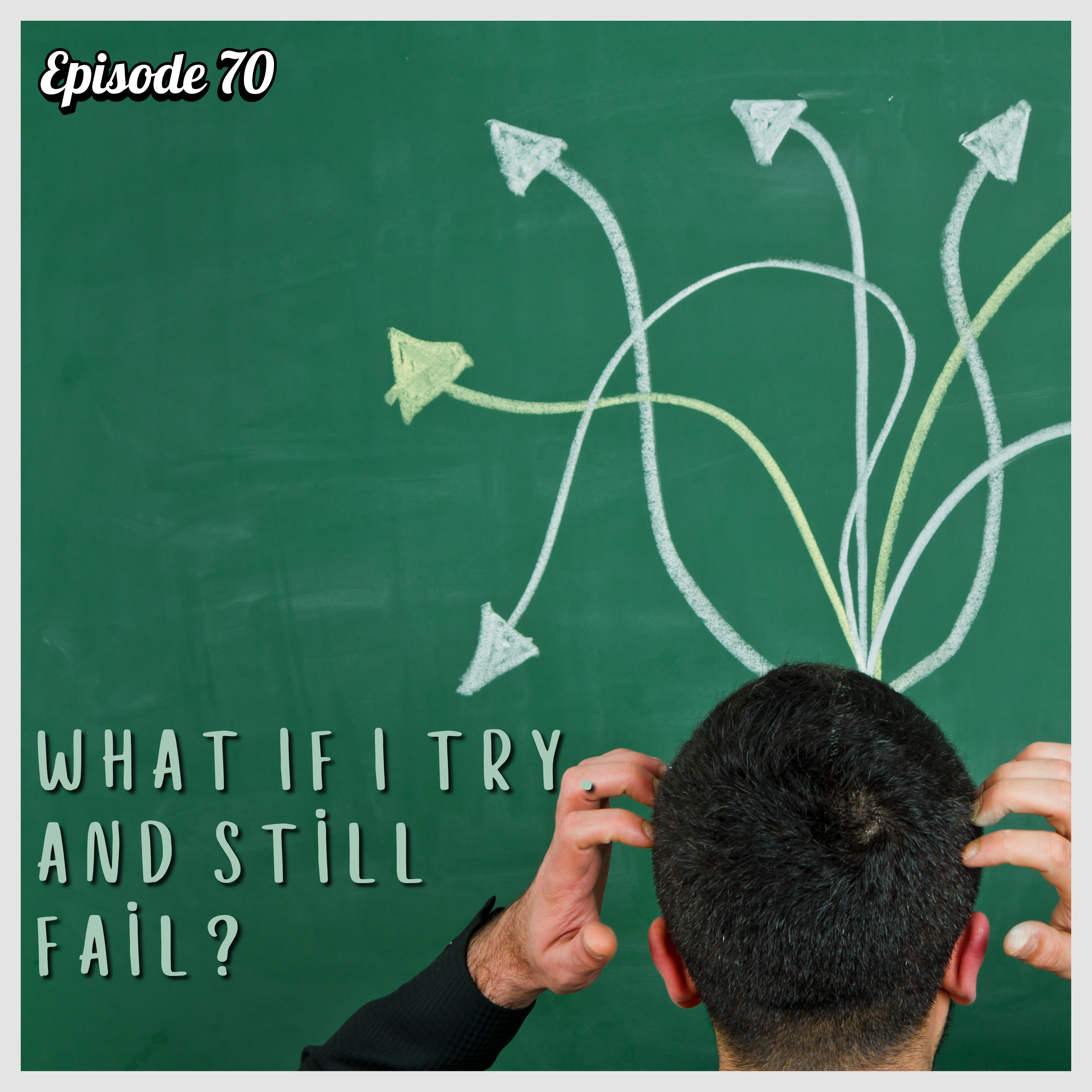
Episode 70: “What If I Try… And Still Fail?”(Bhagavad Gita 6.35-39)
Tonight's Episode
Episode 70 enters one of the most practical, emotional, and transformational moments in Bhagavad Gita Chapter 6.
After Arjuna honestly confesses that the mind feels as impossible to control as the wind… Krishna finally responds.
And His answer changes everything.
Krishna does not deny the struggle.
He does not shame the wandering mind.
Instead, He reveals two powerful principles for inner mastery:
- Abhyāsa — repeated practice
- Vairāgya — intelligent detachment
But then the conversation goes even deeper…
Arjuna asks the question every sincere human being secretly carries:
“What if I try… and still fail?”
This episode explores:
- Why the mind keeps returning to old patterns
- The psychology of overthinking and emotional instability
- How the mind becomes trained in anxiety, panic, and fear
- Why clarity disappears under pressure
- The real meaning of abhyāsa (practice)
- Why vairāgya is not suppression or escape
- The difference between discipline and control
- Why doubt keeps regenerating itself
- Osho’s profound insights on the bargaining mind
- The fear of losing both worldly success and spiritual growth
- Leadership under uncertainty
- Why growth never comes with guarantees
Jessica and Ankur deeply unpack:
✔ Bhagavad Gita 6.35
✔ Bhagavad Gita 6.36
✔ Bhagavad Gita 6.37
✔ Bhagavad Gita 6.38
✔ Bhagavad Gita 6.39
This episode is especially powerful for:
- leaders facing uncertainty,
- founders struggling with fear and inconsistency,
- professionals battling anxiety and mental noise,
- seekers struggling with discipline,
- and anyone afraid of failing despite sincere effort.
Krishna reveals something deeply compassionate:
A restless mind is not proof of failure.
It is simply the starting point of transformation.
And perhaps the greatest danger is not falling…
…but never beginning because the mind demanded guarantees.
🎙️ Key Themes:
- Mind discipline
- Emotional mastery
- Practice & detachment
- Fear of failure
- Doubt and uncertainty
- Leadership psychology
- Spiritual growth
- Anxiety & overthinking
- Stability under pressure
- The restless mind
- Inner transformation
Inspired deeply by Osho’s Geeta Darshan insights and Bhagavad Gita Chapter 6.
📩 Write to us: [email protected]
🤖 Explore the Beyond the Battlefield Companion GPT:
https://chatgpt.com/g/g-6845186212588191ae7aa9e327bebc9a-beyond-the-battlefield-assistant?utm_source=chatgpt.com
What if the biggest battle of your life is not outside, but inside your own mind? What if you've built success, made decisions, LED people, and still you cannot sit quietly with yourself? And what if, even after trying, you feel like you might fail? In this episode, we go into one of the most honest conversations in the Bhagavad Gita. Not about victory, but about struggle. Not about certainty, but about doubt and a question every modern leader carries. What if I try and still don't make it? Welcome back to Beyond the Battlefield.
This is episode 70, so Arjun has just said something very honest, very human. This mind, it's like the wind, impossible to control. And honestly, Ankur, I think every listener right now is nodding. Yes, and what happens next is very beautiful. Krishna does not reject him, He does not correct him. He does not say you are wrong. Instead, he begins with acceptance. Let's listen to the verse 35. O mighty armed son of Kunti, what you say is correct. The mind is indeed very difficult to restrain, but by practice and detachment it can be controlled.
Krishna says asanshayam Mahabhaho, no doubt, O Mahabhaho, you are right, Mahabhaho, that means mighty armed one, right? And this is not just a name, it's a reminder. Krishna is telling Arjun, you who have defeated the greatest warriors, you who have conquered battlefields, can you not conquer your own mind? See the depth here? Krishna is not denying the problem, but he is also not letting Arjun shrink in front of it. That's powerful because most of us do one of two things. Either we underestimate the mind or we feel completely defeated by it.
But Krishna stands right in the middle. He says, yes, the mind is restless, chalam constantly moving. Yes, it is durnigraham very difficult to control. But, and this is the most important word too, but it can still be mastered. And then Krishna says something that changes everything. Krishna is saying your restlessness is not failure, it is simply your current condition. And this is where most people misunderstand their journey. They think my mind is wandering, I'm not capable. Krishna says no, the wandering mind is the starting point, not the disqualification.
And this is not just meditation, this is leadership. So the problem is not that the mind moves, it's that we don't know how to work with it. And Krishna gives 2 very precise tools, not philosophy, not abstraction, but methods. He says Abhyasen Vera ke naj through abhiyasa and Vairagya through practice and detachment. Let's start with abhiyasa. We usually translate it as practice, but I feel there is more to it. Yes, Abhiyasa is not occasional effort. It is repeated, returning again and again and again, bringing the mind back.
And here's something very important. We think we are not practicing anything, but that's not true. What do you mean? We are already practicing, just unconsciously. We practice worrying every day, we practice overthinking every day. We practice reacting, getting triggered, getting attached, replaying past stories. So Krishna is not saying start practice, he's saying change the direction of your practice. That's such a shift. A leader who panics in crisis is not naturally anxious, he's practised in panic.
A founder who collapses under uncertainty is practised in chaos, and someone who stays steady is also practice. Abhiyasa means training the return. Not controlling every thought, but coming back every time we drift. Exactly. Not perfection, but persistence. And what about Vairagya? Because many people misunderstand this. Yes, Vairagya is not running away from life. It is not giving up everything. It is not becoming cold. It is a deep understanding that nothing outside can give you permanent stability.
That sounds almost uncomfortable. It is uncomfortable, but it is also liberating because look at our lives. We expect success to give us peace, recognition to give us worth, relationships to remove inner emptiness. And then the mind remains restless because we are asking the outside world to do something it was never designed to do. So Vaidagya is not rejecting the world, it's seeing it clearly. Exactly. It is the moment you say I have walked this path before and it did not give me what I thought it would.
And here is something very deep. Everyone experiences Vairagya in glimpses. After indulgence comes emptiness. After anger comes regret. After chasing something comes disappointment. That moment, that clarity, that is Vairagya. But it doesn't stay. That's why we need abhiyasa. Vairagya shows you the truth. Abhiyasa helps you live it. Without Vairagya, practice becomes mechanical. Without abhiyasa, detachment fades away. So one gives inside, the other gives stability, and together they transform the mind.
If we bring this into modern leadership, what does this really mean? It means a scattered mind cannot lead a stable life. A leader who depends on outcomes for inner balance will always shake under pressure. So, Krishna is giving a leadership formula here. Train your mind daily. That is abhiyasa stop expecting permanent fulfillment from external success. I east vairagya. And that's how clarity becomes consistent. Because clarity is not an event, it is a discipline. So if we bring this entire verse into one simple line, the mind is restless.
Not because something is wrong with you, but because it has been trained that way and it can be retrained through practice and detachment.
So Krishna just gave us the method in the last verse, practice and detachment. But now it feels like he's drawing a line. Almost like saying this is where things get real. Yes, verse 6.36 is where Krishna becomes very direct, he says. Yog is difficult to attain for one whose mind is unbridled. However, those who have learnt to control the mind and who strive earnestly by proper means can attain perfection in Yog. This is my opinion. Asaya tatmana yogo dush prap itime mati. For one whose mind is not disciplined, yoga is difficult to attain.
Difficult, but not impossible. And that distinction is everything. Krishna could have said it's impossible, but he doesn't. He says Dushprap very difficult, not impossible. Why does he leave that window open? Because Krishna is precise. He's compassionate, but never misleading. He's saying yes, even without mastering the mind. Attainment is possible, but so rare that for almost everyone it is not the path. So this is not an excuse, it's a warning. Because the human tendency is dangerous here. The moment we hear it's possible without discipline, the mind says that must be me.
And that's where people get stuck for years. They choose the hardest path thinking it's the easiest. So when Krishna says Asanya Dhatmana, what exactly is he pointing to? He's pointing to something very fundamental, not skill, not intelligence, but inner governance. A person may run a company, manage teams, make $1,000,000 decisions, but cannot sit quietly with their own mind for 5 minutes. And Krishna is saying in that state, yoga becomes difficult. Not because yoga is complex, but because the mind cannot stay.
And why an uncontrolled mind struggles? Because the uncontrolled mind has a pattern, it swings constantly. Success, then fear of losing it, attachment, then regret, excitement, then exhaustion. So when such a mind tries to focus, it doesn't fail because the method is wrong. It fails because it cannot stay in One Direction. So the problem is not depth, it's consistency. And then Krishna flips it, right? He talks about the other side. Yes, vasyatmana tu yatta. For the one who has mastered the mind and continues to strive, yoga becomes achievable.
So what changes? Everything becomes simpler because the biggest obstacle, the mind itself, is now aligned. Think of it like this. If your mind is like 100 horses all running in different directions, you go nowhere. But if those same horses are trained, the same energy takes you forward. So the problem was never lack of energy, it was lack of direction. But Krishna adds one more word, Yatata effort. Yes, And this is very important. Even after discipline effort continues, there is no, I've figured it out once, now I'm done.
So clarity is not permanent, it's maintained. It's a living process. And then Krishna says upayathaha through the right method. This is very practical. Not all effort leads to clarity. You can force the mind, it won't work. You can suppress thoughts, they come back stronger. You can escape, but the mind follows. Only the right method works and Krishna already gave that method Abhiyasa repeated return Vairagya clear detachment. If we bring this into leadership, this feels very real. Very real and uncontrolled mind in leadership reacts instead of responding, gets attached to outcomes, swings emotionally with situations, loses clarity under pressure.
Not because the leader is weak, but because the mind is untrained. And the trained mind stays steady in uncertainty, sees clearly in chaos, acts without panic, leads without inner noise.
So if we bring this entire verse into one truth, yoga is not difficult. An undisciplined mind makes it difficult. Train the mind, apply the right method, stay in effort, and what once felt impossible becomes natural. And justice. When it feels like clarity is forming, something unexpected happens. It's not about controlling the mind anymore, it's about what if I try and still fail? Yes, and this is one of the most human moments in the Gita. Arjun asks. What is the fate of the unsuccessful Yogi who begins the path with faith, but who does not endeavour sufficiently due to an unsteady mind and is unable to reach the goal of yoga in this life?
That's such an honest question. It is because Arjun is not asking about failure without effort. He is asking about failure despite effort. The fear. What if I lose both? And then Arjun goes deeper. Does not such a person who deviates from Yog get deprived of both material and spiritual success or mighty armed Krishna and perish like a broken cloud with no position in either sphere? What does that mean? He says, what happens to such a person? Do they become like a fragmented cloud scattered in the sky, lost with no direction, A cloud that belongs nowhere, neither fully in the world nor established in the spiritual?
Arjun is asking what if I lose both? This is the fear that stops transformation. So this is not just Arjun's question. This is everyone's fear. As long as we are in the world, we have something to hold. Relationships, identity, success, structure. Even if it's imperfect, it's familiar. But the spiritual path asks you to loosen that grip. And that's where fear begins. Because the mind immediately asks, if I let go of this, will I actually reach something higher or will I just fall? The worldly mind cannot let go unless it is guaranteed something in return.
And even surrender becomes a transaction. We don't give up, we negotiate. I'll let go if I'm sure I'll gain something better. That's not surrender, that's a deal. Yes, and that's why Arjun is asking for assurance. Osho uses a beautiful metaphor here. Imagine a boat tied to the shore. 1 shore is the world, the other shore is the unknown. Arjun is standing in the boat asking if I untie from this shore, will I definitely reach the other and if not then the fear is I will drift, lose direction, and sink somewhere in between.
Now here's the deeper truth. Even if the current shore is imperfect, the mind still clings to it because it gives the illusion of security. Even if it's painful, it's predictable. Arjun knows the world is incomplete, Krishna has made that clear, but still it's something and the unknown is nothing. And then Arjun asks Krishna to remove his doubt completely. He says. Oh Krishna, please dispel this doubt of mine completely, for who other than you can do so? But can doubt ever be completely removed like that?
That's the deeper twist. Osho says doubt does not end by answering it, because the doubting mind will create a new doubt, and even if Krishna answers, the mind will still question First doubt resolved second appears, second resolved third appears. Doubt is not a question, it's a pattern, and a pattern cannot be solved by answers. So Krishna is not just answering Arjun, he's slowly helping him see that the mind itself cannot be the basis of certainty. This feels very real in leadership as well. Every leader faces this moment when you leave a stable role to build something uncertain.
When you step away from comfort toward purpose, the question is the same, What if I lose what I have and don't reach what I seek? That fear stops most people because the mind wants guarantees, but growth never comes with guarantees. So the essence of these verses, the fear is not failure. The fear is becoming nothing, and Krishna is preparing Arjun for something deeper. You don't lose by leaving the falls. You only lose if you never leave it. So today Krishna did not remove struggle, He made it meaningful.
He showed us something very powerful. The mind will resist. It will doubt, it will wander. But that does not mean you are failing, because no effort is ever lost. And maybe the real question is not will I reach, but will I stay on the path long enough? Because what you are building is not success, it is stability.
If this episode made you pause, reflect, or question something deeper, share it with someone who is navigating their own battlefield. And if you want to go deeper, explore our GPT companion link in the description or write to us at Beyond the Battlefield at Outlook dot in. Because this journey, it's not about reaching faster. It's about not turning back.
 Apple Podcasts
 Castbox
 Castro
 Goodpods
 Moon FM
 Overcast
 Pocket Casts
 Podbean
 Podcast Addict
 Podcast Republic
 Spotify