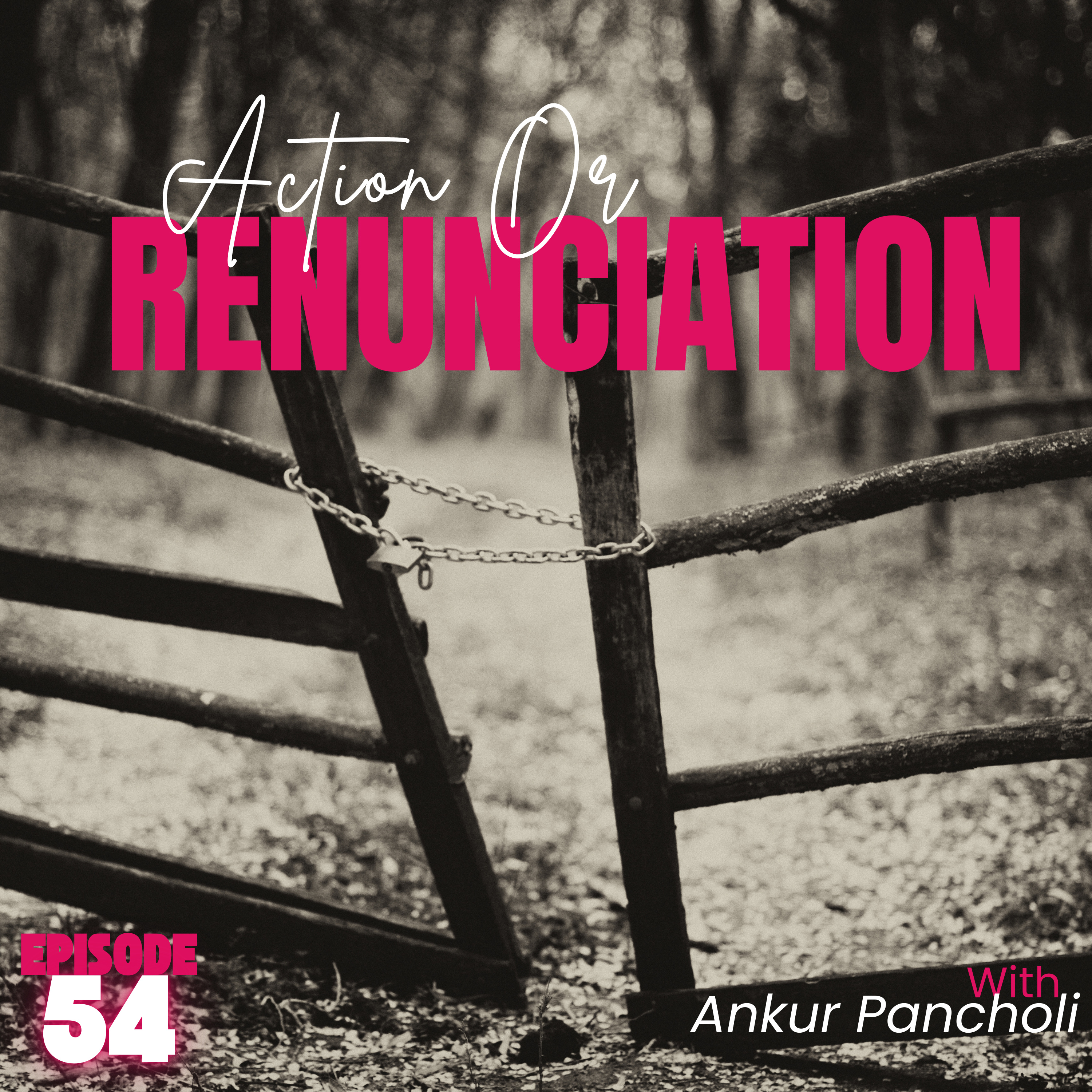
Episode 54: Action or Renunciation — Just Tell Me What’s Right l Bhagavad Gita Chapter 5, Verse 1
Tonight's Episode
🎧 Episode 54 — Action or Renunciation: Just Tell Me What’s Right
Bhagavad Gita | Chapter 5 | Verse 1
The Bhagavad Gita opens Chapter 5 not with an answer — but with a question that feels deeply human.
A question the Bhagavad Gita knows every sincere seeker eventually asks:
Should I renounce action… or continue acting in the world?
In Episode 54 of Beyond the Battlefield, we enter Bhagavad Gita Chapter 5, Verse 1, where Arjuna returns to Krishna with quiet exhaustion. He has heard about renunciation. He has heard about Karma Yoga. Both sound right. Both sound complete. And the Bhagavad Gita allows his confusion to surface without judgment.
This episode explores why the Bhagavad Gita does not rush to resolve this tension. Instead, it reveals:
- how the desire for certainty often hides a deeper fatigue
- why the mind wants someone else to decide what is “right”
- how renunciation can become escape when maturity is missing
- why the Bhagavad Gita refuses borrowed clarity and shortcuts
- and how true understanding begins only when responsibility cannot be avoided
Through a modern leadership mirror and a cinematic inner battlefield, Jessica and Ankur show how the Bhagavad Gita treats confusion not as a failure — but as a doorway. This is not ignorance speaking. This is what happens when multiple truths begin to pull the mind in different directions.
The Bhagavad Gita is not asking Arjuna to choose yet.
It is asking him to stay present with the question.
If you’ve ever felt torn between stepping away and staying engaged…
between withdrawal and responsibility…
between relief and growth —
this episode of Beyond the Battlefield will feel uncomfortably familiar.
🎙️ Beyond the Battlefield explores modern leadership, inner conflict, and self-discovery through the timeless wisdom of the Bhagavad Gita — without preaching, without simplification, and without easy answers.
🎧 Listen now, and step into the question — with the Bhagavad Gita as your companion.
🤖 BYB Interactive-GPT Companion
Explore yajña, purpose, contribution, leadership clarity, and how Bhagavad Gita wisdom supports meaningful success:
https://chatgpt.com/g/g-6845186212588191ae7aa9e327bebc9a-byb-interactive
📩 Write to us: [email protected]
🔔 Share, subscribe, and continue the journey — because leadership lasts when life is lived as an offering.
Welcome back to Beyond the Battlefield. Today we begin a new chapter and I want to say this up front. Chapter 5 is where many listeners quietly whisper, wait, is Krishna asking me to stop acting or act even more consciously? Because this chapter doesn't sound dramatic, it sounds confusing and that's exactly why it matters. Chapter 5 is often called Karma Sanyasa Yoga and already the words themselves feel like they are pulling us in opposite directions, renunciation and action. So before we touch even a single verse, I want to ask the question every modern leader, founder, professional and seeker is already carrying.
Do I step away from the world to find peace? Or do I stay in the world and somehow not lose myself? Chapter 5 is Krishna's answer to that exact dilemma. This chapter compares 2 paths. Karma Sanya Sir, renunciation of actions and karma yoga work done in devotion. Krishna makes something very clear here. Both paths lead to the same ultimate goal, union with the self, union with the Atman. But not everyone is ready for both paths in the same way. So Krishna is not rejecting renunciation, he's questioning whether we are ready for it.
Exactly. Renunciation of action sounds noble, but Krishna points out something subtle and uncomfortable. True renunciation cannot be done perfectly until the mind is sufficiently pure. And purification of the mind does not happen by escaping life. It happens through action, but action done without attachment. That is why Krishna says for the majority of humankind, karma yoga is the appropriate path. That feels deeply relevant today, because when people feel overwhelmed, they don't actually want wisdom, they want relief.
So renunciation becomes romantic. Quitting becomes spiritual. Withdrawal starts looking like enlightenment. And Krishna gently dismantles that illusion. A karma Yogi does not abandon responsibility. They abandon attachment to results. They perform their worldly duties with a purified intellect and dedicate the fruits of their actions to God. Such a person remains untouched by sin, just as a Lotus leaf remains untouched by the water it floats on. That Lotus image is powerful. It doesn't escape the water, it simply doesn't absorb it.
Is that what Krishna is teaching here? To live fully in life without letting life stick to us. Yes, with the light of knowledge, the Karma Yogi begins to see the body as a city of nine gates, a place where actions happen, but not the true self. They no longer see themselves as the doer or the enjoyer. This shift creates something extraordinary equality of vision. This is where the chapter becomes radical, isn't it? Krishna says such a person sees a Brahmin, a cow, an elephant, a dog and even a dog eater with the same inner vision, not because they are identical externally, but because the same Atman shines within all.
Such a person begins to reflect the flawless qualities of the divine. They become seated in the absolute truth while still living in the world. And yet the world keeps pulling us outward. Sense pleasures, achievements, validation. So where does Krishna place joy in this chapter? Worldly pleasures promise joy but secretly generate suffering. Karma yogis see this clearly. They stop delighting in sense objects, not out of suppression, but out of understanding. Instead, they begin to relish the bliss of God within, a joy that does not fluctuate, a joy that does not exhaust.
And then Krishna still talks about renunciation later in the chapter, which means he's not dismissing it. Not at all. Krishna describes the path of Karma sanyasa as well. Those who renounce actions discipline the senses, the mind and the intellect. They withdraw attention from external enjoyment, become free from desire, greed and anger, and combine austerity with devotion. Only then renunciation becomes peace, not escape. And This is why Chapter 5 is so important, because Krishna is not asking us to choose between action and renunciation.
He is asking us to understand which one actually purifies us and which one we might be using as a disguise. And it all begins with Arjuna asking a single, honest question. Oh Sri Krishna, you praised karma sanyas, the path of renunciation of actions and you also advised to do karma yoga work with devotion. Please tell me decisively which of the two is more beneficial. Arjuna turns to Krishna and says, In essence you speak of renunciation of action. You also praise action with devotion. Both sound right, both sound noble, both sound complete.
So tell me clearly which one should I choose? This is not confusion born of ignorance. This is confusion born of too much light coming from different directions. And maybe it's the same confusion many of us live with today. Before we enter verse one Anker, let me place this moment. This is Arjuna's fifth major question. He has already heard about the soul's immortality, he has heard about duty, he has heard about karma yoga, he has heard about renunciation, he has heard about sacrifice, yagna, knowledge.
And now he is overwhelmed. So he asks again, not because Krishna hasn't spoken clearly, but because clarity is starting to demand responsibility. Is that fair? Completely fair and very important. This question is not philosophical confusion. This is psychological resistance. Arjuna's mind wants something very specific. Now he wants Krishna to decide for him. Mankaman narantharhi Asha chahata hai koyor Thai karde. The mind wants someone else to decide because decision making hurts. Deciding requires thinking.
Thinking requires tapasya, tapasya requires effort. And the mind says, why not skip all that? So when Arjuna asks which path is better, he's not just asking about paths, he's asking for relief. Yes, Arjuna is saying you have spoken about karma sanyas, you have spoken about karma yoga. But please don't make me think anymore. Give me a straight Rd. a ready made answer, a path where I don't have to choose. The mind wants enlightenment without digestion. That feels uncomfortably modern. We ask Just tell me the right career.
Just tell me the right belief. Just tell me the right leader. Just tell me the right side. No confusion, no responsibility. Exactly. And Krishna refuses to do that. This is crucial. Krishna is not giving Arjuna commands. He's opening possibilities. Krishna NE adesh nahidiye unone sambhavnai kholi. Why? Because borrowed decisions never transform. They sit on the surface. The metaphor used is beautiful. Borrowed decisions are like market bought fruits tied to a tree. They look real, but they didn't grow there.
They have no roots in your life force. So even if the answer is correct, if it's borrowed, it won't change me. It might change your behaviour, but it will not change your being. Krishna is not interested in obedience. He's interested in inner transformation, and transformation only happens when insight ripens from within. But Arjuna does reach a breakthrough here, he finally admits. I don't know, isn't that progress? Massive progress. This is one of the most important moments in the Gita. Earlier Arjuna was speaking confidently, quoting Dharma, quoting tradition, sounding wise.
But now he collapses and says I'm confused. This is the first step of wisdom. And yet there's still danger here. Yes, because now Arjuna says I don't know, so you tell me. This is where many seekers get stuck. They drop arrogance but replace it with dependency. They want ready made enlightenment and Krishna will not allow that. So Krishna is not being evasive, he's being responsible. Absolutely false gurus give answers. True gurus build capacity. Krishna knows if Arjuna doesn't earn clarity, he will never own it.
That's why Krishna keeps expanding the conversation. More paths, more angles, more apparent contradictions. Not to confuse Arjuna, but to exhaust his laziness. So when Arjuna asks in verse one, should I renounce action or should I act in devotion, he's not just asking about pads. He's revealing his exhaustion, his confusion, his hunger to be told what to do. Exactly. Verse one is not a question of philosophy, it is a confession of the human condition. I am tired of choosing. I want certainty, I want peace without struggle.
And Krishna hears this. But he will not betray Arjuna by giving him a shortcut, because shortcuts create followers, not free beings. Different battlefield, same question. Let's meet Anaya. She leads a fast growing team. Smart, calm, decisive. At least on the outside. It's past midnight. Everyone else has left. Both options look right. That's the problem, one voice says. Step back, create distance, protect yourself. Another says stay lead, don't abandoned what you built. I've heard both versions so many times they sound equally wise now.
This isn't confusion from ignorance, this is confusion from too many frameworks.
I'm tired of evaluating pros, cons, impact, long term consequences. Every decision feels like a future version of Maine will blame the present one.
I wish someone would just say it. Not advice, not perspective, just this is right. Do this. I'll commit, I'll execute, I'll stop thinking. That sentence. Now stop thinking. That's where Chapter 5 begins. What if I walk away? No decisions, no expectations, no wait. But then what about the people who trust me? And if I stay, how long before I disappear completely? Action pulls her apart. Renunciation terrifies her. Both promise peace. Neither feel safe. I don't know and I hate that I don't know so please someone decide for me.
Just like Arjuna, Anaya is ready to surrender. But here's the truth. No one tells leaders. If someone decides for you, you may get relief, but you will not get clarity. In the next episode, we won't answer Anaya's question because Krishna didn't answer Arjuna's either. Instead, we'll watch what happens when a leader is asked to stay with the question and why the absence of an answer may be the beginning of freedom. If you've ever wished someone would just tell you what's right, stay with us. Share this episode, subscribe to Beyond the Battlefield, write to us at Beyond the Battlefield at Outlook dot in and check the GPT companion link in the description next time.
The answer still doesn't come, but something shifts.
 Apple Podcasts
 Castbox
 Castro
 Goodpods
 Moon FM
 Overcast
 Pocket Casts
 Podbean
 Podcast Addict
 Podcast Republic
 Spotify