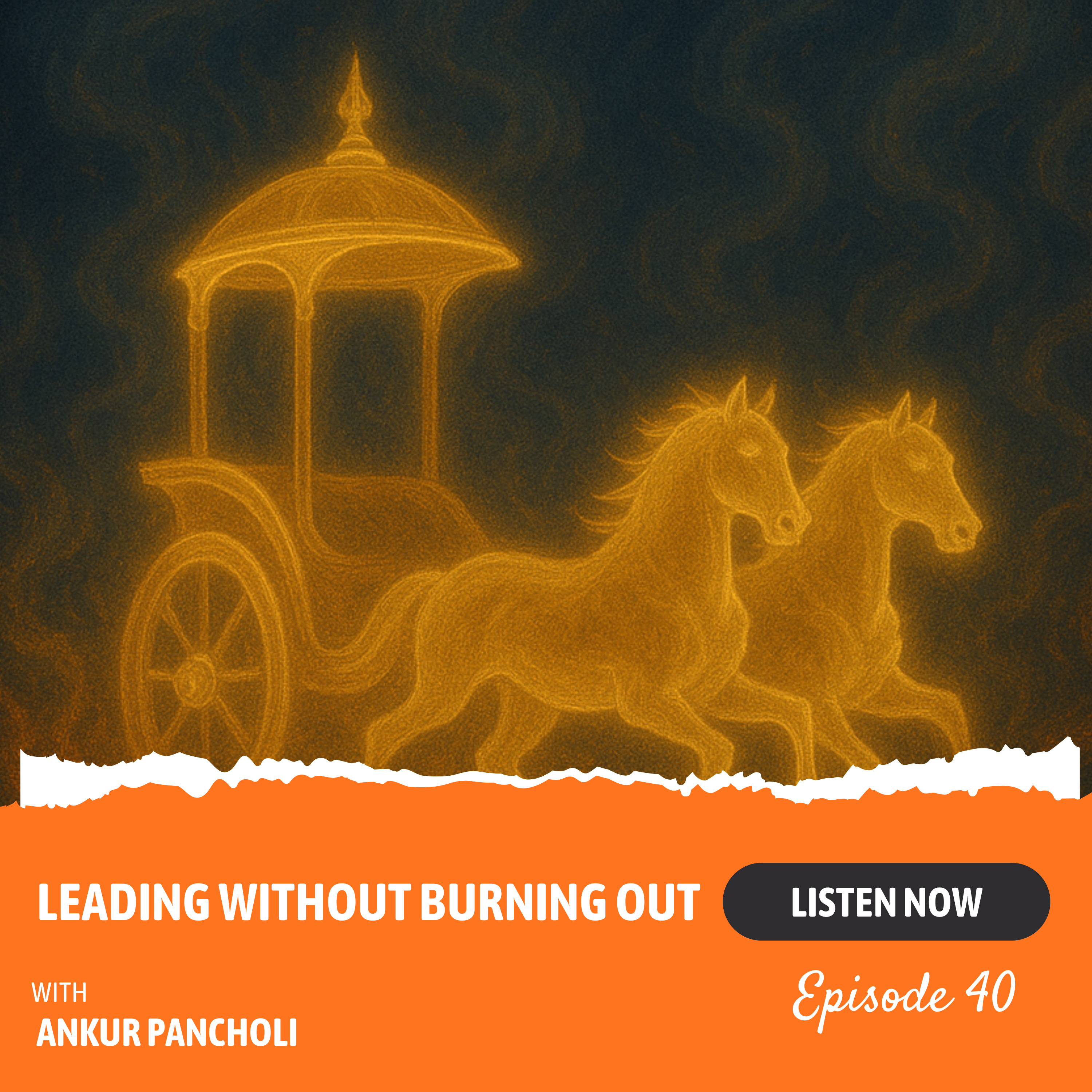
Episode 40:Leading Without Burning Out: Mastering Desire and Discipline | Bhagavad Gita 3.37 – 43
Tonight's Episode
Bhagavad Gita leadership wisdom reaches its most intense psychological climax in Episode 40 of Beyond the Battlefield, as Krishna reveals the real cause of burnout, collapse, and loss of clarity in leaders.
Why do driven leaders burn out?
Why does passion turn into frustration?
Why does ambition, once inspiring, begin to consume?
In Bhagavad Gita Chapter 3, Verses 37–43, Krishna delivers a fearless diagnosis: the enemy is not outside. It is kāma and krodha — desire and anger — when left unconscious.
Jessica opens Episode 40 by naming a modern leadership paradox: the same drive that builds success often destroys peace. Through a charged Inner Doubter vs. Inner Leader exchange, the episode asks a critical question:
Can desire be refined — or must it be crushed?
As Ankur unpacks Krishna’s teaching from the Bhagavad Gita, the answer becomes liberating. Desire is not evil. It is raw energy. When unconscious, it burns. When guided by awareness, it illuminates.
Krishna offers three unforgettable metaphors:
• fire covered by smoke — awareness dimmed, not destroyed
• mirror covered by dust — clarity obscured by habit
• embryo in the womb — potential waiting to mature
The Bhagavad Gita reveals a powerful leadership truth:
what you fight grows stronger.
what you understand transforms.
Drawing from Osho’s reflections, the episode expands this into a sustainability lens. When desire runs without awareness, it exploits Prakriti — nature, people, systems. When desire is aligned with intelligence, it becomes cooperation, creativity, and care. This insight lands squarely in today’s context of environmental stress, burnout culture, and unchecked growth.
Modern leadership parallels sharpen the teaching:
• founders driven by ambition losing inner balance
• executives burning teams in the name of performance
• professionals mistaking discipline for repression
• leaders exhausting themselves trying to “control” desire
Krishna’s solution is not suppression — it is hierarchy and harmony.
Episode 40 closes with the profound “Chariot of Consciousness”:
• senses as horses
• mind as reins
• intellect as charioteer
• Self as the master
When the Self is awake, leadership becomes calm, precise, and sustainable.
The core realization lands with force:
burnout is not caused by work —
it is caused by unconscious desire.
This episode completes Chapter 3’s inner arc — from action, to yajna, to self-mastery — and prepares the listener for the deeper yogas ahead.
This conversation is for leaders on the edge of exhaustion…
for founders questioning the cost of ambition…
for seekers ready to transform drive into wisdom.
Episode 40 delivers one of the Bhagavad Gita’s most urgent leadership lessons:
When desire is disciplined by awareness,
leadership becomes sustainable — and free.
🤖 BYB Interactive-GPT Companion
Explore desire, discipline, and the Chariot of Consciousness — and apply Bhagavad Gita insights to burnout-free leadership:
https://chatgpt.com/g/g-6845186212588191ae7aa9e327bebc9a-byb-interactive
📩 Write to us: [email protected]
🔔 Share, subscribe, and continue the journey — because true leadership begins where inner mastery is born.
Last time we ended with a pause. Krishna had just said even the whys are carried forward by their own nature and that line stayed with me. Because if that's true, then what happens to choice? What happens to self-control? Why do we still do things we know we shouldn't? You know that feeling when you promise yourself never again, but a moment later you're right back in the same loop? That surge, that pull, that invisible push from within. Yes, Jessica. Arjuna looks at Krishna and asks almost helplessly.
Kin Priyuktuyam. Pappam Charati Purusha. By what is man impelled to sin, even unwillingly, as though? Forced by some power. Oh, Krishna, that question is timeless. It's not. Just about battlefields, it's about. Every impulse that hijacks our awareness. Every. Time a leader loses temper every time a founder gives in to eco. Every time we know yet. Still act against our knowing that's where Arjuna takes. US next. And that's where Krishna reveals something astonishing. The enemy isn't outside. It's not fate.
It's not karma chasing us from past lives. It's something subtler, closer, a force that dresses up as desire and burns as anger. Episode 40 begins. With that revelation. Calm ash growth Ish Rajo born from rajas, from restless passion, This is the fire that. Blinds even the vice. The question of the age, not how to conquer the world, Krishna said. It is desire, it is anger born of the quality of rajas. All devouring, all sinful know this to be the enemy here on earth. So Krishna calls it out. Come ish crude ish, desire, anger born of rajas.
He doesn't say a demon or an outer enemy. He says this is the enemy. But anchor. Why does he begin with desire and not with anger? Because Jessica. Anger is never the root. It's always. The shadow of desire. Whenever we want. Something and reality refuses. Desire flips into anger. Unfulfilled wanting becomes. Rage. That's why Krishna says this is born. Of Rajas the restless. Energy that. Keeps the mind chasing. Comparing competing in Osho's words. Calm is not bad, it's raw energy. But when we identify with it, when we try to.
Own. Or control. Its object it becomes crude, A consuming fire. So the same energy can either create or destroy depending on how we hold it. Desire is like. Fire if you. Cook with it. It nourishes if you. Play with it. It burns. In leadership or entrepreneurship? Today. We celebrate, drive, be. Ambitious, chase your goals. But Krishna is inviting us to see the other side of drive when ambition turns into. Agitation when I must. Achieve becomes. I cannot rest. Until I win that shift. From creative intensity to compulsive craving marks the birth.
Of the enemy within. It's interesting because in corporate life we often glorify that restlessness. We call it hunger, but Krishna seems to be warning hunger without awareness will eventually eat you.
Beautifully said. That's why he. Calls it Mashan, the Great Devourer Desire. First promises fulfillment, then devours the very peace. It promised, it keeps. Saying just one more win, one more purchase, one more promotion, and when we feed it, it only. Grows hungrier. You can satisfy a need never agreed because greed doesn't belong to the body, it belongs to the ego, and the ego lives on dissatisfaction like a parasite needing. New goals to survive. So when Krishna says know this to be the enemy, he's not moralizing.
He's diagnosing. He's saying this is the real virus of consciousness. Yes. Not sin in the old religious sense, but psychological blindness when your awareness. Is hijacked by grieving. Your intelligence shuts down. That's why we make impulsive choices. Send that angry. E-mail break a promise. Overreact. Desire narrows. Vision anger blinds completely.
So the journey isn't about suppressing desire. It's about. Transmuting it to turn. Passion into purpose to let. Energy serve clarity. Not chaos. That makes me think of the modern founder who starts with vision, then somewhere down the line becomes addicted to valuation. The same flame that once created, starts burning the creator. The same pattern Arjuna faces in the Gita every day we face in our. Wardrooms and bedrooms when? Krishna names Kaam and crude. He's really talking about the. 2. Ends of the same rope craving and frustration if we keep pulling the rope.
Tightens around the neck. If we let it rest. It becomes a bridge of awareness. So the first lesson of this verse, don't fight the fire, understand it, channel it. Because when energy turns to awareness, the enemy becomes the ally. So in this verse Krishna says that desire covers the self. Now comes one of the most delicate verses in this chapter. Krishna explains how desire and anger don't. Destroy the self, they cover it.
As fire is covered by smoke, as a mirror by dust, and as an embryo by the womb, so is this Atman, the self covered by desire. In this verse, Krishna says that calm and crude desire and anger. Don't kill your divinity. They veil it just as smoke veils. Fire. The self is hidden. Behind layers of our own tendencies, the flame is never. Gone only covered. This means we have never. Truly lost ourselves nor the divine spark that lives within it's. Only been covered. Layer after layer of noise, habits, expectations.
And so we keep. Searching outside in success, in recognition in people in places. But the truth is what? We've been trying to find was never lost. It was always here, quietly waiting beneath the noise. And he uses those three images, fire and smoke, mirror and dust, the embryo in a womb. Each feels deeper than the last. Each one feels deeper than the last. Each image shows how clearly the self can be seen. Through the whale and how easy. Or difficult it is to remove that whale. For instance, smoke and fire.
Even with thick black smoke, you can still. Glimpse the fire beneath. And with just a little breeze or one gentle. Blow. The smoke clears. That's the mark of a satwik. Person. Pure hearted, striving, reflective. Such a person's desires are like a thin muslin sheet. They exist, but you can still see. The divine light shining through. These are people who. Live with pure. Intentions. Desire to serve. To teach to. Uplift to love. They act, but their actions don't enslave them for them a little. Mindfulness is enough.
Just one breath and the smoke parts. The divinity within. Glows through effortlessly. That's beautiful. It's like you can see the self in a satvik person. Even when they have desires, they radiate love, calm and clarity. They tower with. Knowledge. As Osho would say, walking examples of light wrapped. In a thin veil. They too have desires, but those desires serve the higher self. Now the second image, a mirror covered. With dust, that's. Rajasic desire restless, ambitious result driven like dust on a mirror that's been lying in an attic.
For years. The reflection is still there, but blurred.
To clear it, you've got to scrub. Polish put in effort and that's. What? Most of us. Experience. We know the. Truth. Intellectually, we've read the books, maybe even listen to. The Gita. Every week. But it's still lumber at a construction site. It's there. But. Not yet. Built into the house. Like knowledge waiting to be assembled, you have the material but not the structure. Precisely. Or like watering a tree with just. A few drops it. Stays on the surface, it doesn't reach the roots. That's why the.
Gita emphasizes Mananam reflection. Deep thinking repeated turning over of ideas until they sink into your being, until wisdom moves. From your notes to your nature. Otherwise it's just stored. Lumber. Not yet your living. Shelter. Rajasic people are like. That brilliant, energetic but. Still caught in friction, they're a mirror reflect in flashes sometimes. They shine, sometimes they blur. To clean that mirror requires sustained work. Meditation, service, discipline, Patience. And the third image, the embryo inside the womb, that's Temasek, isn't it?
Yes, the thick is covering when the self is completely unseen, buried in lethargy, ignorance. And inertia. It's like being asleep within one's own. Shell. No matter how much you shake. Such a person the. Birth of awareness cannot be hurried. They are still gestating in darkness, waiting for awakening and justice. As you can't pull a. Baby out before its time. You can't rush a. Tamasic mind into Enlightenment.
So Krishna isn't condemning, he's describing the density of illusion, that which translucent. Smoke. Rajasish thick dust, tamasic opaque womb. Each layer hides the same fire, each needs a different effort to. Reveal it. That's such a compassionate perspective. The self is never lost, only covered. And the coverings themselves tell us what kind of work we need to do. The Gita psychology is practical. You don't fight the. Smoke you open the window. You don't curse the dust, you start cleaning. You don't reject the womb.
You prepare for rebirth. It's all about. Purification, not punishment, and. Here's the leadership reflection your team, your. Family, even you. Are not defined by faults, but by how thick. The whale has become. Every conscious act of clarity. Empathy and reflection is like wiping a layer of the mirror of the soul. So the lesson of verse 38, The self is never lost, never broken, only hidden. Smoke clears with breath, dust clears with effort, and darkness clears with awakening. Now he goes one step deeper to show how the same desire begins to corrupt our very knowing.
O Countere, this wisdom of even the wise is veiled by this eternal enemy of man. Desire the insatiable fire that can never be filled. Krishna now moves from. The Atman to gan the mind that knows. He says even the wise, even those who study, reflect and teach, can lose clarity when desire arises. It's like. Smoke entering the ice, the fire still. Burns but the vision. Blurs. The intellect, her buddhi, becomes coloured by craving. So even wisdom itself isn't safe. Even after we've understood the Gita, we can still be overpowered by our own impulses.
Because gain is only the first step. It's information. But Vivek discrimination is when that knowledge has matured. Into insight. Remember what we spoke about in the last verse? Knowledge is like lumber at a construction site. You may own piles of it, but until you build it into your. House. It's not shelter. That's why the Gita insists on Shravan, Manan and. Nidhi Tyasan. Listening, reflecting and deep. Absorption until truth becomes second nature. That doesn't happen. Desire sleeps in. Like a thief at night and occupies the mind.
And Krishna calls it dushpur inanlin, the fire that cannot be filled. That word Anil literally means fire, doesn't it? Yes, and Dushpur. One that nothing can satisfy you. Feed it with fuel and it only burns brighter. That's how desire functions psychologically. Each fulfillment creates space for a new want. In today's language is the. Algorithm of the mind. Every like every promotion, every success feeds. The loop. And the loop demands more. We think we are in control, but our tension has been hacked.
By our own. Unexamined wants. So even a person of learning can be scrolled away from their own wisdom. And that's why Krishna uses the. Word neete varina. The eternal enemy you. Can't kill it once and for all. It keeps returning in new. Forms in. Ambition in possessiveness in pride. That's why awareness must be continuous. Desire is like fire. You don't fear it. You watch it. You. Respect its power and keep it contained within. Purpose. So this verse is a warning to those who believe they've arrived.
Even after insight, you can still fall back into illusion. Yes, and it happens every day. How often do we hear of leaders? Who rise with vision but fall with greed. The same fire that gave them clarity. Turns into. The flame that. Consumes them. That's why Krishna's psychology is so timeless. He doesn't say destroy desire. He says know its nature and don't let it cover your game. So the message of verse 39, desire is not a sin, but an unending fire. Left unwatched, it consumes wisdom itself. Watched with awareness, it becomes light.
Krishna showed us what desire does. It blinds even the wise. Now he points to where it lives. Because unless we know the enemy's fortress, we can't win the war. He says. The senses, the mind, and the intellect are said to be the seats of this desire. Through them it deludes the embodied being by veiling his wisdom.
Krishna is now the strategist. He is mapping the chain of command. Inside us. Desire begins at the. Indri Senses. But you see here taste. And touch. The senses then excite. The mind mind the mind seduces the buddhi intellect and the intellect loses its power of Vivek discernment once that. Happens. Clarity collapses impulse. Rules the Kingdom.
So the very faculties meant to serve wisdom become the basis of its downfall. These instruments aren't. Evil they were given. To us for God realization or in modern. Language for higher purpose. But we've let. Calm, Lust, Lobe, Creed, and Ankar. Ego sees control of the console. Krishna is saying locate the takeover. Points. That's the. Beginning of leadership. Knowing where your energy. Leaks. In business terms, the senses are your data streams, the mind is your dashboard, and the intellect is your decision engine if the input is noisy constant.
Stimulation, comparison, distraction. The whole system malfunctions. The leader then reacts instead of. Response. So this verse is almost a manual for attention management. Guard your inputs, what you read, watch, listen to, and I love around you. The war for leadership today isn't fought in boardrooms, it's fought in browsers. If you don't curate your senses, algorithms will curate your desires. And that's why Krishna next gives the command that's so often misunderstood, he says in verse 41.
Therefore, O Arjuna, first control the senses and slay this enemy, the destroyer of knowledge and wisdom. The word traje. Slayed is among the most misunderstood in the Gita. For centuries, people thought Krishna was asking us to kill. Desire to reject, joy to abandon. Life, but he never. Asked for repression. He asked for realization. He's saying slay the. Delusion, not the dynamism. Desire is the world's fuel. Suppress it. And you become dull. Purify it and you become divine. So Slay means to transform, to reclaim mastery over the energy itself.
That's why he adds. Adho nyamya indriyani. Start with the senses. Guard the gateways first. In modern life this means regulate information intake. Don't let screens and streams. Hijack awareness. Refine the minds appetite. Less reaction, more reflection. Align the intellects. Purpose. Let decisions serve values. Not vanity. Discipline here isn't punishment. Its. Precision of focus. A true leader doesn't fight the fire of. Ambition. He channels it into contribution. That's how desire turns. From enemy to engine when?
Desire forgets his direction towards the divine. It attacks nature. This is why Krishna's warning is not just moral, it's ecological. When we exploit prakarti, we move toward wikarti, distortion, imbalance, disease, the same fire that once. Cooked our food now burns our forests. The same technology that could connect. Hearts now consumes attention. Every time we act from greed. Instead of gratitude, we scar the. Harmony of the whole, but when desire is sanctified. When calm becomes Co cooperation.
The energy of nature. Flows through US, not. Against us, that's a real sustainability desire aligned with. Dharma, not domination. So slaying desire also means protecting balance within us and around us. It's the foundation of sustainable growth, not sterile renunciation. Yes, Krishna's command is timeless. Don't let passion become possession. The same flame that light innovation can burn integrity if left unchecked. Every project, every enterprise, every civilization must begin with self governance.
Because the outer empire always mirrors. The inner 1 when. Individuals master their senses. Society is master sustainability. So the message of verse 41, desire isn't the enemy of progress, Unconscious desire is. When awareness guides ambition, growth becomes grace. That's the path from prakarti to sampati, from exploitation to abundance. Krishna now gives Arjuna the master key, the final design of the human system, the inner hierarchy through which the journey of mastery unfolds. Why those senses are so restless in the first place?
In verse 42 he says the senses are superior to the body, The mind is higher than the senses, the intellect is higher than the mind. But beyond the intellect is the self. Osho says something fascinating here. Senses are machines. They have no. Morality of their own. They just keep. Functioning your eyes keep. Seeing your ears keep hearing, your tongue keeps tasting even when you are not paying attention. When these senses repeat the same actions day after day. They begin to form habits. What the Gita?
Calls Sanskar and once. Habits form. The body can move through life like a robot. Good habits. Awareness, gratitude, discipline become. Allies of liberation, Bad habits. Distraction indulgence comparison become. Chains of subtle slavery.
So our senses left alone keep acting out of momentum, like wheels that don't stop turning. The problem isn't the senses. It's the mind. 'S interference. The mind keeps commenting, judging, choosing. This sound is pleasant. That face is beautiful. This food is mine. That's how awareness slips away. The mind inserts identity where only perception was needed. A sound becomes my song. A taste becomes my. Craving the neutral becomes personal. And bondage begins. Osho said. If the senses work in silence, they create rhythm.
If the mind intrudes, it creates noise. That's the essence of Krishna's letter. The mind is higher than the senses. Because it can direct them. But also dangerous because it can disturb them. That's why the Gita gives us a simple formula for mastering Let the intellect guide the mind, and let the self illuminate the intellect.
And what happens when we don't? Then our habits Dr. our destiny unchecked impulses become addictions, addictions become lifestyles, and lifestyles become our unconscious karma. A person who scrolls aimlessly for years trains the. Eyes to seek distraction. A professional who rushes through decisions trains the mind to skip reflection, but a leader who pauses to breathe before reacting trains the senses to serve. Awareness, not anxiety every. Small repetition builds either. Freedom or imprisonment?
That's the practical. Science of Sanskar.
So verse 42 isn't just philosophy, it's behavioural wisdom. It tells us that consistency without consciousness is chaos. A sustainable organization like a conscious. Person runs on good habits of awareness meeting. Rhythms, communication styles, ethical reflexes, these are the corporate senses, if they. Operate mechanically without reflection. The system may succeed outwardly but collapse inwardly. But when intellect and awareness guide those patterns? Habit. Turns into harmony. Automation turns into art.
So the lesson of verse 42. Your senses will act, your habits will form, but whether they build peace or pressure depends on who's holding the reins, the restless mind or the awakened self. Now comes verse 43, the last verse of chapter 3. Thus, knowing the soul to be superior to the material intellect, O mighty armed Arjun, subdue the lower self senses, mind and intellect by the higher self strength of the soul, and kill this formidable enemy called Lust.
Here Krishna lays out the hierarchy. Of command inside us. A ladder from the outermost. To the innermost. Body is made of. Matter. Above it are the senses. That gather information above. The senses is the mind that. Interprets and reacts above. The mind stands, the intellect that decides and discriminates. And beyond all of them, the Atman, the silent witness, the real self, an inferior entity can always. Be controlled by its superior One South. If we awaken to this hierarchy, we can reverse the chain of.
Slavery.
It sounds like Krishna is showing us the architecture of inner leadership. Who should lead whom?
Yes, the. Upanizas gave the same. Wisdom through a story. The chariot of life. Imagine life as a chariot. The body is the. Vehicle the horses. Are the five senses. Eyes. Ears, tongue, nose and skin. The reins are the mind that tries to. Hold them together. The charioter is the intellect meant to guide the mind with discrimination, and the passenger, silent and serene at the back, is the at man, the self. When the passenger is awake, the journey is harmonious, but when the soul sleeps. The horses run wild.
The mind gets dragged by impulse. The intellect becomes the lawyer for the senses. Instead of the guardian of the soul. In Krishna's time. The wild horses were desires of the world. Today they're. Fed energy drinks. Of dopamine every social. Media feed. Tugs at the race. Of our mind. Every notification is a new. Horse. Pulling in another direction, marketing gurus of the digital age have become expert horse timers, not for your peace, but for your attention they dazzle the senses with. Colour, sound and speed.
They hook the mind through. FOMO and comparison. And they trick the intellect into rationalizing. Why you? Need the next? Purchase. The next binge. The next. Promotion. The corporate machine learned this science. Well. It sells identity. As a subscription it. Markets desire as. Motivation. It rewards overstimulation. As high performance, so our chariot now gallops day and night. Horses for me. Mind confused, intellect dizzy, soul asleep. And what happens when the soul wakes up? When the passenger opens its eyes, the whole chariot remembers its purpose.
Awareness touches the intellect, and the intellect turns from arrogance to clarity, Osho said. When the intellect is an. Illuminate. It becomes equal. When it touches the self. It becomes wisdom. Weak soul doesn't. Fight the horses it guides. Them it doesn't kill. The mind, it calms it. It doesn't reject the world. It drives. Through it with awareness. Now. Even amid marketing noise, you can scroll without being dragged in boardrooms of power you can decide without. Being dazzled in the. Marketplace You can act without being addicted to outcome.
That's the difference between being a driven leader and a conscious leader. The driven leader is pulled. By horses of greed, ambition and fear. The conscious leader holds the reins. Of purpose, service and clarity.
Every organization is a chariot too. Its. Departments are the senses, each rushing toward targets and matrix. Its culture is the mind often swayed by. Emotion and trend its. Strategy team is the intellect. Supposed to steer wisely. Yet sometimes seduced. By ego. In the soul of the. Organization, its purpose is. Often. Asleep, forgotten under dashboards and deadlines. A company where purpose is awake functions like a well driven. Chariot. Its. Horses run fast. But aligned. Its. Mind is creative but calm its intellect.
Is sharp but humble and its soul. The vision guides everything. That's how we bring Krishna's teaching. Into the 21st century. Lead from the self, not from the senses. So the teaching of verses 42 and 43 is simple yet supreme. The chariot is yours, the horses will run, the roads will tempt, but if the soul stays awake, you will never lose direction. When awareness leads intelligence, clarity replaces. Chaos. Desire turns into drive. Action becomes worship. And leadership becomes love in motion. So as we close today's journey through Chapter 3, remember this image of the chariot.
Your life has many horses, ambition, emotion, fear, love. But the one who must hold the reins is you. When the self is awake, even in the noisiest marketplace, you can lead with clarity. That's the promise Krishna makes to every modern warrior. And this chapter? The yoga affection. Hence. Exactly where real leadership begins with self. Covenants when? Awareness leads intelligence. Desire turns into. Direction and work becomes worship. If this episode brought you clarity or a moment of stillness, share it with someone who needs that pause today.
Follow and rate Beyond the Battlefield on Spotify or Apple Podcasts and help us take these timeless teachings to leaders everywhere. You can also write to us at Beyond the Battlefield at Outlook dot in or explore our interactive companion on GPT for deeper study and reflection. See you in next episode. Till then, keep your chariot steady, your soul awake, and your journey luminous.
 Apple Podcasts
 Castbox
 Castro
 Goodpods
 Moon FM
 Overcast
 Pocket Casts
 Podbean
 Podcast Addict
 Podcast Republic
 Spotify