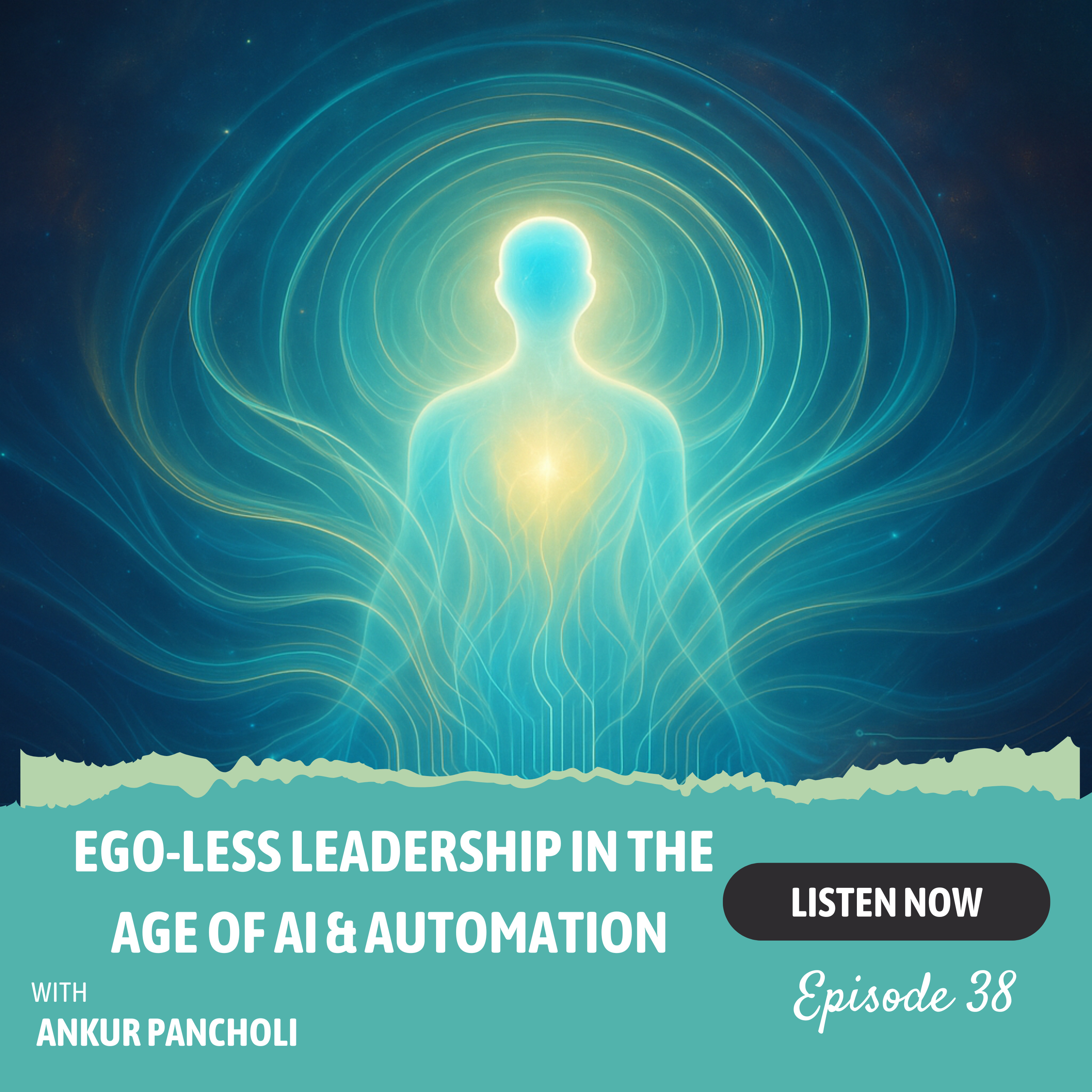
Episode 38: Ego-less Leadership in the Age of AI & Automation | Bhagavad Gita 3.27–3.30 on Action, Awareness & Surrender
Tonight's Episode
Bhagavad Gita leadership wisdom dissolves the ego at its root in Episode 38 of Beyond the Battlefield, as Krishna reveals a truth that transforms how leaders act, decide, and carry responsibility.
What if everything you do…
every decision, every success, every failure…
is not you at all?
In Bhagavad Gita Chapter 3, Verses 27–30, Krishna delivers one of the most unsettling — and liberating — insights of the Gita:
Nature acts through the gunas.
The ego only claims authorship.
Jessica opens this episode by naming a silent weight leaders carry — “I did this.” Through a contemplative Inner Doubter vs. Inner Leader exchange, the episode asks a question that changes everything:
What happens when leadership stops being about ownership… and becomes about awareness?
As Ankur unpacks these verses from the Bhagavad Gita, Krishna’s psychology becomes precise. Action is happening constantly through सत्त्व, रजस्, तमस् — clarity, drive, inertia. When awareness is absent, ego hijacks the process and says, “I am the doer.” When awareness is present, action continues — but without inner burden.
The Bhagavad Gita delivers a radical leadership insight here:
ego creates stress by claiming control.
awareness creates freedom by releasing it.
This episode bridges ancient wisdom with modern leadership realities:
• executives overwhelmed by personal ownership of outcomes
• founders carrying the weight of “my success” and “my failure”
• teams suffocated by micromanagement and fear
• AI-driven workplaces where collaboration replaces control
Drawing from Osho’s Geeta Darshan, the episode clarifies that ego-free action is not passivity. It is intelligence without interference. When leaders act without the “I,” work turns into worship, effort becomes light, and decision-making gains clarity.
Krishna’s instruction to offer all actions to the higher is reframed here — not as religious surrender, but as psychological hygiene. The mind relaxes when it stops pretending to be the sole driver of existence.
The core realization settles deeply:
true power begins
where ego ends.
This episode also reframes leadership in the age of AI and automation. As machines handle execution, the human role shifts from control to consciousness. From domination to collaboration. From ambition to alignment.
This conversation is for leaders exhausted by pressure…
for entrepreneurs carrying invisible weight…
for seekers ready to act without egoic strain.
Episode 38 delivers one of the Bhagavad Gita’s most freeing leadership lessons:
When action flows through you —
life works with you.
🤖 BYB Interactive-GPT Companion
Explore ego-free action, the gunas, and how Bhagavad Gita insights reshape leadership in the AI era:
https://chatgpt.com/g/g-6845186212588191ae7aa9e327bebc9a-byb-interactive
📩 Write to us: [email protected]
🔔 Share, subscribe, and continue the journey — because leadership lightens when the ego steps aside.
In a world where machines think, write, and even decide, we're beginning to ask a question that's older than any algorithm who's really in control. We automate, optimize, predict, and still, inside the human heart, there's that restless whisper. If I stop pushing, everything will collapse. But what if control itself is the biggest illusion of our times? What if life, like code, already runs on a deeper intelligence, one that doesn't need our panic to keep the system alive? 5000 years ago, on a battlefield filled with chaos and confusion, Arjuna faced the same dilemma we face today, not about artificial intelligence but about existence itself.
He asked should I act or stand still? Should I fight or walk away? And Krishna answered with a vision that dissolves the ego of doing. Action will still happen, but the wise know who truly acts. Welcome to Beyond the Battlefield episode 38 egoless action in the age of AI and automation when nature acts through you. Encore Krishna says Prakritiya kriyamarani, Gunahi karmani Sarvasha. All actions are performed by the gunas of prakriti. But look at the world we live in today. We're trained to believe, we make things happen.
We decide, we design, we execute. Leadership is measured by what we do. If I'm not the doer, then who is? That's the exact illusion Krishna begins to dissolve here, Jessica, he says. Ahankar vimudatma karta hamiti Mannyathe the deluded 1 covered by ego believes I am the doer. But all action flows through Krakarti, through the constant play of gunas, SAT, rajas, tamas.
These are the three forces that govern everything. Not just the universe, but our moods, decisions, even our leadership styles. They are the three building codes of reality. Every action, every personality, every environment is a unique blend of these three forces. Sat is light, harmony, clarity, like the stillness of dawn or the smile after understanding truth. Rajas is motion, passion, desire, like the heat of midday or a city that never sleeps. Tamas is inertia, heaviness, confusion, like a foggy night when you can't see what's ahead.
They coexist like the three primary colours of existence. Mix them in different proportions and the entire canvas of life appears. So even our moods, our creativity, our fatigue, all are just the play of gunas. Exactly. When Sadhva dominates, you feel calm, clear and wise. Decisions come effortlessly. When Rages takes over, you feel restless, ambitious, driven to act, to prove, to chase. And when tumbus clouds the mind, there is dullness, confusion, procrastination. But here's the beauty, none of them are bad.
Each goon has a role in creation's balance, even tumus. The darkness of night allows rest, silence and renewal. The trouble begins when ego identifies with these states, saying I am wise, I am successful, I'm lazy. That's when bondage begins. So Prakarti acts through these gunas, but the ego mistakes their movement as mine. It's almost like we're watching a movie and forget that we're the screen. Perfect analogy. The screen never becomes the scene, yet without it, no scene can exist. Or think of it like the human body.
The heart beats, the lungs breathe, the neurons fire. Do you command each of them? No, they act through nature's intelligence. And yet we say I live. I think I do. That's the delusion. Krishna calls Ahankar Vimurta the forgetfulness of being merely the witness. That's humbling. It means leadership isn't about control. It's about harmony with the forces already at work. Yes, just as the wind doesn't claim I move the clouds, the wise leader doesn't claim I created success. They understand the dance of prakriti and move with it, not against it.
When the gunas play through awareness work becomes Leela, divine play. When the gunas play through, ego work becomes samsara, endless tension and struggle.
So Krishna isn't asking Arjuna to stop acting, he's asking him to stop claiming. Exactly the wise one knows Prakriti does eyewitness, and in that awareness even battle becomes meditation. This is the beginning of egoless action, where energy flows but the eye dissolves.
So we're not the programmers, we're being programmed. You could say that even the most advanced AI doesn't decide to learn, it simply follows its design. In the same way, human beings act as per their kuna configuration. Desire arises, action follows, anger arises, reaction follows. It's the dance of energy. The problem begins when the ahankar, the ego, jumps in and says I did it. And the moment that happens, fear is born. Because if you believe I do, then you must also believe I can fail.
That's painfully true. Every leader I know lives in that loop of pride and fear, always claiming responsibility, always carrying the weight of me.
Yes, but Krishna's message here is profoundly freeing. He's not telling Arjuna to stop acting, he's telling him to stop owning the action. When Prakriti acts through you, you become like a flute, hollow but divine. Music flows, the doer disappears, yet action becomes perfect. The river doesn't boast I flowed, the wind doesn't say I move the trees. They simply express what they are. When a leader acts from that space, work becomes Lila, not labour. So in truth, Krishna is not asking Arjuna to withdraw from duty, he's asking him to withdraw the ego that claims to be the doer anchor.
If everything is being done by Prakriti, then what does Krishna expect the wise to do? Should they just stand back and watch? Does awareness mean in action? Not at all. Krishna never tells Arjuna to withdraw from life in the next verse, he says. Tatva vidh tu mahabhu guna karma vibhagyo guna gune suvartant iti matwa na sajate the tattvit. The knower of truth understands the difference between gun and karma. He sees that the genus interact with each other, that nature is acting upon nature. Knowing this, he does not get entangled.
He still acts, but without clinging. So the wise don't stop action, they stop identification. Exactly. Action flows but the inner centre remains silent. It's like a wheel spinning fast. Yet the hub at the centre is still. Sattva, Rajesh and Tamas continue their dance. Body, mind, emotion. But the witness within is steady. That sounds so peaceful, but in modern life, how does one stay unattached and still lead a company, A-Team, a family?
Imagine a leader in a storm of emails, deadlines, meetings, yet aware that none of this is truly mine. He act fully, decides, clearly, but inside he knows. It's the play of forces, technology, market people, emotion. When clarity Sattva rises, he uses it to plan. When energy rises, rises, he channels it into creation. When rest Tamas calls, he allows it without guilt. He is the observer of this currents, not their victim. That's leadership through Sakshi Bow. Awareness amidst action. So it's a shift from control to collaboration with nature.
Not I will make things happen, but I will align with what is happening. Exactly. That's why Krishna calls Arjuna Mahabao mighty armed one to remind him strength is not abandoned, it is purified. The Tattvit acts in the world like a Lotus in water, immersed yet untouched. The drops cling to the petal but never wet it. Similarly, a wise leader moves through the mud of conflict and pressure without getting soiled by ego. That's such a beautiful image. Action without stickiness. It feels like the essence of flow.
Yes. Flow is the natural state of Prakriti. Resistance is the state of ego. When we resist we create heat, stress, comparison, fear. When we flow with the gunas, life becomes a Symphony where no note is wrong.
Krishna's message is not to renounce the world, but to renounce confusion, to see clearly that prakriti acts through Prakriti while the Self remains the witness in that seeing, Arjuna becomes fearless. The battlefield doesn't disappear, but his bondage to it does. Ankara Krishna's logic feels so complete, the wise act without attachment. But what happens when they live among those who are still caught in the illusion? People driven by ego, ambition and constant comparison. How should awareness walk amidst ignorance?
That's the heart of Krishna's next verse. Prakritiya gunasamudha sajjante gunkar masu tankritz navidoman tankritz Navin vichal ayat. Those deluded by the Gunas of Prakriti become attached to their actions, but the Kritznovit, the knower of the whole, should not disturb them.
It's one of the most compassionate lines in the entire Gita. Navichal yet do not disturb them. That's such a gentle instruction. So Krishna is asking the wise not to force awareness on others.
Exactly. Osho kehta hai agyaani andhere Mein jeeta hai. Agar tum achanak roshni jalado to uski aankhi JAL Jain Ki. Truth can't be imposed, it can only be lived. The wise one becomes light, not noise. Krishna doesn't want Arjuna to run around converting the world, He wants him to become a living example of awareness, to lead by stillness, not by superiority.
So relevant today in leadership, we often try to fix people to show them the right way, but sometimes that just creates resistance. Exactly Jessica. Modern workplaces are filled with prakriter goon sammuda people acting from Rajesh ambition or tamps fair inertia. The wise leader recognizes the forces, not the faults. If someone is restless and aggressive, they're under the dominance of rage. If someone avoids responsibility, they're bound by mess. The wise doesn't condemn either. He guides them gently by living in like a gardener.
He doesn't shout at the seed. He gives it light, water and time.
So awareness becomes quiet mentorship, not interference. You allow others to evolve at their own rhythm. Exactly. Krishna calls this Smatva Ki Karuna, compassion that sees all beings as part of one process. Just as Prakarti allows clouds to Thunder, flowers to bloom, and stones to rest without judgment, the wise allow others their space to grow. True leadership doesn't impose evolution, it inspires it. When the wise act without ego, others sense the peace, and something shifts silently, that's the beginning of real transformation.
So in a way, Krishna is saying don't preach from the mountain, walk through the valley and let your calmness teach. Beautifully said. That's the essence of and Vitaly. Let your presence be the teaching. That's how Krishna himself leads, not by command, but by consciousness. So far, Krishna has revealed how action happens through Prakriti, how the wise act without attachment, and how they guide others with compassion, not control. But there's still one step left, the final key to freedom. Surrender.
What does it really mean to offer all action to the divine? Let's step into that final verse. Mai sarvani karmani sanyasya. Krishna's voice suddenly feels different here, tender yet commanding anchor. What does this moment really mean? Is this where knowledge turns into devotion? Yes, Jessica, this is the verse where Gyan flowers into bhakti, Krishna says. Mai sarwani karmani sanyasyeh adhyatma chaitasa nirashi nirmamo bhutwa yudhyaswa vigatajwara. Surrender all your actions unto me, with your inner consciousness, united in the self, free from desire, free from ownership, free from feverish anxiety and fight.
This is not an instruction to give up action, it's a call to give up anxiety in action, Mai. Sarvani karmani sanyasiya Krishna says surrender all your actions into me but anchor this me. Who exactly is it? Is Krishna asking Arjuna to surrender to a person or something deeper? That's one of the most profound and most misunderstood questions in the Gita. Jessica Krishna never says Sarvani Karmani, Sanyasiya, Keshavai, surrender to this human form. He says meh. And My means in me, in that consciousness which speaks through this form, in that presence that lives in every being.
When Krishna says Me, he is not referring to the man standing in front of Arjuna, but to the state of pure awareness speaking through him. The same me that flows in Arjuna, in the soldiers, in the battlefield, in you, in me in all. So surrender into me doesn't mean worship Krishna the person. It means dissolve into the field of consciousness itself. Exactly. That me is not ego, it's existence. To surrender there is to melt the small eye into the ocean of the hole. It's like a drop saying I return to the sea.
The drop doesn't vanish, it expands into Infinity. This surrender isn't obedience. It's awakening. Not dependency, but dissolving separation. That changes everything. Surrender isn't submission, it's union. Not I follow you, but I become one with you. Precisely when Krishna says Mai Sarvani, karmani samyasi, he's saying let every action arise from that center of wholeness, not from fair, not from ambition. In leadership language, it means act from the field, not from the ego. When you act as the field, creativity flows, intuition sharpens, relationships heal because your decisions are no longer defensive or possessive.
Osho calls this Karamka Sakshatkar, the realization that Karam itself is divine when the doer dissolves. And that's why Krishna adds vigat ajwara without fever. Fever is the friction between I must control and life already knows. When surrender happens, that fever ends and action becomes is.
So in truth, Krishna's me is not a command, it's an invitation. An invitation to move from individuality to universality. Beautifully put, Jessica. My means in that which connects us all to surrender, that is, to trust reality itself. It's not about giving up responsibility, it's about giving up resistance. Then, even in the heart of battle, one moves with grace. Leadership becomes effortless because it's no longer mine. It's time. And that is the true yoga of action. To surrender all actions, it feels both beautiful and difficult.
How can one really act without ownership in a world that constantly measures us by results? That's the paradox. Krishna dissolves here. He doesn't say do nothing, He says do everything, but let it flow through the divine intelligence. Imagine, Jessica, when a musician truly surrenders to music, does he play the instrument or does music play through him? When a poet forgets himself, the poem writes itself. That's Mai Sarvani karmani sanyasiya. When you surrender the Kartrithwa Bhau, the sense of I'm doing you become a Clear Channel of the universal will.
So surrender is not weakness, it's participation without possession. Exactly, Osho says in Gita darshan Samarpan har nahi hai. Samarpan us siti ka naam hai Jahan AB koi harne wala nahi bacha. When you dissolve the doer only doing remains pure, effortless alive. It's almost like leadership without self, where performance comes from presence, not pressure. Yes, that's the heart of divine leadership. Karmyog is not the management of tasks, it's the purification of intention. Krishna is telling Arjuna act from stillness, move from surrender.
Let your action be my instrument, not your identity. When that awareness dawns, every battlefield becomes a temple, every task becomes a prayer, every decision becomes an offering. That's the ultimate shift from ambition to alignment.
From ambition to alignment, that's such a powerful image. So when Krishna says Yudhyasua, he's not telling Arjuna just to fight, he's telling him to act from the sacred.
Exactly. To fight without hatred, to lead without pride, to serve without seeking reward. That's the real victory. Krishna points to the victory over the fever of AI. When Karam becomes egg and leadership becomes offering, then even in the noise of the world, silence reigns within. In these 4 verses 3.27 to 3.30, Krishna takes us from illusion to liberation, from I act to nature, acts to awareness, acts with compassion, and finally all action is divine. Perhaps this is the greatest lesson for our age, that true leadership is not about holding power, but about becoming a transparent medium for a greater intelligence.
From Ahankar to Samarpur, from the illusion of control to the grace of surrender, Krishna has shown us that true leadership begins when the ego ends, when we realize that prakriti moves through us, not because of us. Every action becomes sacred. Every moment becomes a prayer. Each episode of Beyond the Battlefield is a step inward from striving towards stillness, from pressure toward presence. Remember, you are not the storm, you are the sky through which it moves. If this episode touched you, please like, share and subscribe to Beyond the Battlefield so more seekers can discover Krishna's timeless wisdom.
You can also explore our Beyond the Battlefield GPT companion, your interactive guide to Gita based leadership and self mastery. The link is available in the episode description below. And if you'd like to share your reflections, experiences, or questions, write to us at Beyond the Battlefield at Outlook dot in. We'd love to hear your thoughts and stories. Until next time, stay rooted, stay aware, and let life flow through you, not from your.
 Apple Podcasts
 Castbox
 Castro
 Goodpods
 Moon FM
 Overcast
 Pocket Casts
 Podbean
 Podcast Addict
 Podcast Republic
 Spotify